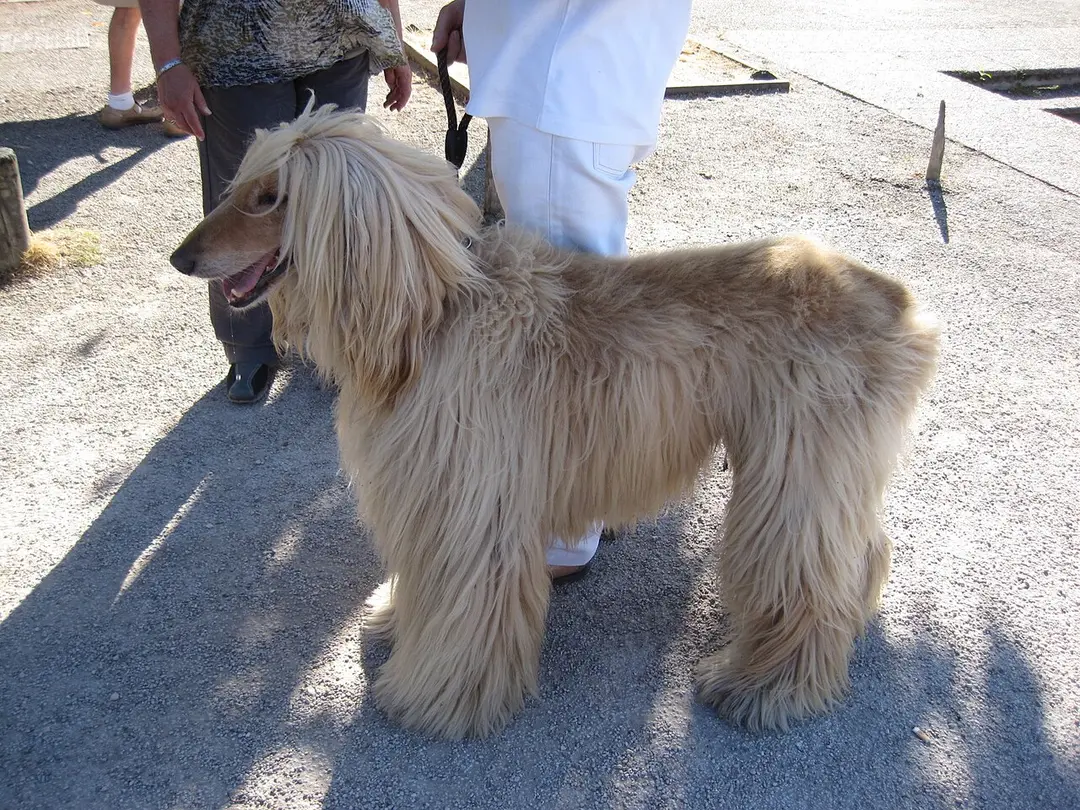
Afghan Hound

Aloof with strangers, playful and loving at home.
Adult weight
20–27 kg
44–60 lb
Lifespan
11.1 yrs
Class · Companion
also Field

What it's like

With strangers the breed is aloof and dignified, and it is independent in outlook, so it can be slow to obey commands. At home, though, it is often playful and affectionate. Pablo Picasso kept an Afghan named Kabul, who appears in several of his works. In the twenty-first century an Afghan Hound called Snuppy became the first dog to be cloned.

Day to day
Activity
A good daily walk and play
Intelligence
Easy-going, simple routines
Handler demand
Needs steady training
With people
Affection
Likes its own space
Loyalty
Bonded to its family
Independence
Decides for itself
Around the home
Sensitivity
Needs a calm, predictable home
Voice
Quiet
Prey drive
Likely to chase small pets
Breed explains only about 9% of how individual dogs differ in behaviour1. Meet the dog. A good breeder breeds for temperament as well as health, and matches each puppy's personality to the right home2,3.
Is an Afghan Hound right for you?
Take the breed matcher

Living with one

It has a long coat. It sheds through the year rather than in big seasonal moults. Plan on daily brushing. It needs a moderate amount of exercise compared with other breeds.

Size and growth

An Afghan Hound is a medium dog, heavier than a Border Collie and lighter than a Golden Retriever.

It is tall and lean, with a long, refined head carried high, prominent hipbones and large feet suited to uneven terrain. A long, fine, silky coat covers most of the body, though mature dogs usually have a short-haired saddle along the back. A topknot of silky hair crowns the head, and the tail ends in a distinctive ring or curl.

Puppy growth

Reference curve · community data appears as owners log
By about 5 months, a male Afghan Hound puppy is already as heavy as a grown Cocker Spaniel. They grow fastest between 3 and 4 months old.
Fully grown
11 mo
Both sexes, at 99% of adult weight7
Male
Female
Shaded: expected range
01020302m4m6m9m12m18m
01020302m3m4m6m9m12m18m
Age
Male
Female
2 months
4.4–5.9 kg 9.7–13.0 lb
4.8–6.5 kg 10.6–14.3 lb
3 months
6.4–8.7 kg 14.1–19.2 lb
6.8–9.2 kg 15.0–20.3 lb
4 months
9.3–12.6 kg 20.5–27.8 lb
9.7–13.1 kg 21.4–28.9 lb
5 months
12.0–16.1 kg 26.5–35.5 lb
12.3–16.6 kg 27.1–36.6 lb
6 months
14.3–19.3 kg 31.5–42.5 lb
14.4–19.5 kg 31.7–43.0 lb
7 months
16.0–21.6 kg 35.3–47.6 lb
8 months
17.3–23.3 kg 38.1–51.4 lb
17.1–23.1 kg 37.7–50.9 lb
9 months
18.1–24.5 kg 39.9–54.0 lb
17.9–24.2 kg 39.5–53.4 lb
10 months
18.7–25.2 kg 41.2–55.6 lb
18.5–24.9 kg 40.8–54.9 lb
11 months
19.1–25.8 kg 42.1–56.9 lb
18.9–25.5 kg 41.7–56.2 lb
12 months
19.4–26.2 kg 42.8–57.8 lb
19.1–25.8 kg 42.1–56.9 lb
15 months
19.9–26.8 kg 43.9–59.1 lb
19.7–26.6 kg 43.4–58.6 lb

Lifespan

In UK vet records, the typical Afghan Hound lived to about 11 years, shorter than the typical medium breed.

Where it comes from

The Afghan Hound is a sighthound and hunter from the mountains of Afghanistan. Zardin, brought to Britain in 1907, won that year at the Crystal Palace show in London and became the model for the first standard. Early British Afghans were a mixed lot, including Major Bell Murray's hounds and the Ghazni hounds the Amps brought over in 1925, and breeders set out to unite the strengths of each4,9.

The Afghan Hound settled in Britain between the two world wars. Breeders blended the heavier-coated mountain hounds with the lighter, finer desert type, and the dog seen today grew out of that blend. Imports also reached the United States, where the breed gained official recognition in the nineteen-twenties, and it became fashionable on both sides of the Atlantic in the nineteen-seventies. In its homeland it was a hunting hound. It chased hare, deer, gazelle and other quarry by sight across rough, rocky ground.

Breed standard

The Afghan Hound is judged against standard no. 228, in group 10, Sighthounds4.

Questions people ask

General guidance for dogs rather than a measured Afghan Hound figure: most females have a first season somewhere between six and fifteen months, and cycles then settle to roughly every 180 days. Smaller breeds tend to start earlier and larger ones later, so a medium-sized breed is most likely somewhere in the middle.
Track your own Afghan Hound
Log a minute a day and watch them sit on these curves. Free.

Sources

Something wrong on this page?
Parts of this page were written by AI ·