American Bully
What it's like
Breed standards describe a confident, outgoing and gentle dog, affectionate with its household, and treat aggression towards people as highly undesirable. Public concern in Britain over attacks involving XL-type dogs led to the restrictions on that type now in force there.
Size and growth
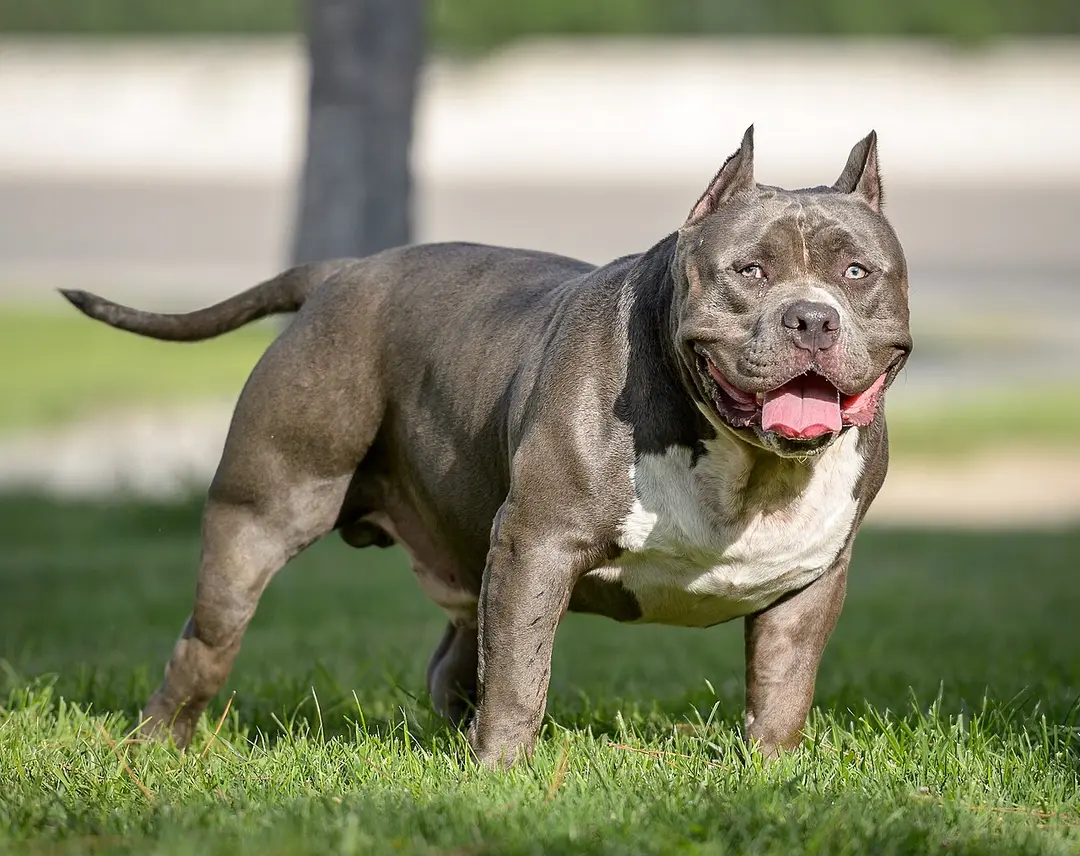
It is compact and powerfully built, with a broad, blocky head, a medium-length muzzle, a deep, wide chest and heavy bone, though build varies between the size classes. The short coat is close, glossy and stiff to the touch; all colours and patterns are accepted except merle.
Varieties
Puppy growth
Lifespan
Where it comes from
The American Bully took shape in the United States during the late twentieth century, when breeders began selecting American Pit Bull Terrier and American Staffordshire Terrier lines, reportedly with some bulldog-type crosses, for bulk and a calmer, more sociable nature rather than for working ability. Bloodlines such as Razor's Edge and Gotti became closely associated with the type. The American Bully Kennel Club was set up in the early two-thousands to register it, and the UKC later recognised it as a separate breed. Unlike the pit bull lines behind it, the breed was developed from the outset as a companion rather than a working or sporting dog.
Breed standard
Questions people ask
Compare with related
Sources
- 1Morrill et al., 2022. Ancestry-inclusive dog genomics challenges popular breed stereotypes. Science 376: eabk0639 (Darwin's Ark). ↑
- 2Dogs Trust. Finding a good, responsible breeder. ↑
- 3American Kennel Club. Screening puppy buyers: how top breeders find the best homes. ↑
- 4ABKC. American Bully breed figures. ↑
- 5ABKC. Pocket American Bully breed figures. ↑
- 6ABKC. Standard American Bully breed figures. ↑
- 7ABKC. Classic American Bully breed figures. ↑
- 8ABKC. XL American Bully breed figures. ↑
- 9Hawthorne et al., 2004. Body-weight changes during growth in puppies of different breeds. Journal of Nutrition 134(8 Suppl): 2027S–2030S (WALTHAM). ↑
- 10AAFCO, 2016. AAFCO Dog and Cat Food Nutrient Profiles. Association of American Feed Control Officials. ↑
- 11Wikidata. Item Q5570. ↑
- 12UKC. American Bully breed standard. ↑
- 13ABKC. American Bully standard. ↑
- 14Defra. XL Bully conformation standard. ↑
- 15GOV.UK. XL Bully rules. ↑