American Eskimo Dog
What it's like
True to its watchdog ancestry, the breed is alert and quick to raise the alarm, and it tends to be reserved with strangers. With its own household it is friendly, lively and eager to please, and it learns quickly, a trait that suited it to the circus ring.
Size and growth
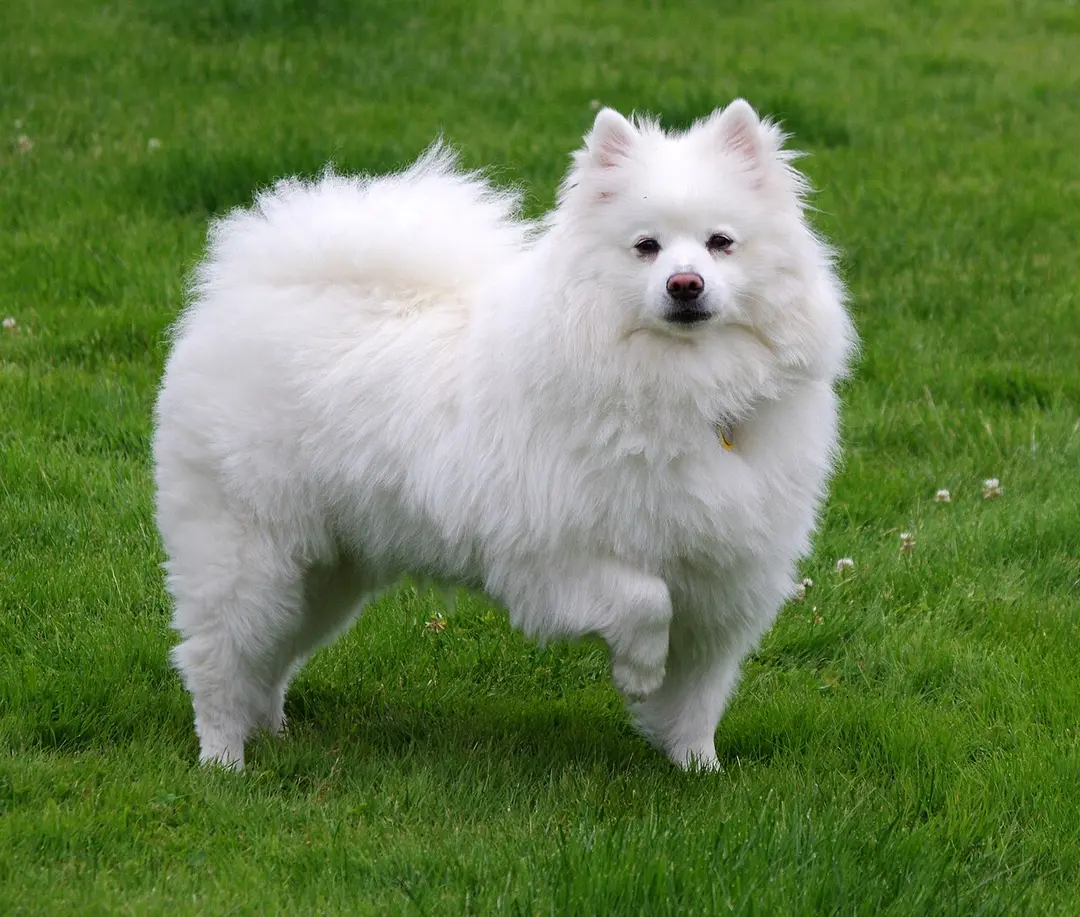
It is a compact, Nordic-type spitz, shown in toy, miniature and standard sizes. The colour is white, or white with biscuit cream, set off by a dark nose, lips and eye rims. A double coat forms a lion-like ruff around the neck and chest, heavier in males, and the plumed tail is carried over the back. The head is wedge-shaped, with erect triangular ears.
Varieties
Puppy growth
Lifespan
Where it comes from
The American Eskimo Dog is thought to owe much of its spread across the United States to the travelling circuses of the early twentieth century. Troupes prized the white spitz for its looks, agility and aptitude for tricks, and one dog, Stout's Pal Pierre, is often said to have walked a tightrope. Puppies were reportedly sold to spectators after performances, and many later dogs are said to trace back to circus lines. The United Kennel Club kept the breed's records for decades; the American Kennel Club recognised it only in the mid-nineteen-nineties.
Breed standard
Questions people ask
Compare with related
Sources
- 1Morrill et al., 2022. Ancestry-inclusive dog genomics challenges popular breed stereotypes. Science 376: eabk0639 (Darwin's Ark). ↑
- 2Dogs Trust. Finding a good, responsible breeder. ↑
- 3American Kennel Club. Screening puppy buyers: how top breeders find the best homes. ↑
- 4American Kennel Club. American Eskimo Dog breed page. ↑
- 5American Kennel Club. American Eskimo Dog breed standard. ↑
- 6American Kennel Club. Toy American Eskimo Dog breed page. ↑
- 7American Kennel Club. Miniature American Eskimo Dog breed page. ↑
- 8American Kennel Club. Standard American Eskimo Dog breed page. ↑
- 9
- 10Hawthorne et al., 2004. Body-weight changes during growth in puppies of different breeds. Journal of Nutrition 134(8 Suppl): 2027S–2030S (WALTHAM). ↑
- 11Wikidata. Item Q37699. ↑
- 12American Eskimo Dog Club of America. Breed history. ↑
- 13American Kennel Club. American Eskimo Dog. ↑