American Hairless Terrier
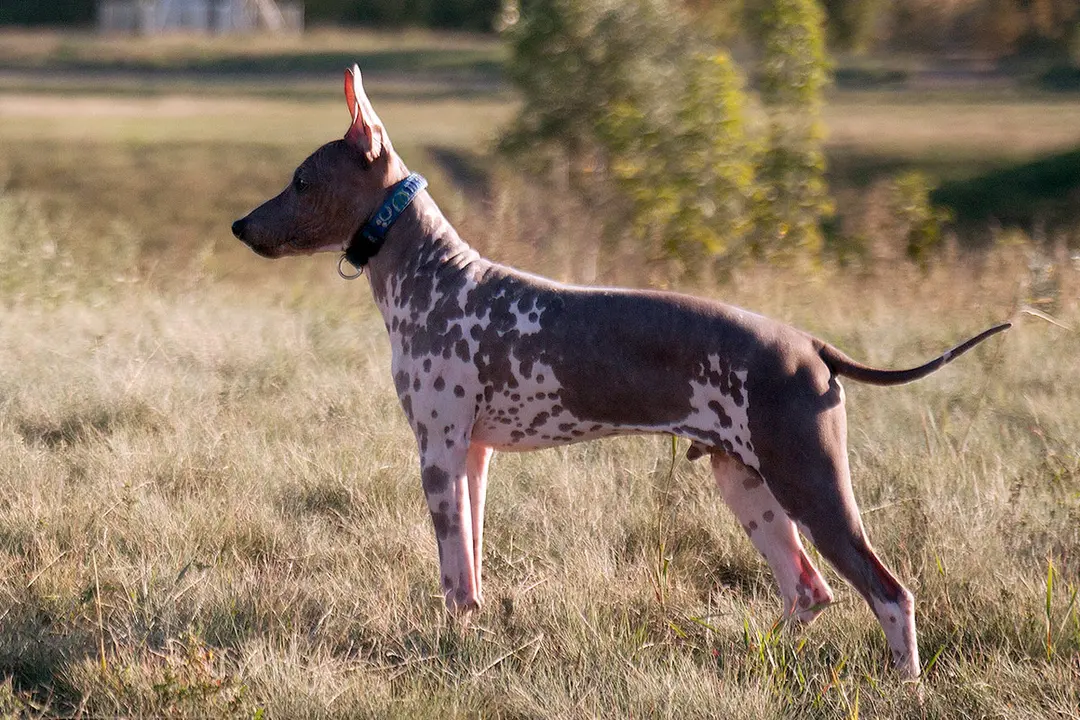
Lively and inquisitive; keen to chase small animals.
Adult weight
5.4–13 kg
12–28 lb
Lifespan
10–12 yrs
Class · Companion
also Family

What it's like

In temperament the breed is lively, inquisitive and quick to notice anything new. It is playful and affectionate with its household and keen to chase small animals. Owners describe it as quick to learn and responsive to training.

Day to day
Activity
A good daily walk and play
Intelligence
Needs daily brain work
Handler demand
Needs steady training
With people
Affection
A lap or leaning dog
Loyalty
Bonded to its family
Independence
Cooperative, with its own ideas
Around the home
Sensitivity
Average
Voice
Barks to alert, then settles
Prey drive
Likely to chase small pets
Breed explains only about 9% of how individual dogs differ in behaviour1. Meet the dog. A good breeder breeds for temperament as well as health, and matches each puppy's personality to the right home2,3.
Is an American Hairless Terrier right for you?
Take the breed matcher

Size and growth

An American Hairless Terrier is a small dog, about the weight of a grown Pug.

The breed is small, muscular and agile, with a wedge-shaped head and ears that are usually carried erect. The skin is smooth and warm to the touch. It is often pale, with darker freckles or patches that can deepen in the sun, and the dogs keep their whiskers and eyebrows. Coated dogs carry a short, dense, glossy coat.

Puppy growth

Reference curve · community data appears as owners log
By about 5 months, a male American Hairless Terrier puppy is already as heavy as a grown Yorkshire Terrier. They grow fastest between 3 and 4 months old.
Fully grown
10 mo
Both sexes, at 99% of adult weight7
Male
Female
Shaded: expected range
0510152m4m6m9m12m18m
0510152m3m4m6m9m12m18m
Age
Male
Female
2 months
1.4–3.2 kg 3.1–7.1 lb
1.5–3.6 kg 3.3–7.9 lb
3 months
1.9–4.4 kg 4.2–9.7 lb
2.0–4.6 kg 4.4–10.1 lb
4 months
2.6–6.2 kg 5.7–13.7 lb
2.7–6.2 kg 6.0–13.7 lb
5 months
3.2–7.6 kg 7.1–16.8 lb
3.2–7.5 kg 7.1–16.5 lb
6 months
3.8–8.8 kg 8.4–19.4 lb
3.6–8.6 kg 7.9–19.0 lb
7 months
4.1–9.7 kg 9.0–21.4 lb
4.0–9.3 kg 8.8–20.5 lb
8 months
4.4–10.4 kg 9.7–22.9 lb
4.2–10.0 kg 9.3–22.0 lb
9 months
4.6–10.9 kg 10.1–24.0 lb
4.5–10.5 kg 9.9–23.1 lb
10 months
4.8–11.3 kg 10.6–24.9 lb
4.6–10.9 kg 10.1–24.0 lb
11 months
4.9–11.6 kg 10.8–25.6 lb
4.8–11.2 kg 10.6–24.7 lb
12 months
5.0–11.8 kg 11.0–26.0 lb
4.9–11.5 kg 10.8–25.4 lb
15 months
5.2–12.3 kg 11.5–27.1 lb
5.1–12.1 kg 11.2–26.7 lb
18 months
5.4–13 kg 12–28 lb
5.3–12.6 kg 11.7–27.8 lb

Lifespan

No vet study has measured how long American Hairless Terriers live yet. The 10–12 years shown is a reference range, not a measured one.

Where it comes from

The American Hairless Terrier began in 1972 in Trout, Louisiana, when a hairless pup, Josephine, was born to coated Rat Terriers; Edwin and Willie Scott bred from her. In 1999 the UKC took the dogs into its registry as a hairless variety of Rat Terrier, recognising them as a breed in 2004; the AKC followed in 2016. Hairless puppies lose their fine birth coat within a few weeks9,10.

The American Hairless Terrier was established by the Scotts, who built on their hairless founder's line over the following decades and later widened the stock with outcrosses to Rat Terriers. Its hairlessness comes from a recessive gene. This sets it apart from the Chinese Crested and the Mexican hairless dog, whose bare skin comes from a dominant gene. The recessive gene and Rat Terrier ancestry explain why a coated variety still forms part of it. Its forebears were farm terriers kept to kill rats and other vermin. Lacking a protective coat, the hairless dogs are now kept mainly as companions, although the strong terrier instinct to hunt remains.

Breed standard

No FCI standard covers it; its group here is AKC Terrier group.

Questions people ask

General guidance for dogs rather than a measured American Hairless Terrier figure: most females have a first season somewhere between six and fifteen months, and cycles then settle to roughly every 180 days. Smaller breeds tend to start earlier and larger ones later, so a small breed is most likely at the early end.
Track your own American Hairless Terrier
Log a minute a day and watch them sit on these curves. Free.

Sources

Something wrong on this page?
Parts of this page were written by AI ·