Australian Cattle Dog
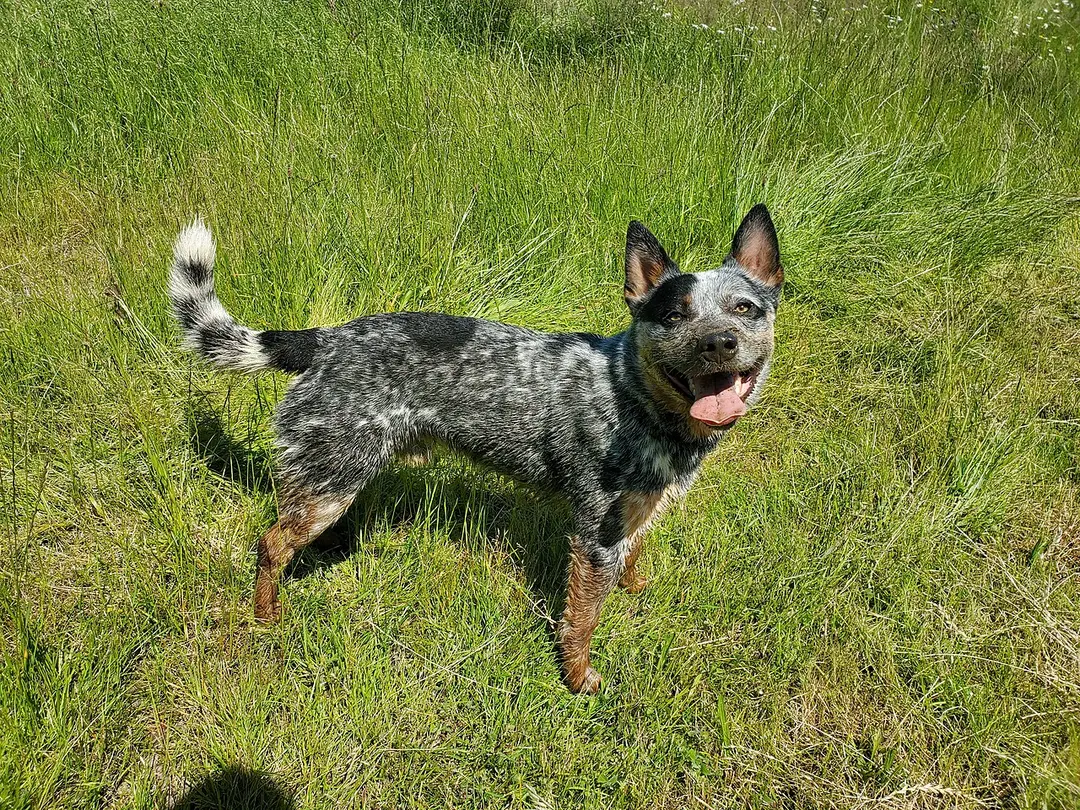
Tireless and quick to learn; reserved with strangers.
Adult weight
16–23 kg
35–50 lb
Lifespan
14 yrs
Class · Working
also Sport

What it's like

In temperament it is alert, tireless and quick to learn, usually devoted to its own people and reserved with strangers. Many carry a small white forehead patch, the Bentley mark, which tradition traces to a single dog owned by a drover named Tom Bentley.

Owners in a large survey found Australian Cattle Dogs tend to be less independent-minded than dogs in general. On friendliness with people, calmness and friendliness with other dogs, they were about average. Breed is only a small part of any one dog's personality, so meet the dog before you decide.
Day to day
Activity
Needs lots of exercise
Intelligence
Needs daily brain work
Handler demand
Needs an experienced owner
With people
Affection
Affectionate on its own terms
Loyalty
Sticks close to its people
Independence
Cooperative, with its own ideas
Around the home
Sensitivity
Average
Voice
Barks to alert, then settles
Prey drive
Likely to chase small pets
Breed explains only about 9% of how individual dogs differ in behaviour1. Meet the dog. A good breeder breeds for temperament as well as health, and matches each puppy's personality to the right home2,3.
Is an Australian Cattle Dog right for you?
Take the breed matcher

Living with one

It has a short coat. Most of the shedding comes when the seasons change. Plan on a brush once a week, plus daily brushing through the seasonal moult. It needs plenty of exercise compared with other breeds.

Size and growth

An Australian Cattle Dog is a medium dog, heavier than a Border Collie and lighter than a Golden Retriever.

It is a compact, muscular dog with a broad head, pricked ears and a short, dense, weather-resistant double coat. The coat is either blue, mottled or speckled, often with tan markings, or an even red speckle. Puppies are born white and colour in as they grow, a trait popularly but uncertainly credited to Dalmatian ancestry.

Puppy growth

Reference curve · community data appears as owners log
By about 5 months, a male Australian Cattle Dog puppy is already as heavy as a grown Pug. They grow fastest between 3 and 4 months old.
Fully grown
11 mo
Both sexes, at 99% of adult weight7
Male
Female
Shaded: expected range
01020302m4m6m9m12m18m
01020302m3m4m6m9m12m18m
Age
Male
Female
2 months
3.5–4.9 kg 7.7–10.8 lb
3.8–5.5 kg 8.4–12.1 lb
3 months
5.1–7.3 kg 11.2–16.1 lb
5.4–7.7 kg 11.9–17.0 lb
4 months
7.4–10.6 kg 16.3–23.4 lb
7.7–11.1 kg 17.0–24.5 lb
5 months
9.5–13.6 kg 20.9–30.0 lb
9.8–14.0 kg 21.6–30.9 lb
6 months
11.4–16.2 kg 25.1–35.7 lb
11.5–16.4 kg 25.4–36.2 lb
7 months
12.7–18.2 kg 28.0–40.1 lb
8 months
13.7–19.6 kg 30.2–43.2 lb
13.6–19.4 kg 30.0–42.8 lb
9 months
14.4–20.6 kg 31.7–45.4 lb
14.2–20.3 kg 31.3–44.8 lb
10 months
14.9–21.2 kg 32.8–46.7 lb
14.7–21.0 kg 32.4–46.3 lb
11 months
15.2–21.7 kg 33.5–47.8 lb
15.0–21.4 kg 33.1–47.2 lb
12 months
15.4–22.0 kg 34.0–48.5 lb
15.2–21.7 kg 33.5–47.8 lb
15 months
15.8–22.6 kg 34.8–49.8 lb
15.7–22.4 kg 34.6–49.4 lb

Lifespan

In UK vet records, the typical Australian Cattle Dog lived to about 14 years, longer than the typical medium breed. The group was small, so treat the figure as rough.

Where it comes from

The Australian Cattle Dog was bred to drive wild cattle across unfenced country as settlers moved inland in the 19th century. Records are thin and opinions differ, but a Dingo cross on smooth-coated blue merle Collies is generally accepted, with Dalmatian and black-and-tan Kelpie added later. Its other names, Blue, Red and Queensland Heeler, come from the way it nips at cattle's heels4,9,10.

The Australian Cattle Dog took shape in New South Wales, where the pastoralist Thomas Hall's crosses became known as Hall's Heelers in the mid-nineteenth century. After his death, breeders around Sydney, among them, by the usual account, the Bagust brothers, refined the type, and Robert Kaleski drew up the first written standard near the end of that century. A naturally bob-tailed relative, the Australian Stumpy Tail Cattle Dog, is now treated as a separate breed. It was bred to work cattle quietly, moving them by darting in to nip at the heels and then dropping low to avoid a kick.

Breed standard

The Australian Cattle Dog is judged against standard no. 287, in group 1, Sheepdogs and Cattledogs4.

Questions people ask

General guidance for dogs rather than a measured Australian Cattle Dog figure: most females have a first season somewhere between six and fifteen months, and cycles then settle to roughly every 180 days. Smaller breeds tend to start earlier and larger ones later, so a medium-sized breed is most likely somewhere in the middle.
Track your own Australian Cattle Dog
Log a minute a day and watch them sit on these curves. Free.

Sources

Something wrong on this page?
Parts of this page were written by AI ·