Basset Fauve de Bretagne
What it's like
The Basset Fauve de Bretagne was bred to push through the dense gorse and scrub of Brittany, and it stays energetic and persistent, quick to pick up a scent and slow to give it up. It is sociable with people and with other dogs, has the independent streak of a pack hound and readily uses its voice.
Living with one
Size and growth
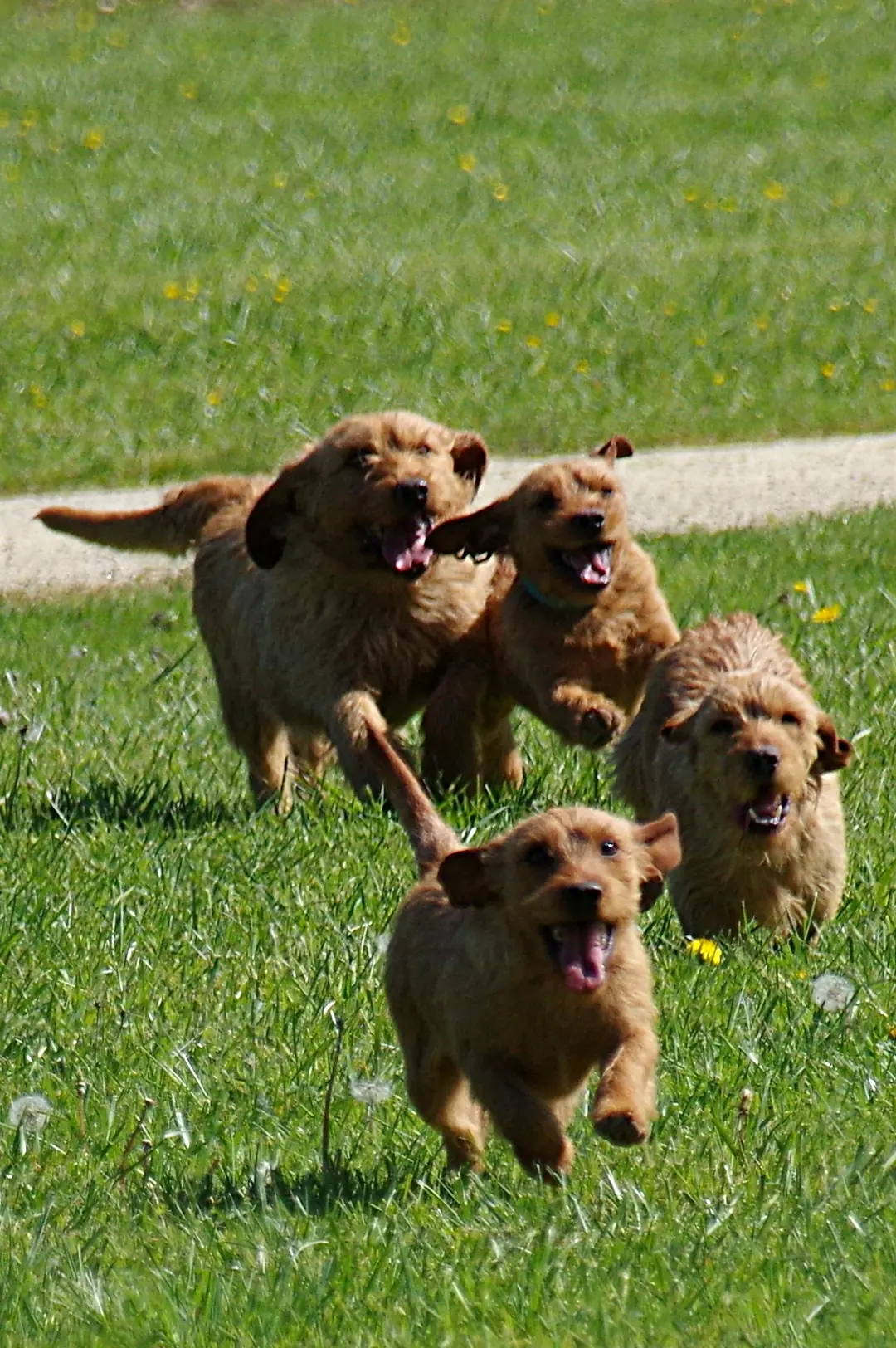
The name describes the dog: fauve is French for fawn. It is a compact, short-legged hound, longer than it is tall but less drawn out than many bassets, with an alert head and dark eyes. The coat is harsh, dense and fairly short, never woolly or curled, in shades from golden wheat to red brick. A small white mark on the chest is allowed. The folded, pointed ears are covered in finer, darker hair.
Puppy growth
Lifespan
Where it comes from
The Basset Fauve de Bretagne belongs to an old family of fawn-coated Breton hounds. Its larger relative, the Grand Fauve de Bretagne, was a wolf hound that died out in the early twentieth century as wolf hunting declined. The basset itself became scarce around the Second World War, and breeders rebuilt it in the decades that followed, reportedly with some use of the Basset Griffon Vendéen. It reached Britain in the nineteen-eighties.
Breed standard
Questions people ask
Compare with related
Sources
- 1Morrill et al., 2022. Ancestry-inclusive dog genomics challenges popular breed stereotypes. Science 376: eabk0639 (Darwin's Ark). ↑
- 2Dogs Trust. Finding a good, responsible breeder. ↑
- 3American Kennel Club. Screening puppy buyers: how top breeders find the best homes. ↑
- 4
- 5American Kennel Club. Basset Fauve de Bretagne breed page. ↑
- 6
- 7Hawthorne et al., 2004. Body-weight changes during growth in puppies of different breeds. Journal of Nutrition 134(8 Suppl): 2027S–2030S (WALTHAM). ↑