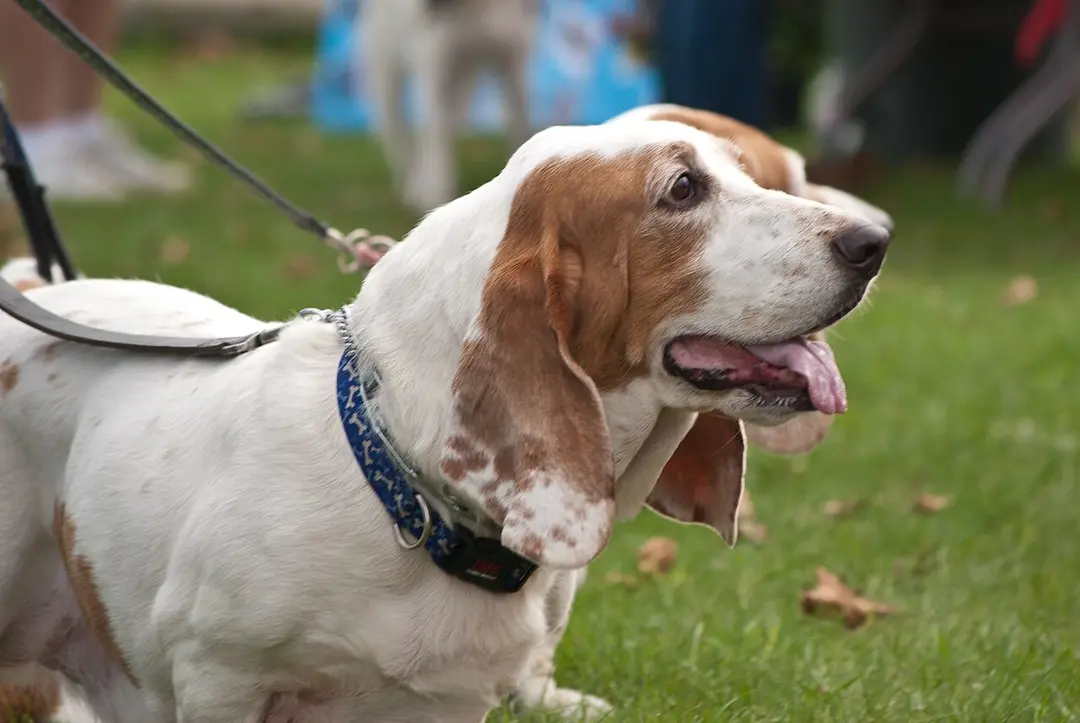
Basset Hound

Placid at home, single-minded once on a scent.
Adult weight
18–29 kg
40–65 lb
Lifespan
12.5 yrs
Class · Companion
also Family, Field

What it's like

Bred to hunt in packs, the Basset is sociable with people and other dogs and placid at home, though single-minded once it picks up a scent. It has a deep, carrying bay. In Britain it is familiar from the Fred Basset cartoon strip, and it is widely known as the face of the Hush Puppies shoe brand.

Day to day
Activity
Happy with modest walks
Intelligence
Easy-going, simple routines
Handler demand
Needs steady training
With people
Affection
A lap or leaning dog
Loyalty
Friendly with everyone
Independence
Decides for itself
Around the home
Sensitivity
Average
Voice
Very vocal
Prey drive
Chases; needs managing
Breed explains only about 9% of how individual dogs differ in behaviour1. Meet the dog. A good breeder breeds for temperament as well as health, and matches each puppy's personality to the right home2,3.
Is a Basset Hound right for you?
Take the breed matcher

Living with one

It has a short coat. It sheds through the year rather than in big seasonal moults. Plan on a brush once a week. It needs plenty of exercise compared with other breeds.

Size and growth

A Basset Hound is a medium dog, heavier than a Border Collie and lighter than a Golden Retriever.

It is a long, heavy-boned dog set close to the ground, with large feet, a deep chest and a long tail carried well up. The head is domed, with long, velvety ears that hang well below the jaw, loose skin, a wrinkled brow and a mournful expression. The short, smooth coat is usually black, white and tan, or lemon and white.

Puppy growth

Reference curve · community data appears as owners log
By about 5 months, a male Basset Hound puppy is already as heavy as a grown Staffordshire Bull Terrier. They grow fastest between 3 and 4 months old.
Fully grown
11 mo
Both sexes, at 99% of adult weight7
Male
Female
Shaded: expected range
01020302m4m6m9m12m18m
01020302m3m4m6m9m12m18m
Age
Male
Female
2 months
3.9–6.4 kg 8.6–14.1 lb
4.4–7.1 kg 9.7–15.7 lb
3 months
5.8–9.5 kg 12.8–20.9 lb
6.2–10.1 kg 13.7–22.3 lb
4 months
8.4–13.7 kg 18.5–30.2 lb
8.8–14.4 kg 19.4–31.7 lb
5 months
10.8–17.6 kg 23.8–38.8 lb
11.1–18.2 kg 24.5–40.1 lb
6 months
12.9–21.1 kg 28.4–46.5 lb
13.1–21.3 kg 28.9–47.0 lb
7 months
14.5–23.6 kg 32.0–52.0 lb
8 months
15.6–25.5 kg 34.4–56.2 lb
15.5–25.2 kg 34.2–55.6 lb
9 months
16.4–26.7 kg 36.2–58.9 lb
16.2–26.4 kg 35.7–58.2 lb
10 months
16.9–27.6 kg 37.3–60.8 lb
16.7–27.2 kg 36.8–60.0 lb
11 months
17.3–28.2 kg 38.1–62.2 lb
17.1–27.8 kg 37.7–61.3 lb
12 months
17.5–28.6 kg 38.6–63.1 lb
17.3–28.2 kg 38.1–62.2 lb
15 months
18.0–29.3 kg 39.7–64.6 lb
17.9–29.1 kg 39.5–64.2 lb

Health and lifespan

In UK vet records, the conditions below turn up more often in Basset Hounds than in crossbreeds. Dry eye, skin fold inflammation and outward-drooping eyelid stand out as far more likely. None of them is rated serious. These are figures for the breed as a whole, not a prediction for your dog.
Listed by likelihood level, highest first, then by how serious it is, then by name. These are the first 5 of 7 measured.
  • Dry eye
    Far more likely
    Impact: moderate
  • Skin fold inflammation
    Far more likely
    Impact: moderate
  • Outward-drooping eyelid
    Far more likely
    Impact: minor
  • Inward-rolling eyelid
    Much more likely
    Impact: moderate
  • Ear canal inflammation
    Much more likely
    Impact: minor

Lifespan

In UK vet records, the typical Basset Hound lived to about 12 and a half years, shorter than the typical medium breed.

Where it comes from

French monks of the Middle Ages are reputed to have started the Basset Hound, as a hound that could work thick cover with its nose held low. Britain gave it its present form: Lord Galway imported a French pair in 1866 and Sir Everett Millais, later called the breed's father in England, showed the first. Its quarry is the hare, followed at an unhurried pace over long distances4,13.

The Basset Hound takes its name from the French word bas, meaning low, a reference to its short legs. Once in Britain, the breed was shaped by breeders who wanted more substance, and late in the nineteenth century Everett Millais crossed his hounds with a Bloodhound, adding size and bone. Packs that hunted hare on foot carried on alongside a heavier type bred for the show ring. In the twentieth century, some working packs brought in Harrier blood to produce a lighter, more agile hound.

Breed standard

The Basset Hound is judged against standard no. 163, in group 6, Scenthounds and related breeds4.

Questions people ask

General guidance for dogs rather than a measured Basset Hound figure: most females have a first season somewhere between six and fifteen months, and cycles then settle to roughly every 180 days. Smaller breeds tend to start earlier and larger ones later, so a medium-sized breed is most likely somewhere in the middle.
Track your own Basset Hound
Log a minute a day and watch them sit on these curves. Free.

Sources

Something wrong on this page?
Parts of this page were written by AI ·