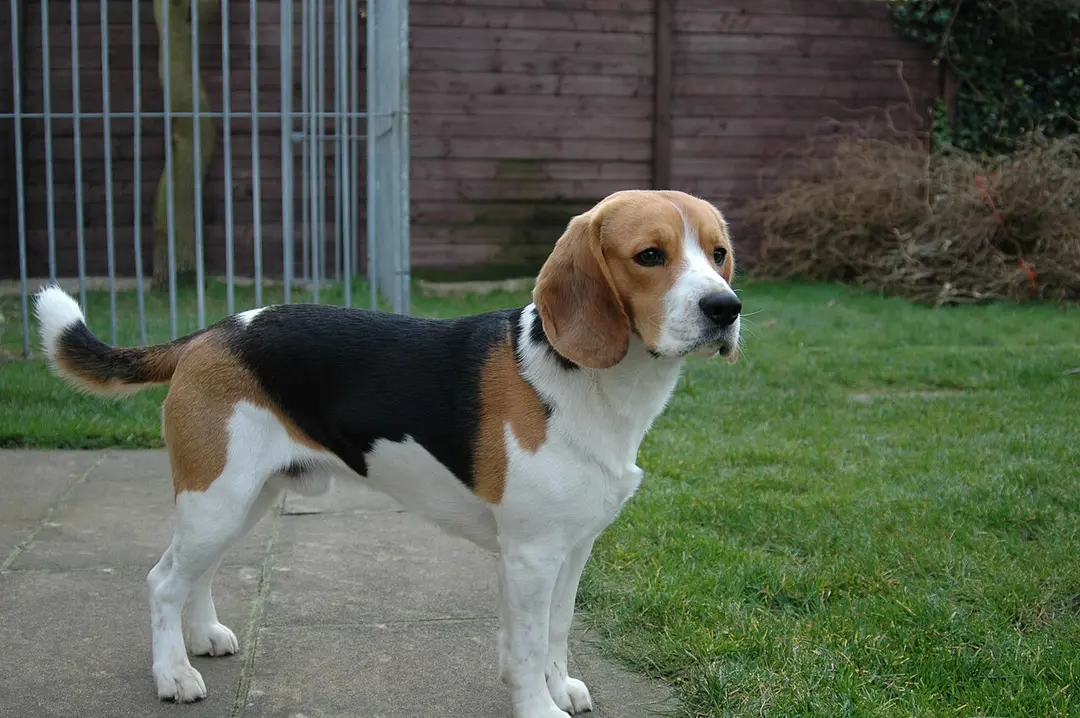
Beagle

Cheerful and sociable; follows its nose and bays.
Adult male
17.3–22.4 kg
38–49 lb
Adult female
14.5–19 kg
32–42 lb
Lifespan
12.5 yrs
Class · Family
also Field

What it's like

Bred to work in packs, the Beagle is sociable with people and other dogs, cheerful and inquisitive. It tends to follow its nose, which makes it determined and often single-minded once on a scent, and it has a distinctive baying voice. Its keen sense of smell has led to Beagles being used as detection dogs, for example by the United States Department of Agriculture to find undeclared food at airports.

Owners who rated their dogs' everyday behaviour found Beagles more independent-minded than most, and far more often said they howl, which is worth knowing if you share a wall. Otherwise they were about average. Breed is only a small part of any one dog's personality, so meet the dog before you decide.
Day to day
Activity
A good daily walk and play
Intelligence
Learns readily, likes games
Handler demand
Needs steady training
With people
Affection
Affectionate on its own terms
Loyalty
Friendly with everyone
Independence
Decides for itself
Around the home
Sensitivity
Average
Voice
Very vocal
Prey drive
Likely to chase small pets
Breed explains only about 9% of how individual dogs differ in behaviour1. Meet the dog. A good breeder breeds for temperament as well as health, and matches each puppy's personality to the right home2,3.
Is a Beagle right for you?
Take the breed matcher

Living with one

Bred to follow a scent, a Beagle needs a moderate amount of exercise, and owners say it seeks constant activity less often than most. The short coat sheds through the year and needs a weekly brush.

Size and growth

A Beagle is a medium dog, about the weight of a grown Border Collie. Males end up clearly heavier than females.

It is a compact, sturdy hound with a slightly domed head, long, low-set ears with rounded tips, and brown or hazel eyes. The short, dense coat is most often tricolour: black, tan and white. Lemon and white, and red and white, are also seen. The tail is carried high and usually tipped with white, which is said to help hunters spot the dog in long cover.

Puppy growth

Reference curve · community data appears as owners log
By about 3 months, a male Beagle puppy is already as heavy as a grown Cavalier King Charles Spaniel. They grow fastest between 3 and 4 months old. The chart follows Beagles themselves, not a general size band.
Fully grown
10 mo
Both sexes, at 99% of adult weight7
Male
Female
Shaded: expected range
01020302m4m6m9m12m18m
01020302m3m4m6m9m12m18m
Age
Male
Female
2 months
4.5–5.9 kg 9.9–13.0 lb
3.8–5.0 kg 8.4–11.0 lb
3 months
7.4–9.5 kg 16.3–20.9 lb
6.2–8.1 kg 13.7–17.9 lb
4 months
10.5–13.6 kg 23.1–30.0 lb
8.8–11.6 kg 19.4–25.6 lb
5 months
13.2–17.1 kg 29.1–37.7 lb
11.1–14.5 kg 24.5–32.0 lb
6 months
15.1–19.5 kg 33.3–43.0 lb
12.6–16.6 kg 27.8–36.6 lb
7 months
16.2–20.9 kg 35.7–46.1 lb
13.6–17.8 kg 30.0–39.2 lb
8 months
16.7–21.7 kg 36.8–47.8 lb
14.0–18.4 kg 30.9–40.6 lb
9 months
17.0–22.0 kg 37.5–48.5 lb
14.3–18.7 kg 31.5–41.2 lb
10 months
17.2–22.2 kg 37.9–48.9 lb
14.4–18.9 kg 31.7–41.7 lb
11 months
17.2–22.3 kg 37.9–49.2 lb
14.4–18.9 kg 31.7–41.7 lb
12 months
17.3–22.4 kg 38–49 lb
14.5–19 kg 32–42 lb

Health and lifespan

Vets record these more often in Beagles than in crossbreeds. Dry eye (moderate) is much more likely. Blood-vessel cancer (life-limiting), balance disorder and underactive thyroid (both moderate) and ear canal inflammation (minor) are more likely. These are figures for the breed as a whole, not a prediction for your dog.
Listed by likelihood level, highest first, then by how serious it is, then by name. These are 5 of 9 measured; lab-confirmed figures only fill places the vet-record studies leave empty.
  • Dry eye
    Much more likely
    Impact: moderate
  • Blood-vessel cancer
    More likely
    Impact: life-limiting
  • Balance disorder
    More likely
    Impact: moderate
  • Underactive thyroid
    More likely
    Impact: moderate
  • Ear canal inflammation
    More likely
    Impact: minor

Lifespan

In UK vet records, the typical Beagle lived to about 12 and a half years, shorter than the typical medium breed.

Where it comes from

The Beagle is a British pack hound, an established breed in England by the 1400s and reputedly bred down from the Foxhound to hunt hare. Hunters could keep pace with it on foot, so no horse was needed. Elizabeth I's miniature Beagles were reputedly small enough to ride in a saddle pannier4,14.

The Beagle's modern form took shape in the nineteenth century. A pack kept by the Reverend Phillip Honeywood in Essex during the eighteen-thirties is often credited as the foundation of today's breed, and beagling packs spread across England later in the century. A breed club followed in the eighteen-nineties. By that time Beagles had also been taken to North America, where the breed became established.

Breed standard

The Beagle is judged against standard no. 161, in group 6, Scenthounds and related breeds4.

Questions people ask

General guidance for dogs rather than a measured Beagle figure: most females have a first season somewhere between six and fifteen months, and cycles then settle to roughly every 180 days. Smaller breeds tend to start earlier and larger ones later, so a medium-sized breed is most likely somewhere in the middle.
Track your own Beagle
Log a minute a day and watch them sit on these curves. Free.

Sources

Something wrong on this page?
Parts of this page were written by AI ·