Bernese Mountain Dog
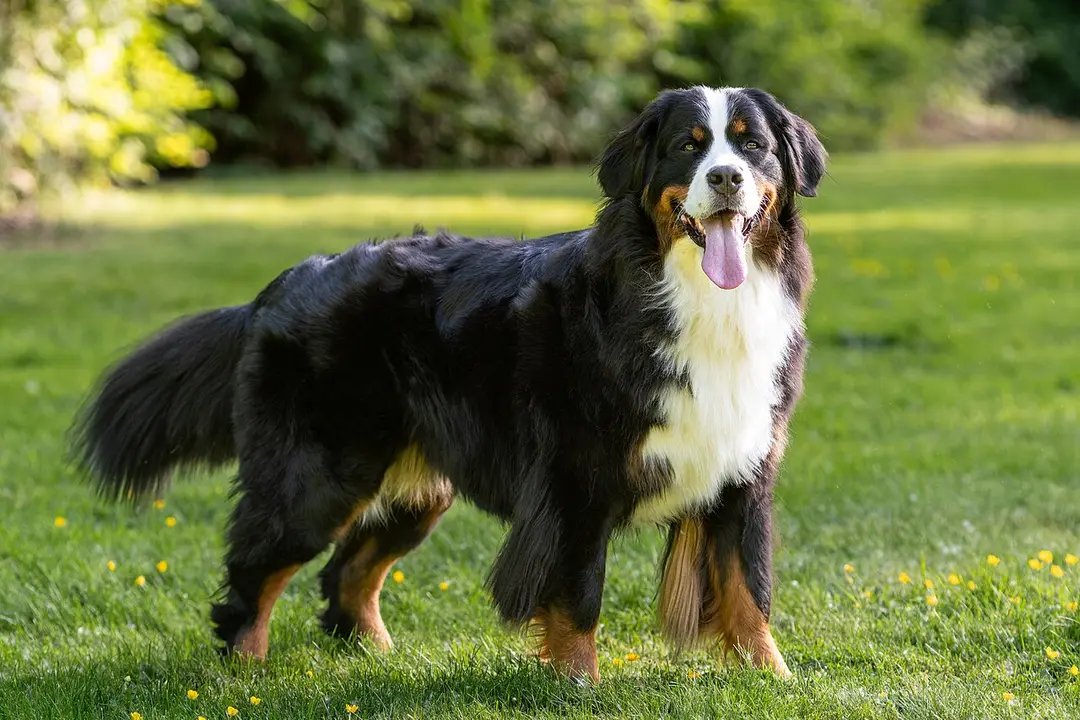
Good-natured and calm; slow to mature.
Adult male
36–52 kg
80–115 lb
Adult female
32–43 kg
70–95 lb
Lifespan
10.1 yrs
Class · Family
also Companion

What it's like

In temperament it is good-natured and calm, steady rather than excitable, and closely attached to its family. It tends to be reserved with strangers without being sharp, and it matures slowly in mind as well as body. Draught work survives as an organised activity, with carting at shows and events.

Day to day
Activity
Happy with modest walks
Intelligence
Learns readily, likes games
Handler demand
Needs steady training
With people
Affection
A lap or leaning dog
Loyalty
Bonded to its family
Independence
Keen to work with you
Around the home
Sensitivity
Average
Voice
Barks to alert, then settles
Prey drive
Usually fine with small pets
Breed explains only about 9% of how individual dogs differ in behaviour1. Meet the dog. A good breeder breeds for temperament as well as health, and matches each puppy's personality to the right home2,3.
Is a Bernese Mountain Dog right for you?
Take the breed matcher

Living with one

It has a long coat. It sheds through the year rather than in big seasonal moults. Plan on daily brushing. It needs a moderate amount of exercise compared with other breeds.

Size and growth

A Bernese Mountain Dog is a large dog, about the weight of a grown German Shepherd. Males end up clearly heavier than females.

The coat is thick and moderately long, straight or slightly wavy, jet black with rich rust on the cheeks, above the eyes, on the legs and beside a white chest, usually with a white blaze and often white feet and tail tip.

Puppy growth

Reference curve · community data appears as owners log
Bernese Mountain Dogs reach half their adult weight at about 5 months. They grow fastest between 4 and 5 months old. They keep growing past their first birthday, longer than a Beagle does. Most males grow into the size large-breed puppy foods are made for.
Fully grown
13 mo
Both sexes, at 99% of adult weight6
Male
Female
Shaded: expected range
02040602m4m6m9m12m18m
02040602m3m4m6m9m12m18m
Age
Male
Female
2 months
6.3–9.1 kg 13.9–20.1 lb
7.3–9.9 kg 16.1–21.8 lb
3 months
10.2–14.6 kg 22.5–32.2 lb
10.6–14.3 kg 23.4–31.5 lb
4 months
15.1–21.7 kg 33.3–47.8 lb
15.3–20.8 kg 33.7–45.9 lb
5 months
20.4–29.4 kg 45.0–64.8 lb
19.5–26.4 kg 43.0–58.2 lb
6 months
25.3–36.4 kg 55.8–80.2 lb
22.9–31.1 kg 50.5–68.6 lb
7 months
29.2–42.0 kg 64.4–92.6 lb
25.4–34.4 kg 56.0–75.8 lb
8 months
31.9–45.8 kg 70.3–101.0 lb
27.2–36.8 kg 60.0–81.1 lb
9 months
33.6–48.3 kg 74.1–106.5 lb
28.5–38.6 kg 62.8–85.1 lb
10 months
34.7–49.9 kg 76.5–110.0 lb
29.4–39.8 kg 64.8–87.7 lb
11 months
35.4–50.8 kg 78.0–112.0 lb
30.0–40.6 kg 66.1–89.5 lb
12 months
35.8–51.4 kg 78.9–113.3 lb
30.5–41.3 kg 67.2–91.1 lb
15 months
36.2–52.0 kg 79.8–114.6 lb
31.3–42.5 kg 69.0–93.7 lb
18 months
36.3–52.1 kg 80.0–114.9 lb
32–43 kg 70–95 lb

Health and lifespan

In vet and lab records from the UK and North America, the conditions below turn up more often in Bernese Mountain Dogs than in crossbreeds. Melanoma of the eye or eyelid stands out as far more likely. The most serious are bone cancer (much more likely), mouth melanoma (much more likely) and lymph node cancer (more likely), and all can shorten a life. These are figures for the breed as a whole, not a prediction for your dog.
Listed by likelihood level, highest first, then by how serious it is, then by name. These are the first 5 of 6 measured.
  • Melanoma of the eye or eyelid
    Lab-confirmed cases
    Far more likely
    Impact: serious
  • Bone cancer
    Lab-confirmed cases
    Much more likely
    Impact: life-limiting
  • Mouth melanoma
    Lab-confirmed cases
    Much more likely
    Impact: life-limiting
  • Skin melanoma
    Lab-confirmed cases
    Much more likely
    Impact: moderate
  • Lymph node cancer
    More likely
    Impact: life-limiting
Lab-confirmed: compares dogs whose tumour samples went to a lab with dogs seen in general practice, so the figures run higher than vet-record ones.

Lifespan

In UK vet records, the typical Bernese Mountain Dog lived to about 10 years, shorter than the typical large breed.

Where it comes from

The Bernese Mountain Dog was a farm dog of the country around Bern, used to guard, pull carts and drive cattle, and was first called the Dürrbächler after an inn and hamlet near Riggisberg where these tricolour dogs were common. Breeders around Burgdorf formed a club in 1907 to breed it pure, and it later took its present name to match the other Swiss mountain dogs4.

The Bernese Mountain Dog owes its survival to a small group of Swiss enthusiasts at the turn of the twentieth century, when the old farm type was dwindling and often crossed with other dogs. The geologist Albert Heim, a champion of the native mountain dogs, encouraged its breeding and judged it at early shows. Dogs reached North America between the wars, and the breed took hold in Britain after the Second World War. An all-round farm dog, it drove cattle, kept guard and pulled milk carts to the dairy; it has a sturdy frame, slightly longer than tall. It is the only long-coated breed among the Swiss mountain dogs.

Breed standard

The Bernese Mountain Dog is judged against standard no. 45, in group 2, Pinscher and Schnauzer, Molossoid and Swiss Mountain Dogs4.

Questions people ask

General guidance for dogs rather than a measured Bernese Mountain Dog figure: most females have a first season somewhere between six and fifteen months, and cycles then settle to roughly every 180 days. Smaller breeds tend to start earlier and larger ones later, so a large breed is most likely at the later end.
Track your own Bernese Mountain Dog
Log a minute a day and watch them sit on these curves. Free.

Sources

Something wrong on this page?
Parts of this page were written by AI ·