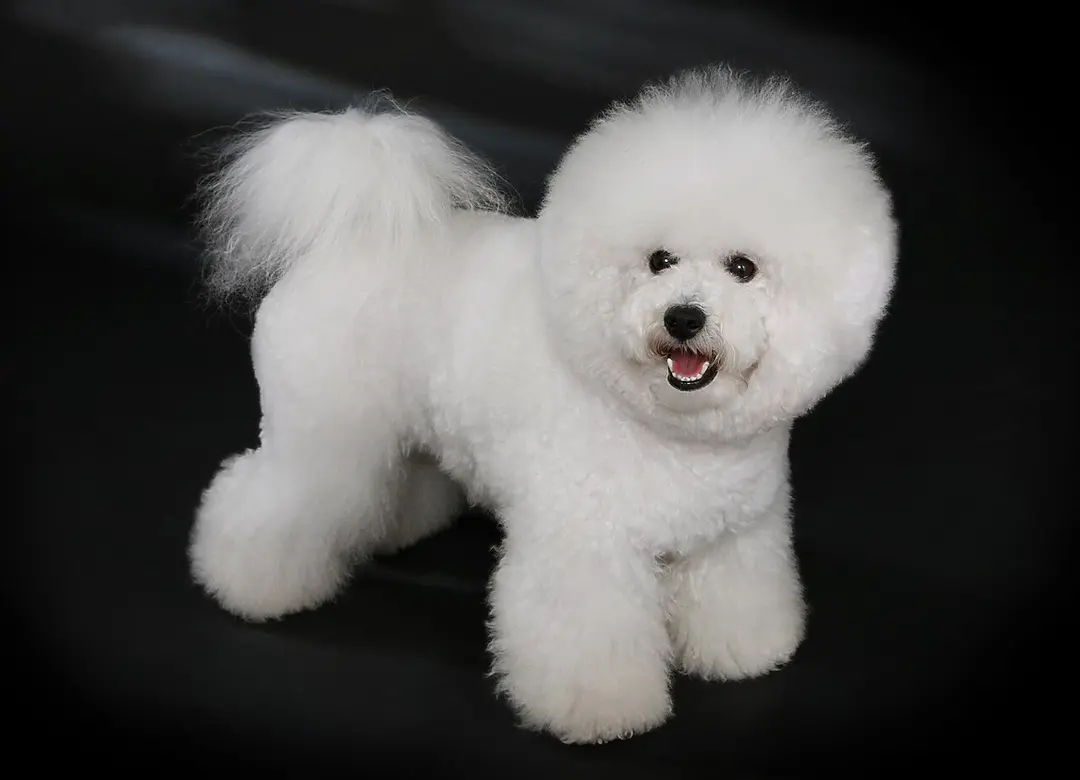
Bichon Frise

Cheerful and sociable; tends to dislike being left alone.
Adult weight
5.4–8.2 kg
12–18 lb
Lifespan
12.5 yrs
Handler demand
Suits a first-time owner
Class · Lap dog
also Companion, Family

What it's like

In temperament the Bichon is cheerful, sociable and quick to learn, qualities that suited its years as a performer. It usually greets strangers and other dogs readily and tends to dislike being left alone.

Day to day
Activity
Happy with modest walks
Intelligence
Learns readily, likes games
Handler demand
Suits a first-time owner
With people
Affection
A lap or leaning dog
Loyalty
Friendly with everyone
Independence
Cooperative, with its own ideas
Around the home
Sensitivity
Needs a calm, predictable home
Voice
Barks to alert, then settles
Prey drive
Usually fine with small pets
Breed explains only about 9% of how individual dogs differ in behaviour1. Meet the dog. A good breeder breeds for temperament as well as health, and matches each puppy's personality to the right home2,3.
Is a Bichon Frise right for you?
Take the breed matcher

Living with one

A Bichon's curly coat holds its loose hair: it stays caught in the coat until it is brushed or clipped out. Plan on brushing a few times a week and clipping every six to eight weeks. Bred for company, it needs a modest amount of exercise compared with other breeds.

Size and growth

A Bichon Frise is a small dog, about the weight of a grown Cavalier King Charles Spaniel.

Bred as a companion rather than a worker, the Bichon is a sturdy little dog with a white double coat: a soft, dense undercoat beneath a curly outer layer that stands away from the body. Dark round eyes, a black nose and a plumed tail carried curved over the back complete the look. The rounded, powder-puff outline owes much to a scissored trim that became popular in America.

Puppy growth

Reference curve · community data appears as owners log
By about 3 months, a male Bichon Frise puppy is already as heavy as a grown Chihuahua. They grow fastest between 3 and 4 months old.
Fully grown
10 mo
Both sexes, at 99% of adult weight8
Male
Female
Shaded: expected range
02.557.5102m4m6m9m12m18m
02.557.5102m3m4m6m9m12m18m
Age
Male
Female
2 months
1.6–2.5 kg 3.5–5.5 lb
1.7–2.7 kg 3.7–6.0 lb
3 months
2.2–3.3 kg 4.9–7.3 lb
2.2–3.4 kg 4.9–7.5 lb
4 months
2.9–4.5 kg 6.4–9.9 lb
3.0–4.5 kg 6.6–9.9 lb
5 months
3.5–5.4 kg 7.7–11.9 lb
3.5–5.3 kg 7.7–11.7 lb
6 months
4.0–6.1 kg 8.8–13.4 lb
3.9–6.0 kg 8.6–13.2 lb
7 months
4.3–6.6 kg 9.5–14.6 lb
4.3–6.5 kg 9.5–14.3 lb
8 months
4.6–7.0 kg 10.1–15.4 lb
4.5–6.8 kg 9.9–15.0 lb
9 months
4.8–7.2 kg 10.6–15.9 lb
4.7–7.1 kg 10.4–15.7 lb
10 months
4.9–7.5 kg 10.8–16.5 lb
4.8–7.3 kg 10.6–16.1 lb
11 months
5.0–7.6 kg 11.0–16.8 lb
4.9–7.5 kg 10.8–16.5 lb
12 months
5.1–7.7 kg 11.2–17.0 lb
5.0–7.6 kg 11.0–16.8 lb
15 months
5.3–8.0 kg 11.7–17.6 lb
5.2–7.9 kg 11.5–17.4 lb

Health and lifespan

Vets record these more often in Bichons than in crossbreeds. Cushing's syndrome (serious) is much more likely. A torn cruciate ligament (serious), cherry eye, dry eye and a slipping kneecap (all three moderate) are more likely. These are figures for the breed as a whole, not a prediction for your dog.
Listed by likelihood level, highest first, then by how serious it is, then by name. These are the first 5 of 8 measured.
  • Cushing's syndrome
    Much more likely
    Impact: serious
  • Torn cruciate ligament in one knee
    More likely
    Impact: serious
  • Cherry eye
    More likely
    Impact: moderate
  • Dry eye
    More likely
    Impact: moderate
  • Kneecap slipping out of place
    More likely
    Impact: moderate

Lifespan

In UK vet records, the typical Bichon Frise lived to about 12 and a half years, shorter than the typical small breed.

Where it comes from

Italian in origin, the Bichon Frise reached France in the Renaissance; its name, shortened from "barbichon", nods to its resemblance to a miniature Barbet. Painters of the 17th and 18th centuries depicted it as the companion of kings and nobles. Nearly lost in the two world wars, it was rebuilt by a few breeders in France and Belgium, and in 1978 took its current French name as a Franco-Belgian breed4.

The Bichon Frise belongs to the bichon family of small companion dogs with Mediterranean roots, alongside the Maltese, Bolognese and Havanese. One variety was known as the Bichon Tenerife, and it is often said that sailors carried these dogs between ports and traded them, though this is told rather than documented. When aristocratic fashion moved on in the nineteenth century, the breed became a dog of the streets and fairgrounds, performing tricks with organ grinders and in circuses. After the Second World War breeders took it to the United States, and it reached Britain in the nineteen-seventies.

Breed standard

The Bichon Frise is judged against standard no. 215, in group 9, Companion and Toy Dogs4.

Questions people ask

General guidance for dogs rather than a measured Bichon Frise figure: most females have a first season somewhere between six and fifteen months, and cycles then settle to roughly every 180 days. Smaller breeds tend to start earlier and larger ones later, so a small breed is most likely at the early end.
Track your own Bichon Frise
Log a minute a day and watch them sit on these curves. Free.

Sources

Something wrong on this page?
Parts of this page were written by AI ·