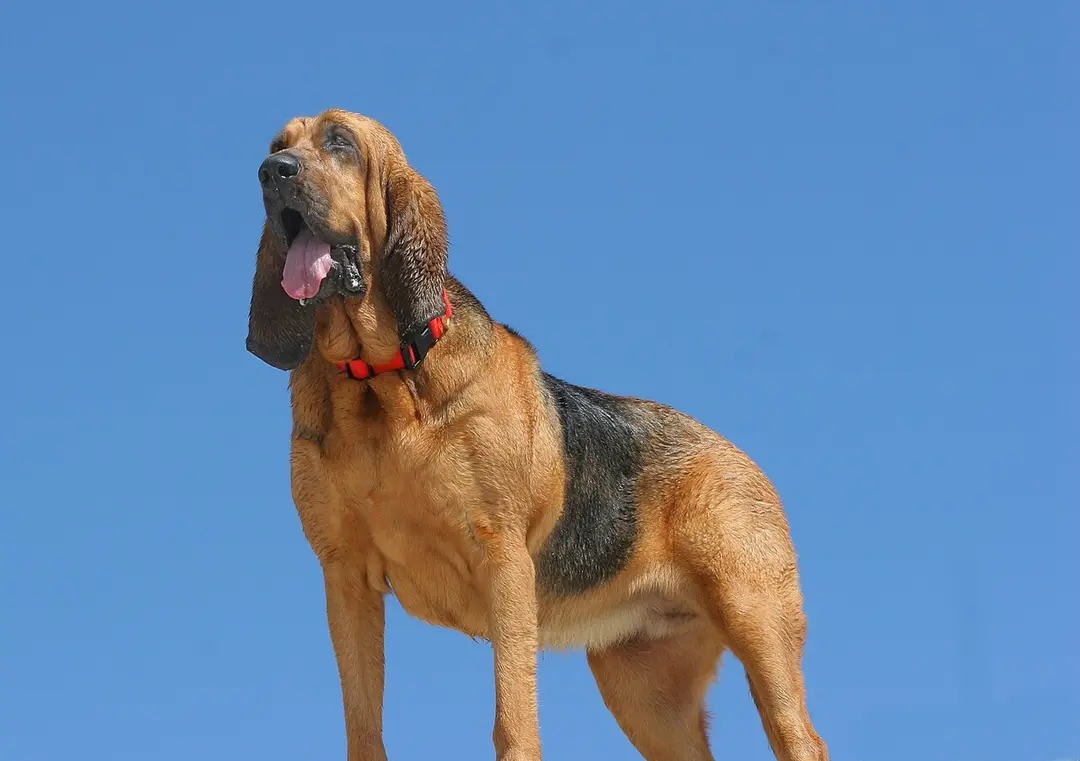
Bloodhound

Affectionate and gentle, wholly absorbed by a scent.
Adult male
46–54 kg
101–119 lb
Adult female
40–48 kg
88–106 lb
Lifespan
9.3 yrs
Class · Field
also Companion

What it's like

The Bloodhound is a large, heavily boned hound whose thin, loose skin hangs in deep folds about the head and throat, with long, low-set ears, pendulous lips and lower eyelids that show some of the haw. The short coat is black and tan, liver and tan, or red. By nature it is affectionate and gentle, somewhat reserved with strangers, and wholly absorbed once on a scent, giving tongue in a deep, resonant bay.

Day to day
Activity
Needs lots of exercise
Intelligence
Learns readily, likes games
Handler demand
Needs an experienced owner
With people
Affection
Affectionate on its own terms
Loyalty
Bonded to its family
Independence
Decides for itself
Around the home
Sensitivity
Average
Voice
Very vocal
Prey drive
Chases; needs managing
Breed explains only about 9% of how individual dogs differ in behaviour1. Meet the dog. A good breeder breeds for temperament as well as health, and matches each puppy's personality to the right home2,3.
Is a Bloodhound right for you?
Take the breed matcher

Living with one

It has a short coat. It sheds through the year rather than in big seasonal moults. Plan on a brush once a week. It needs plenty of exercise compared with other breeds.

Size and growth

A Bloodhound is a giant dog, about the weight of a grown Rottweiler. Males end up a little heavier than females. It is one of the lightest giant breeds.

Puppy growth

Reference curve · community data appears as owners log
By about 3 months, a male Bloodhound puppy is already as heavy as a grown Cocker Spaniel. They grow fastest between 4 and 5 months old. They keep growing past their first birthday, longer than a Beagle does. Most males grow into the size large-breed puppy foods are made for.
Fully grown
13 mo
Both sexes, at 99% of adult weight6
Male
Female
Shaded: expected range
02040602m4m6m9m12m18m
02040602m3m4m6m9m12m18m
Age
Male
Female
2 months
8.0–9.4 kg 17.6–20.7 lb
7.0–8.4 kg 15.4–18.5 lb
3 months
12.9–15.1 kg 28.4–33.3 lb
11.2–13.4 kg 24.7–29.5 lb
4 months
19.1–22.4 kg 42.1–49.4 lb
16.6–19.9 kg 36.6–43.9 lb
5 months
25.9–30.4 kg 57.1–67.0 lb
22.5–27.0 kg 49.6–59.5 lb
6 months
32.1–37.7 kg 70.8–83.1 lb
27.9–33.5 kg 61.5–73.9 lb
7 months
37.0–43.4 kg 81.6–95.7 lb
32.2–38.6 kg 71.0–85.1 lb
8 months
40.4–47.4 kg 89.1–104.5 lb
35.1–42.1 kg 77.4–92.8 lb
9 months
42.6–50.0 kg 93.9–110.2 lb
37.0–44.4 kg 81.6–97.9 lb
10 months
44.0–51.6 kg 97.0–113.8 lb
38.2–45.9 kg 84.2–101.2 lb
11 months
44.8–52.6 kg 98.8–116.0 lb
39.0–46.8 kg 86.0–103.2 lb
12 months
45.3–53.2 kg 99.9–117.3 lb
39.4–47.3 kg 86.9–104.3 lb
15 months
45.8–53.8 kg 101.0–118.6 lb
39.9–47.8 kg 88.0–105.4 lb
18 months
46.0–53.9 kg 101.4–118.8 lb
40–48 kg 88–106 lb

Lifespan

In UK vet records, the typical Bloodhound lived to about 9 and a half years, shorter than the typical giant breed. The group was small, so treat the figure as rough.

Where it comes from

The Bloodhound possibly descends from hounds bred by the monks of Saint-Hubert in the Ardennes, and dogs of that line reached England with William the Conqueror in the 11th century. Bred in Britain since before 1300, it served on both sides of the Scottish border as the sleuth-hound, tracking raiders and cattle thieves. Breeders later drew on it to restore France's Chien de St Hubert4,9.

The Bloodhound's name is usually explained as referring to blooded hounds, meaning those of pure breeding kept by noble houses, rather than to any taste for blood. In Britain its numbers fell as faster hounds came into favour for hunting, and the breed was carried into the era of dog shows by a small number of breeders. The international breed standard names Belgium as its country of origin, reflecting its traditional link to the Saint-Hubert hound. The breed was developed to follow the scent of a single quarry, even along old trails, and has tracked people as well as game. It is still used by police and search teams to trace missing people, and in parts of the United States trailing evidence from Bloodhounds has been admitted in court.

Breed standard

The Bloodhound is judged against standard no. 84, in group 6, Scenthounds and related breeds4.

Questions people ask

General guidance for dogs rather than a measured Bloodhound figure: most females have a first season somewhere between six and fifteen months, and cycles then settle to roughly every 180 days. Smaller breeds tend to start earlier and larger ones later, so a giant breed is most likely at the late end.
Track your own Bloodhound
Log a minute a day and watch them sit on these curves. Free.

Sources

Something wrong on this page?
Parts of this page were written by AI ·