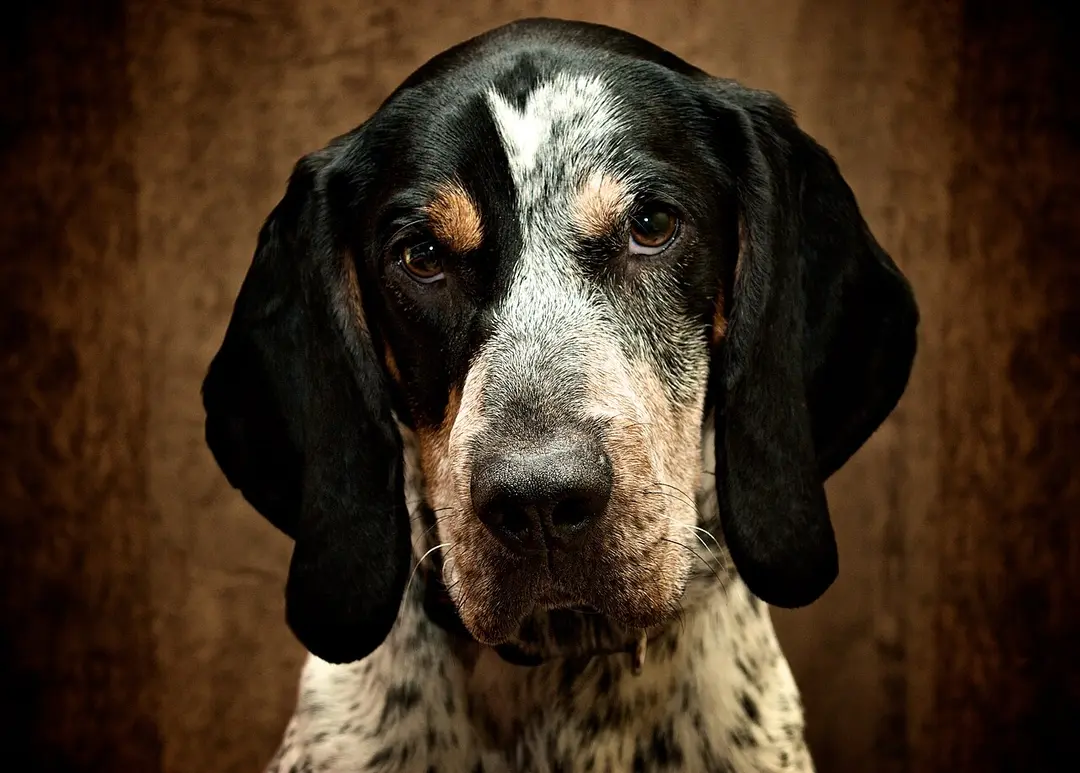
Bluetick Coonhound

Friendly and devoted; determined on a scent and vocal.
Adult male
25–36 kg
55–80 lb
Adult female
20–29 kg
45–65 lb
Lifespan
11–12 yrs
Class · Field
also Sport

What it's like

The coat is short and glossy, thickly mottled with dark blue ticking and marked with black spots on the back, ears and sides; tan above the eyes and on the cheeks is optional, with red ticking on the feet and lower legs. The head is broad, the ears long and low-set, and the body muscular and athletic. In temperament the Bluetick is friendly and devoted, but also determined on a scent and readily vocal. A Bluetick named Smokey is the live mascot of the University of Tennessee.

Day to day
Activity
Needs lots of exercise
Intelligence
Learns readily, likes games
Handler demand
Needs steady training
With people
Affection
Affectionate on its own terms
Loyalty
Bonded to its family
Independence
Decides for itself
Around the home
Sensitivity
Average
Voice
Very vocal
Prey drive
Likely to chase small pets
Breed explains only about 9% of how individual dogs differ in behaviour1. Meet the dog. A good breeder breeds for temperament as well as health, and matches each puppy's personality to the right home2,3.
Is a Bluetick Coonhound right for you?
Take the breed matcher

Size and growth

A Bluetick Coonhound is a large dog, about the weight of a grown Golden Retriever. Males end up clearly heavier than females. It is one of the lightest large breeds.

Puppy growth

Reference curve · community data appears as owners log
By about 5 months, a male Bluetick Coonhound puppy is already as heavy as a grown Border Collie. They grow fastest between 3 and 4 months old. The biggest males grow into the size large-breed puppy foods are made for.
Fully grown
12 mo
Both sexes, at 99% of adult weight7
Male
Female
Shaded: expected range
0102030402m4m6m9m12m18m
0102030402m3m4m6m9m12m18m
Age
Male
Female
2 months
5.2–7.6 kg 11.5–16.8 lb
4.9–7.1 kg 10.8–15.7 lb
3 months
7.9–11.5 kg 17.4–25.4 lb
7.0–10.1 kg 15.4–22.3 lb
4 months
11.7–17.0 kg 25.8–37.5 lb
9.9–14.4 kg 21.8–31.7 lb
5 months
14.9–21.7 kg 32.8–47.8 lb
12.6–18.2 kg 27.8–40.1 lb
6 months
17.8–26.0 kg 39.2–57.3 lb
14.7–21.3 kg 32.4–47.0 lb
7 months
20.1–29.3 kg 44.3–64.6 lb
16.3–23.6 kg 35.9–52.0 lb
8 months
21.8–31.7 kg 48.1–69.9 lb
17.4–25.2 kg 38.4–55.6 lb
9 months
22.9–33.4 kg 50.5–73.6 lb
18.3–26.4 kg 40.3–58.2 lb
10 months
23.6–34.4 kg 52.0–75.8 lb
18.8–27.2 kg 41.4–60.0 lb
11 months
24.0–35.0 kg 52.9–77.2 lb
19.2–27.8 kg 42.3–61.3 lb
12 months
24.3–35.4 kg 53.6–78.0 lb
19.5–28.2 kg 43.0–62.2 lb
15 months
24.6–35.9 kg 54.2–79.1 lb
20.1–29.1 kg 44.3–64.2 lb

Lifespan

No vet study has measured how long Bluetick Coonhounds live yet. The 11–12 years shown is a general figure without a published source.

Where it comes from

The Bluetick Coonhound is an American scenthound that the United Kennel Club thinks most likely comes mainly from fast English foxhounds, with some blood from French big-game hounds known for a cold nose. Besides raccoon, early Blueticks often ran in packs after bear, boar and cougar. Until 1946 the United Kennel Club registered Blueticks as English; that year the breed's fanciers asked for, and got, a register of their own8,9.

The Bluetick Coonhound took its modern shape in the southern United States, where Louisiana is often named as an early centre of breeding. After the split from the English Coonhound, breeders favoured a more deliberate hound, working a trail patiently rather than racing over it. The American Kennel Club admitted the breed to its Hound Group early in the twenty-first century. Its main work is hunting raccoon at night. The hound follows the scent, drives the animal up a tree and holds it there, baying until the hunter arrives. Blueticks are known for a cold nose, able to follow an old trail, and for a loud, carrying voice that hunters describe as a bawl or chop.

Breed standard

No FCI standard covers it; its group here is AKC Hound group.

Questions people ask

General guidance for dogs rather than a measured Bluetick Coonhound figure: most females have a first season somewhere between six and fifteen months, and cycles then settle to roughly every 180 days. Smaller breeds tend to start earlier and larger ones later, so a large breed is most likely at the later end.
Track your own Bluetick Coonhound
Log a minute a day and watch them sit on these curves. Free.

Sources

Uncited on this page: Lifespan — no reviewed source yet, so it is a general reference figure rather than a published one.
Something wrong on this page?
Parts of this page were written by AI ·