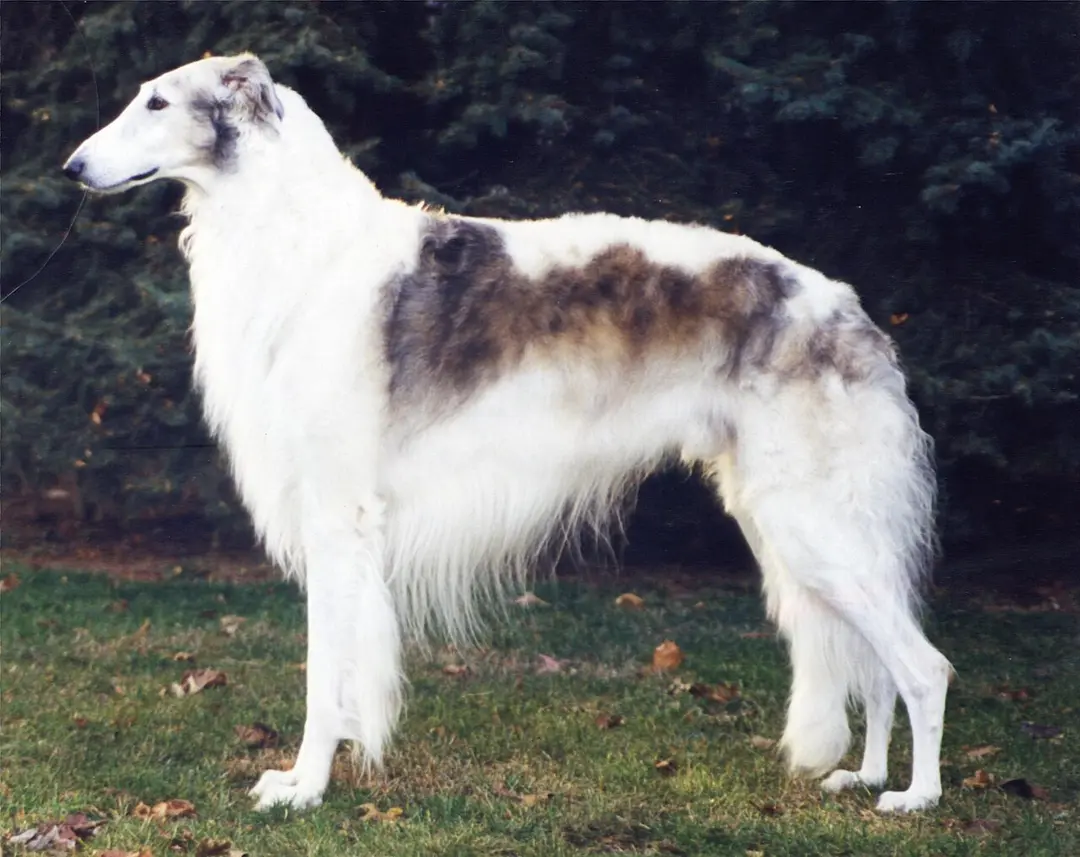
Borzoi

Quiet and gentle at home, but chases anything that runs.
Adult male
34–48 kg
75–105 lb
Adult female
25–41 kg
55–90 lb
Lifespan
12 yrs
Class · Companion
also Field

What it's like

The Borzoi is a tall, narrow and elegant hound. It has a long, lean head, a deep, narrow chest and a back that arches gently over the loin. The silky coat may be flat, wavy or loosely curled. It is short on the head and the fronts of the legs, with heavy feathering on the chest, hindquarters and long, low-carried tail. Many colours are allowed. At home it is usually quiet, gentle and dignified, often reserved with strangers and independent rather than eager to please, but it keeps a strong urge to chase anything that runs.

Day to day
Activity
A good daily walk and play
Intelligence
Easy-going, simple routines
Handler demand
Needs steady training
With people
Affection
Likes its own space
Loyalty
Bonded to its family
Independence
Decides for itself
Around the home
Sensitivity
Needs a calm, predictable home
Voice
Quiet
Prey drive
Likely to chase small pets
Breed explains only about 9% of how individual dogs differ in behaviour1. Meet the dog. A good breeder breeds for temperament as well as health, and matches each puppy's personality to the right home2,3.
Is a Borzoi right for you?
Take the breed matcher

Living with one

It has a long coat. It sheds through the year rather than in big seasonal moults. Plan on daily brushing. It needs a moderate amount of exercise compared with other breeds.

Size and growth

A Borzoi is a large dog, about the weight of a grown German Shepherd. Males end up clearly heavier than females.

Puppy growth

Reference curve · community data appears as owners log
By about 5 months, a male Borzoi puppy is already as heavy as a grown Border Collie. They grow fastest between 4 and 5 months old. They keep growing past their first birthday, longer than a Beagle does. Most males grow into the size large-breed puppy foods are made for.
Fully grown
13 mo
Both sexes, at 99% of adult weight6
Male
Female
Shaded: expected range
02040602m4m6m9m12m18m
02040602m3m4m6m9m12m18m
Age
Male
Female
2 months
5.9–8.3 kg 13.0–18.3 lb
5.7–9.4 kg 12.6–20.7 lb
3 months
9.5–13.3 kg 20.9–29.3 lb
8.3–13.5 kg 18.3–29.8 lb
4 months
14.1–19.8 kg 31.1–43.7 lb
12.0–19.7 kg 26.5–43.4 lb
5 months
19.1–26.8 kg 42.1–59.1 lb
15.3–25.0 kg 33.7–55.1 lb
6 months
23.7–33.2 kg 52.2–73.2 lb
18.0–29.4 kg 39.7–64.8 lb
7 months
27.3–38.3 kg 60.2–84.4 lb
19.9–32.6 kg 43.9–71.9 lb
8 months
29.9–41.8 kg 65.9–92.2 lb
21.3–34.8 kg 47.0–76.7 lb
9 months
31.5–44.1 kg 69.4–97.2 lb
22.3–36.5 kg 49.2–80.5 lb
10 months
32.5–45.5 kg 71.7–100.3 lb
23.0–37.7 kg 50.7–83.1 lb
11 months
33.1–46.4 kg 73.0–102.3 lb
23.5–38.5 kg 51.8–84.9 lb
12 months
33.5–46.9 kg 73.9–103.4 lb
23.9–39.1 kg 52.7–86.2 lb
15 months
33.9–47.4 kg 74.7–104.5 lb
24.5–40.2 kg 54.0–88.6 lb

Lifespan

In UK vet records, the typical Borzoi lived to about 12 years, about average for a large breed. Too few had died yet to pin the figure down, so it may turn out higher.

Where it comes from

The Borzoi was the hunting sighthound of Russia's aristocracy; the FCI traces it to the 15th century, when Tatar sighthounds of Arab origin were crossed with strong native Loshaya dogs, later mixed with Polish, Courland and Crimean sighthounds and Greyhounds. N.P. Yermolov's standard, adopted by the Moscow Hunting Society in 1888, fixed one type. After the 1917 Revolution destroyed the nobles' kennels, earlier exports to England and America kept it alive4,10,11.

In America the Borzoi was long called the Russian Wolfhound, officially taking its present name only in the twentieth century. The name comes from a Russian word meaning swift. Gifts of dogs from the Russian court helped make the breed known in western Europe, and Queen Alexandra kept Borzois at Sandringham. In Britain and America it became a fashionable companion and show dog. It was bred to course game by sight across open country. It hunted hares, foxes and above all wolves, which the hounds were expected to catch and hold until the hunters arrived. Hunts often used Borzois alongside scenthounds, which drove the quarry out of cover.

Breed standard

The Borzoi is judged against standard no. 193, in group 10, Sighthounds4.

Questions people ask

General guidance for dogs rather than a measured Borzoi figure: most females have a first season somewhere between six and fifteen months, and cycles then settle to roughly every 180 days. Smaller breeds tend to start earlier and larger ones later, so a large breed is most likely at the later end.
Track your own Borzoi
Log a minute a day and watch them sit on these curves. Free.

Sources

Something wrong on this page?
Parts of this page were written by AI ·