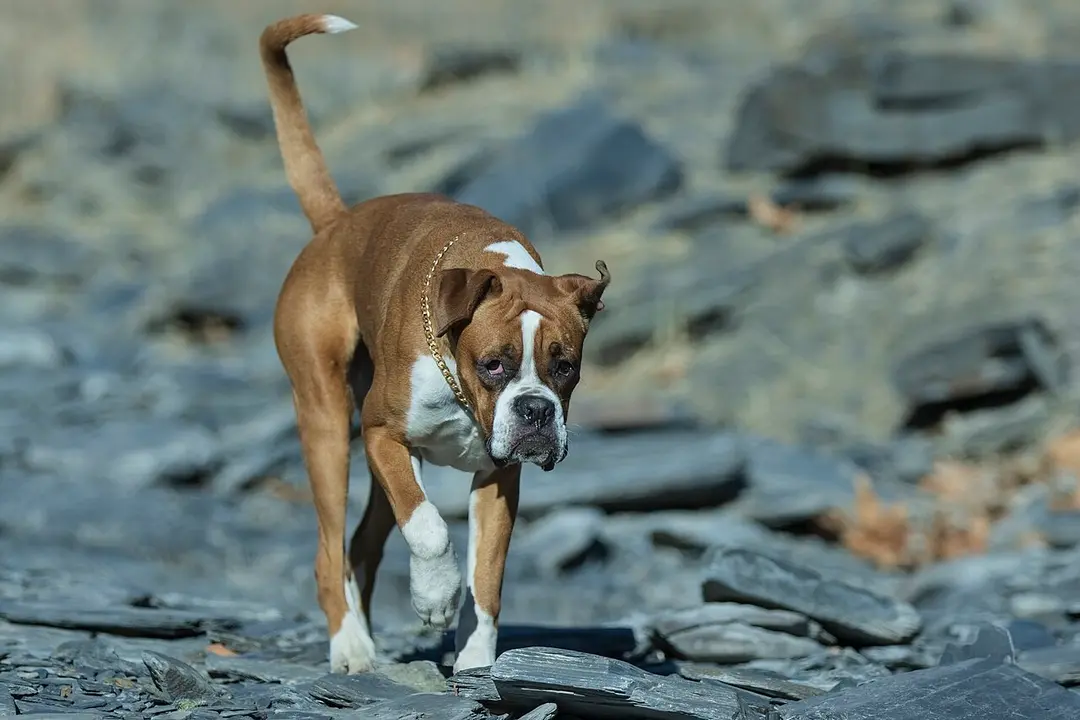
Boxer

Playful and energetic, often puppyish well into adulthood.
Adult male
27.6–38.4 kg
61–85 lb
Adult female
23–32.1 kg
51–71 lb
Lifespan
11.3 yrs
Class · Family
also Watchdog

What it's like

In temperament the Boxer is bright, playful and energetic, alert and watchful by nature. It is often said to keep a puppyish exuberance well into adulthood. The breed's name is popularly linked to its habit of striking out with its front paws when playing, though this explanation is told rather than known.

Owners who rated their dogs' everyday behaviour found Boxers close to the typical dog on independence, calmness, and friendliness with people and with other dogs. Breed is only a small part of any one dog's personality, so meet the dog before you decide.
Day to day
Activity
Needs lots of exercise
Intelligence
Learns readily, likes games
Handler demand
Needs steady training
With people
Affection
A lap or leaning dog
Loyalty
Bonded to its family
Independence
Cooperative, with its own ideas
Around the home
Sensitivity
Average
Voice
Barks to alert, then settles
Prey drive
Chases; needs managing
Breed explains only about 9% of how individual dogs differ in behaviour1. Meet the dog. A good breeder breeds for temperament as well as health, and matches each puppy's personality to the right home2,3.
Is a Boxer right for you?
Take the breed matcher

Living with one

Boxers are described as harmless with their family but distrustful of strangers, so early socialisation matters, and socialisation and puppy classes are called vital for channelling the breed's energy in a positive way. The short coat sheds through the year and needs a weekly brush. It needs a moderate amount of exercise compared with other breeds.

Size and growth

A Boxer is a medium dog, about the weight of a grown Labrador. Males end up clearly heavier than females. It is one of the heaviest medium breeds.

Descended from the Bullenbeisser, a type used to seize and hold large game, the Boxer is a square, muscular dog of medium build with a broad, blunt muzzle, a slightly undershot jaw and a dark mask across the face. The short, glossy coat lies close to the body and comes in fawn or brindle, often with white markings on the chest and feet. Ear cropping is illegal in the UK, so Boxers bred there carry their ears naturally.

Puppy growth

Reference curve · community data appears as owners log
By about 5 months, a male Boxer puppy is already as heavy as a grown Border Collie. They grow fastest between 3 and 4 months old. Most males grow into the size large-breed puppy foods are made for.
Fully grown
12 mo
Both sexes, at 99% of adult weight10
Male
Female
Shaded: expected range
0102030402m4m6m9m12m18m
0102030402m3m4m6m9m12m18m
Age
Male
Female
2 months
5.8–8.1 kg 12.8–17.9 lb
5.5–7.7 kg 12.1–17.0 lb
3 months
8.7–12.1 kg 19.2–26.7 lb
7.8–10.9 kg 17.2–24.0 lb
4 months
12.9–18.0 kg 28.4–39.7 lb
11.2–15.6 kg 24.7–34.4 lb
5 months
16.5–23.0 kg 36.4–50.7 lb
14.2–19.8 kg 31.3–43.7 lb
6 months
19.7–27.5 kg 43.4–60.6 lb
16.6–23.2 kg 36.6–51.1 lb
7 months
22.3–31.0 kg 49.2–68.3 lb
18.4–25.7 kg 40.6–56.7 lb
8 months
24.1–33.6 kg 53.1–74.1 lb
19.7–27.4 kg 43.4–60.4 lb
9 months
25.4–35.3 kg 56.0–77.8 lb
20.6–28.7 kg 45.4–63.3 lb
10 months
26.1–36.4 kg 57.5–80.2 lb
21.2–29.6 kg 46.7–65.3 lb
11 months
26.6–37.0 kg 58.6–81.6 lb
21.7–30.3 kg 47.8–66.8 lb
12 months
26.9–37.4 kg 59.3–82.5 lb
22.0–30.7 kg 48.5–67.7 lb
15 months
27.3–38.0 kg 60.2–83.8 lb
22.7–31.7 kg 50.0–69.9 lb

Health and lifespan

Vets record these more often in Boxers than in crossbreeds. Mast cell tumour (serious), corneal ulcers, underactive thyroid and outward-drooping eyelid are far more likely. Insulin-secreting pancreatic tumour (life-limiting) is much more likely. These are figures for the breed as a whole, not a prediction for your dog.
Listed by likelihood level, highest first, then by how serious it is, then by name. These are 5 of 17 measured; lab-confirmed figures only fill places the vet-record studies leave empty.
  • Mast cell tumour
    Far more likely
    Impact: serious
  • Corneal ulcers
    Far more likely
    Impact: moderate
  • Underactive thyroid
    Far more likely
    Impact: moderate
  • Outward-drooping eyelid
    Far more likely
    Impact: minor
  • Insulin-secreting pancreatic tumour
    Much more likely
    Impact: life-limiting

Flat face and breathing

The Boxer is one of the flat-faced breeds. In UK vet records, flat-faced dogs were more likely to have breathing and airway problems than dogs with a medium-length muzzle, and lived shorter lives on average. Noisy breathing at rest is worth raising with a vet.

Lifespan

In UK vet records, the typical Boxer lived to about 11 and a half years, shorter than the typical medium breed. Flat-faced breeds as a group live shorter lives than breeds with a longer muzzle.

Where it comes from

The Boxer took shape as a breed around Munich late in the 19th century, where a club formed in 1895 drew up the first standard. Its immediate ancestor is held to be the small Brabant Bullenbeisser, a hunter's dog that gripped game the hounds had flushed and held it for the huntsman. English Bulldogs crossed in after about 1830 brought white into coats that had been only fawn or brindle4,19.

The Boxer was developed in Germany in the late nineteenth century, and its type was refined in the early twentieth, with Friederun Stockmann's vom Dom kennel especially influential. The breed was among the first used for police work in Germany, and in the First World War Boxers served the German army as messengers and guard dogs. Its wider spread abroad followed the Second World War.

Breed standard

The Boxer is judged against standard no. 144, in group 2, Pinscher and Schnauzer, Molossoid and Swiss Mountain Dogs4.

Questions people ask

General guidance for dogs rather than a measured Boxer figure: most females have a first season somewhere between six and fifteen months, and cycles then settle to roughly every 180 days. Smaller breeds tend to start earlier and larger ones later, so a medium-sized breed is most likely somewhere in the middle.
Track your own Boxer
Log a minute a day and watch them sit on these curves. Free.

Sources

Something wrong on this page?
Parts of this page were written by AI ·