Bracco Italiano
What it's like
In temperament the Bracco is gentle, docile and affectionate, and it tends to form a close bond with its family. It is sensitive to harsh handling, yet in the field it works with stamina, patience and a steady, methodical drive.
Living with one
Size and growth
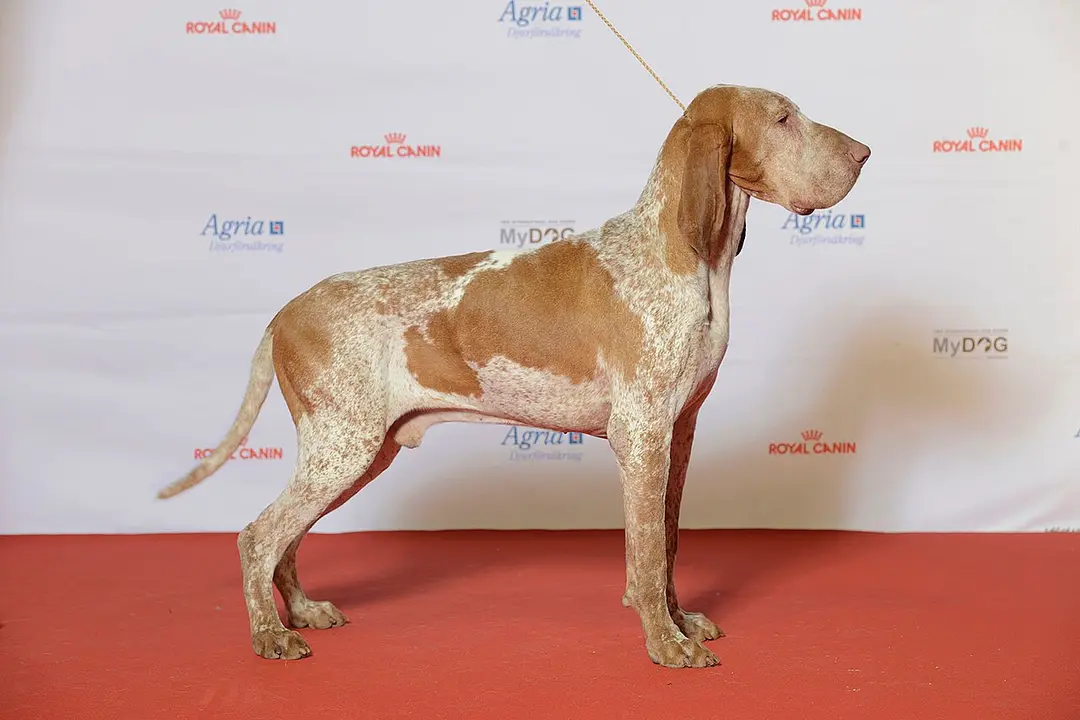
Its working gait is distinctive: a fast, extended trot with the head carried high, rather than the gallop of many pointers. In appearance it is a strong, square, athletic dog with a long head, a slightly arched nose, long ears and loose skin at the throat. The short, dense, glossy coat is white, often with orange or chestnut patches, or flecked in orange or brown roan.
Puppy growth
Lifespan
Where it comes from
The Bracco Italiano owes its survival to Italian enthusiasts of the late nineteenth and twentieth centuries. Ferdinando Delor de Ferrabouc is often credited with much of the revival work, and a breed club, the Società Amatori Bracco Italiano, was founded after the Second World War to guard the standard. The breed reached Britain in the late twentieth century and is now shown and worked there as a hunt, point and retrieve dog. It was bred to quarter ground in front of the gun, find game birds by air scent and hold a firm point.
Breed standard
Questions people ask
Compare with related
Sources
- 1Morrill et al., 2022. Ancestry-inclusive dog genomics challenges popular breed stereotypes. Science 376: eabk0639 (Darwin's Ark). ↑
- 2Dogs Trust. Finding a good, responsible breeder. ↑
- 3American Kennel Club. Screening puppy buyers: how top breeders find the best homes. ↑
- 4
- 5American Kennel Club. Bracco Italiano breed page. ↑
- 6
- 7AAFCO, 2016. AAFCO Dog and Cat Food Nutrient Profiles. Association of American Feed Control Officials. ↑
- 8Hawthorne et al., 2004. Body-weight changes during growth in puppies of different breeds. Journal of Nutrition 134(8 Suppl): 2027S–2030S (WALTHAM). ↑
- 9
- 10American Kennel Club. Bracco Italiano breed history. ↑