Briard
What it's like
The Briard is loyal and protective towards its household and reserved with strangers. It learns quickly but has an independent streak suited to work done with little direction. Its herding instinct can show in a habit of nudging or circling the people around it.
Living with one
Size and growth
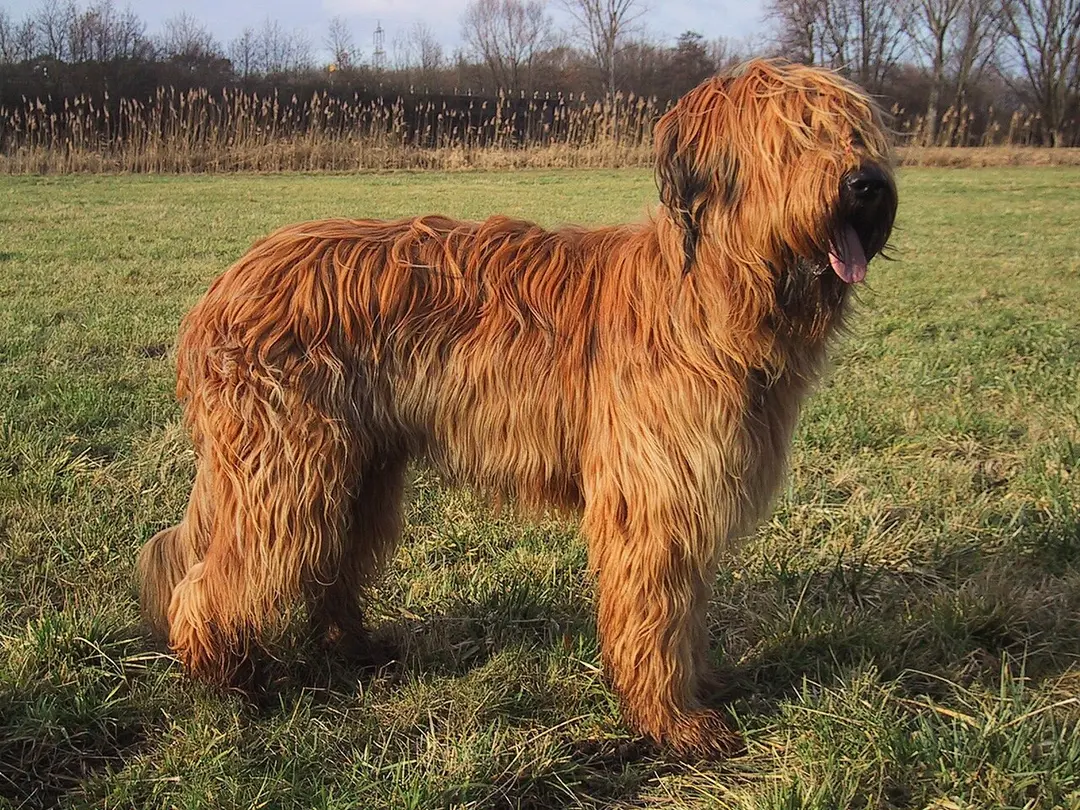
It is a supple, muscular dog with a long, dry, slightly wavy coat often likened to goat hair, usually black, fawn or grey. Long hair on the head forms eyebrows, a beard and a moustache, and the tail ends in a small hook. The breed standard requires double dewclaws on each hind leg.
Puppy growth
Lifespan
Where it comes from
The Briard's modern form was settled in the late nineteenth century, when French breeders and dog shows began to separate the long-coated plains sheepdogs from their short-coated relatives. A first breed standard appeared in the eighteen-nineties, and the breed club Les Amis du Briard was founded in the early twentieth century. American soldiers who had served in France took dogs home after the First World War, but the breed stayed uncommon outside France for decades. On the farm the Briard worked as a 'living fence'. It patrolled the edges of unfenced crops to keep sheep from straying and guarded the flock against thieves and, in earlier times, wolves.
Breed standard
Questions people ask
Compare with related
Sources
- 1Morrill et al., 2022. Ancestry-inclusive dog genomics challenges popular breed stereotypes. Science 376: eabk0639 (Darwin's Ark). ↑
- 2Dogs Trust. Finding a good, responsible breeder. ↑
- 3American Kennel Club. Screening puppy buyers: how top breeders find the best homes. ↑
- 4
- 5American Kennel Club. Briard breed page. ↑
- 6
- 7AAFCO, 2016. AAFCO Dog and Cat Food Nutrient Profiles. Association of American Feed Control Officials. ↑
- 8Hawthorne et al., 2004. Body-weight changes during growth in puppies of different breeds. Journal of Nutrition 134(8 Suppl): 2027S–2030S (WALTHAM). ↑
- 9
- 10The Kennel Club. Briard. ↑