Brittany
What it's like
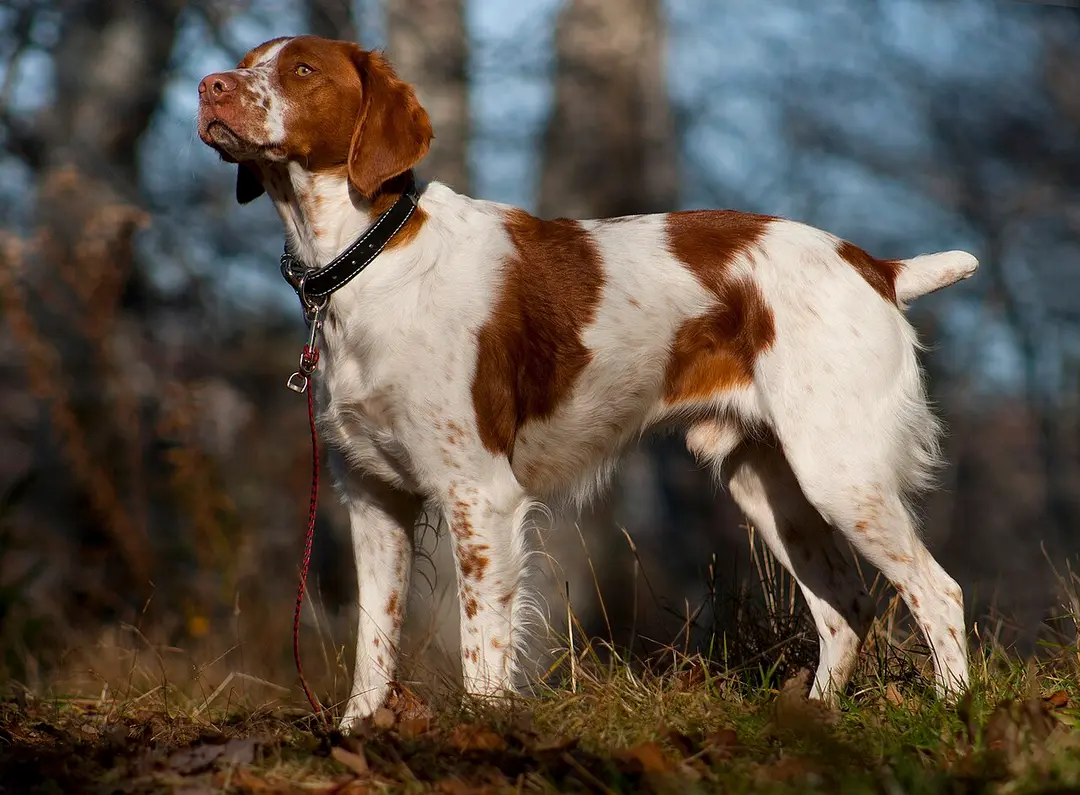
In temperament it is quick, eager and soft-natured, with great stamina and a strong wish to work with its handler; it tends to respond poorly to harsh handling. Black and white dogs are accepted in France but not under the American standard.
Living with one
Size and growth
It is a compact, leggy dog, nearly square in outline, with high-set ears and a tail that is naturally short or absent in some dogs. The dense coat is flat or slightly wavy, lightly feathered, and usually orange and white or liver and white, sometimes roan or tricolour.
Two types
Puppy growth
Lifespan
Where it comes from
The Brittany owes much of its later development to the nineteenth century, when, by the usual account, English sportsmen shooting woodcock in the region brought setters and pointers, and crosses with local farm spaniels are widely thought to have sharpened its pointing instinct. It had reached North America by the early nineteen-thirties, where it was long registered as the Brittany Spaniel until the American Kennel Club shortened the name in the early nineteen-eighties. Bred for rough shooting, it tends to work relatively close to the gun, quartering ground, holding a point on game birds and retrieving, and in Britain it is classed among the hunt, point and retrieve breeds.
Breed standard
Questions people ask
Compare with related
Sources
- 1Morrill et al., 2022. Ancestry-inclusive dog genomics challenges popular breed stereotypes. Science 376: eabk0639 (Darwin's Ark). ↑
- 2Dogs Trust. Finding a good, responsible breeder. ↑
- 3American Kennel Club. Screening puppy buyers: how top breeders find the best homes. ↑
- 4
- 5American Kennel Club. Brittany breed page. ↑
- 6American Kennel Club. Brittany breed standard. ↑
- 7
- 8Hawthorne et al., 2004. Body-weight changes during growth in puppies of different breeds. Journal of Nutrition 134(8 Suppl): 2027S–2030S (WALTHAM). ↑
- 9