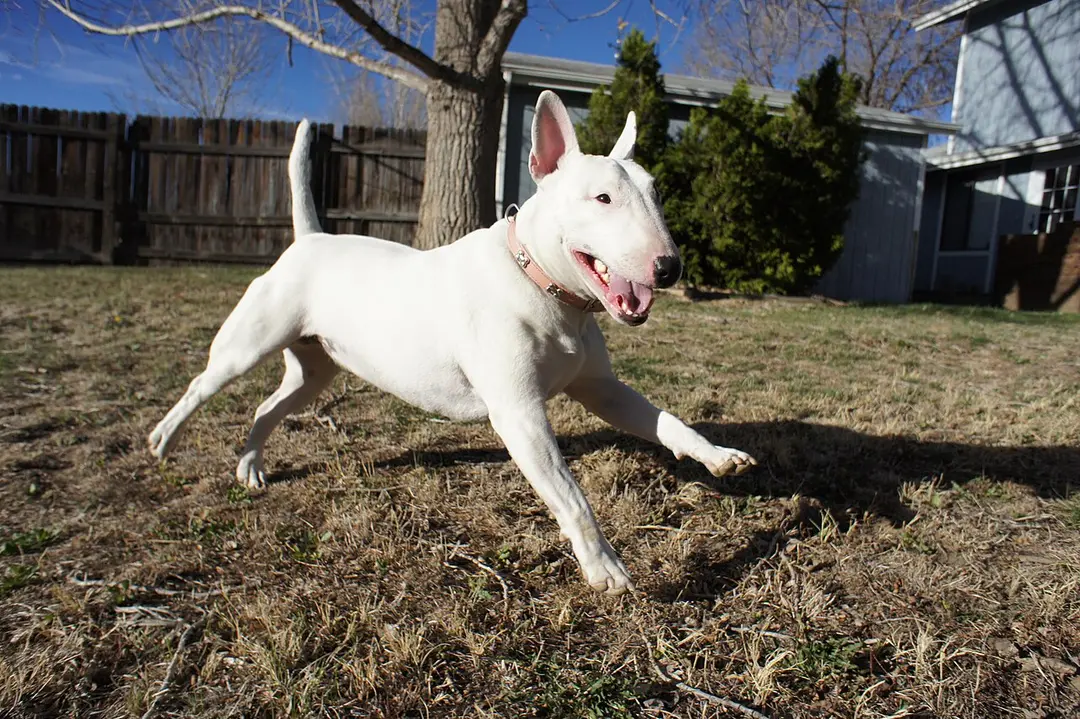
Bull Terrier

Clownish and affectionate, with a stubborn streak.
Adult male
23–32 kg
51–71 lb
Adult female
20–27 kg
44–60 lb
Lifespan
12 yrs
Class · Companion
also Family

What it's like

By temperament the Bull Terrier is lively, affectionate and clownish, with a stubborn streak and a strong attachment to its household, though it can be intolerant of other dogs. General George Patton kept one named Willie, and a white Bull Terrier with a ringed eye serves as mascot of the retailer Target.

Day to day
Activity
A good daily walk and play
Intelligence
Learns readily, likes games
Handler demand
Needs an experienced owner
With people
Affection
Affectionate on its own terms
Loyalty
Bonded to its family
Independence
Decides for itself
Around the home
Sensitivity
Average
Voice
Quiet
Prey drive
Likely to chase small pets
Breed explains only about 9% of how individual dogs differ in behaviour1. Meet the dog. A good breeder breeds for temperament as well as health, and matches each puppy's personality to the right home2,3.
Is a Bull Terrier right for you?
Take the breed matcher

Living with one

Bull Terriers are described as obstinate yet particularly good with people, with a fun-loving attitude. Training follows from that: keep it fun, and start with food or toy rewards. It needs a moderate amount of exercise compared with other breeds.

Size and growth

A Bull Terrier is a medium dog, heavier than a Border Collie and lighter than a Golden Retriever. Males end up clearly heavier than females. It is one of the heaviest medium breeds.

It is a strong, muscular dog. The long, deep head curves down from crown to nose with no stop, and the small, dark, triangular eyes sit close and high, with small ears carried erect. The coat is short, flat and harsh, with a gloss. White dogs may have markings on the head, while coloured dogs are often brindle, though red, fawn and tricolour also occur.

Puppy growth

Reference curve · community data appears as owners log
By about 5 months, a male Bull Terrier puppy is already as heavy as a grown Staffordshire Bull Terrier. They grow fastest between 3 and 4 months old. The biggest males grow into the size large-breed puppy foods are made for.
Fully grown
11 mo
Both sexes, at 99% of adult weight9
Male
Female
Shaded: expected range
0102030402m4m6m9m12m18m
0102030402m3m4m6m9m12m18m
Age
Male
Female
2 months
5.0–7.0 kg 11.0–15.4 lb
4.8–6.5 kg 10.6–14.3 lb
3 months
7.4–10.3 kg 16.3–22.7 lb
6.8–9.2 kg 15.0–20.3 lb
4 months
10.7–14.9 kg 23.6–32.8 lb
9.7–13.1 kg 21.4–28.9 lb
5 months
13.8–19.1 kg 30.4–42.1 lb
12.3–16.6 kg 27.1–36.6 lb
6 months
16.4–22.8 kg 36.2–50.3 lb
14.4–19.5 kg 31.7–43.0 lb
7 months
18.4–25.6 kg 40.6–56.4 lb
16.0–21.6 kg 35.3–47.6 lb
8 months
19.8–27.6 kg 43.7–60.8 lb
17.1–23.1 kg 37.7–50.9 lb
9 months
20.8–29.0 kg 45.9–63.9 lb
17.9–24.2 kg 39.5–53.4 lb
10 months
21.5–29.9 kg 47.4–65.9 lb
18.5–24.9 kg 40.8–54.9 lb
11 months
22.0–30.6 kg 48.5–67.5 lb
18.9–25.5 kg 41.7–56.2 lb
12 months
22.3–31.0 kg 49.2–68.3 lb
19.1–25.8 kg 42.1–56.9 lb
15 months
22.9–31.8 kg 50.5–70.1 lb
19.7–26.6 kg 43.4–58.6 lb

Health and lifespan

In UK vet records, dry eye turns up more often in Bull Terriers than in crossbreeds: it is far more likely. It is not rated serious. These are figures for the breed as a whole, not a prediction for your dog.
Listed by likelihood level, highest first, then by how serious it is, then by name.
  • Dry eye
    Far more likely
    Impact: moderate

Lifespan

In UK vet records, the typical Bull Terrier lived to about 12 years, shorter than the typical medium breed.

Where it comes from

The Bull Terrier comes from 19th-century fighting dogs, a cross of the Bulldog with the White English Terrier. Its egg-shaped head was the choice of James Hinks, the Birmingham breeder who standardised it, and the breed made its show debut in that form in his city in 1862. Unusually, its standard sets no limit on height or weight4,12.

The Bull Terrier moved away from the fighting pit during the nineteenth century. Hinks's all-white dogs became fashionable as smart, game companions for gentlemen and earned the nickname the White Cavalier, said to reflect a dog that would defend itself but never start a fight. In the early twentieth century breeders brought colour back, partly through crosses with the Staffordshire Bull Terrier, and some registries later recognised coloured dogs as a separate variety. The Miniature Bull Terrier shares this descent but is now a distinct breed.

Breed standard

The Bull Terrier is judged against standard no. 11, in group 3, Terriers4.

Questions people ask

General guidance for dogs rather than a measured Bull Terrier figure: most females have a first season somewhere between six and fifteen months, and cycles then settle to roughly every 180 days. Smaller breeds tend to start earlier and larger ones later, so a medium-sized breed is most likely somewhere in the middle.
Track your own Bull Terrier
Log a minute a day and watch them sit on these curves. Free.

Sources

Something wrong on this page?
Parts of this page were written by AI ·