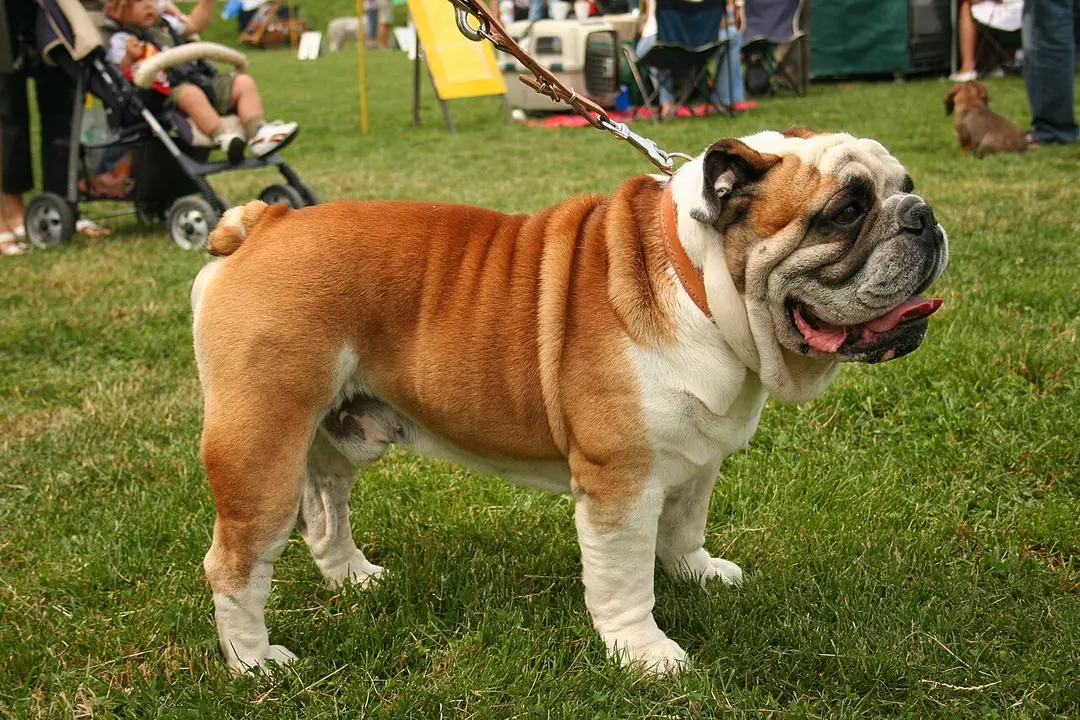
Bulldog

Steady and good-natured, though often a bit stubborn.
Adult male
23–32.2 kg
51–71 lb
Adult female
20.2–28.4 kg
45–63 lb
Lifespan
9.8 yrs
Handler demand
Suits a first-time owner
Class · Companion
also Family

What it's like

In temperament the modern Bulldog is calm, affectionate and good-natured, steady rather than lively, though often determined and somewhat stubborn. It became a national emblem, linked with the figure of John Bull and with wartime images of Churchill. In America, Yale University's live Bulldog mascot, Handsome Dan, dates from the late nineteenth century.

Day to day
Activity
Happy with modest walks
Intelligence
Easy-going, simple routines
Handler demand
Suits a first-time owner
With people
Affection
A lap or leaning dog
Loyalty
Friendly with everyone
Independence
Decides for itself
Around the home
Sensitivity
Hardy, takes a busy home in its stride
Voice
Quiet
Prey drive
Usually fine with small pets
Breed explains only about 9% of how individual dogs differ in behaviour1. Meet the dog. A good breeder breeds for temperament as well as health, and matches each puppy's personality to the right home2,3.
Is a Bulldog right for you?
Take the breed matcher

Living with one

Heat is a real risk for a Bulldog, so on hot days keep its exercise to the cool of the morning or evening. It needs a moderate amount of exercise compared with other breeds. The short coat sheds through the year and needs a weekly brush.

Size and growth

A Bulldog is a medium dog, heavier than a Border Collie and lighter than a Golden Retriever. Males end up a little heavier than females. It is one of the heaviest medium breeds.

It is a thickset, low-slung dog with broad shoulders, a deep, wide chest and a rolling gait. The large head has a short, broad muzzle, an undershot lower jaw and loose skin that falls into folds over the face and under the throat. The small, thin ears fold inwards at the back in what breeders call a rose ear. The coat is short, fine and close, in brindle, fawn, red, white or pied.

Puppy growth

Reference curve · community data appears as owners log
By about 5 months, a male Bulldog puppy is already as heavy as a grown Staffordshire Bull Terrier. They grow fastest between 3 and 4 months old. The biggest males grow into the size large-breed puppy foods are made for.
Fully grown
11 mo
Both sexes, at 99% of adult weight10
Male
Female
Shaded: expected range
0102030402m4m6m9m12m18m
0102030402m3m4m6m9m12m18m
Age
Male
Female
2 months
5.0–7.0 kg 11.0–15.4 lb
4.9–6.8 kg 10.8–15.0 lb
3 months
7.4–10.3 kg 16.3–22.7 lb
6.9–9.7 kg 15.2–21.4 lb
4 months
10.7–15.0 kg 23.6–33.1 lb
9.8–13.8 kg 21.6–30.4 lb
5 months
13.8–19.3 kg 30.4–42.5 lb
12.4–17.5 kg 27.3–38.6 lb
6 months
16.4–23.0 kg 36.2–50.7 lb
14.6–20.5 kg 32.2–45.2 lb
7 months
18.4–25.8 kg 40.6–56.9 lb
16.2–22.7 kg 35.7–50.0 lb
8 months
19.8–27.8 kg 43.7–61.3 lb
17.3–24.3 kg 38.1–53.6 lb
9 months
20.8–29.2 kg 45.9–64.4 lb
18.1–25.4 kg 39.9–56.0 lb
10 months
21.5–30.1 kg 47.4–66.4 lb
18.6–26.2 kg 41.0–57.8 lb
11 months
22.0–30.8 kg 48.5–67.9 lb
19.0–26.8 kg 41.9–59.1 lb
12 months
22.3–31.2 kg 49.2–68.8 lb
19.3–27.2 kg 42.5–60.0 lb
15 months
22.9–32.0 kg 50.5–70.5 lb
19.9–28.0 kg 43.9–61.7 lb

Health and lifespan

Vets record these more often in Bulldogs than in crossbreeds or other dogs, all far more likely. Breathing obstruction from a short muzzle is life-limiting; cherry eye, dry eye, inward-rolling eyelid and skin fold inflammation, moderate. These are figures for the breed as a whole, not a prediction for your dog.
Listed by likelihood level, highest first, then by how serious it is, then by name. These are the first 5 of 38 measured.
  • Breathing obstruction from a short muzzle
    Far more likely
    Impact: life-limiting
  • Cherry eye
    Far more likely
    Impact: moderate
  • Dry eye
    Far more likely
    Impact: moderate
  • Inward-rolling eyelid
    Far more likely
    Impact: moderate
  • Skin fold inflammation
    Far more likely
    Impact: moderate

Flat face and breathing

The Bulldog is one of the flat-faced breeds. In UK vet records, flat-faced dogs were more likely to have breathing and airway problems than dogs with a medium-length muzzle, and lived shorter lives on average. Noisy breathing at rest is worth raising with a vet.

Lifespan

In UK vet records, the typical Bulldog lived to about 10 years, shorter than the typical medium breed. Flat-faced breeds as a group live shorter lives than breeds with a longer muzzle.

Where it comes from

The Bulldog has carried its name since the 1630s and was bred for baiting bulls, later also fighting in the dog pits. After England outlawed those sports in 1835, a few fanciers bred the aggression out of it, shortened its face and gave it a heavier build. It was shown from 1860, and the FCI still calls it Britain's national dog4,19.

The Bulldog's present form was largely settled by show breeders in the later nineteenth century. The Bulldog Club, founded in the eighteen-seventies, drew up a written standard that guided breeders for generations. Bulldogs also helped create other breeds, including the Bullmastiff and the Boston Terrier. The French Bulldog descends partly from small Bulldogs taken to France during the nineteenth century. Its bull-baiting days long past, the Bulldog has been kept for generations chiefly as a companion.

Breed standard

The Bulldog is judged against standard no. 149, in group 2, Pinscher and Schnauzer, Molossoid and Swiss Mountain Dogs4.

Questions people ask

General guidance for dogs rather than a measured Bulldog figure: most females have a first season somewhere between six and fifteen months, and cycles then settle to roughly every 180 days. Smaller breeds tend to start earlier and larger ones later, so a medium-sized breed is most likely somewhere in the middle.
Track your own Bulldog
Log a minute a day and watch them sit on these curves. Free.

Sources

Something wrong on this page?
Parts of this page were written by AI ·