Cavalier King Charles Spaniel
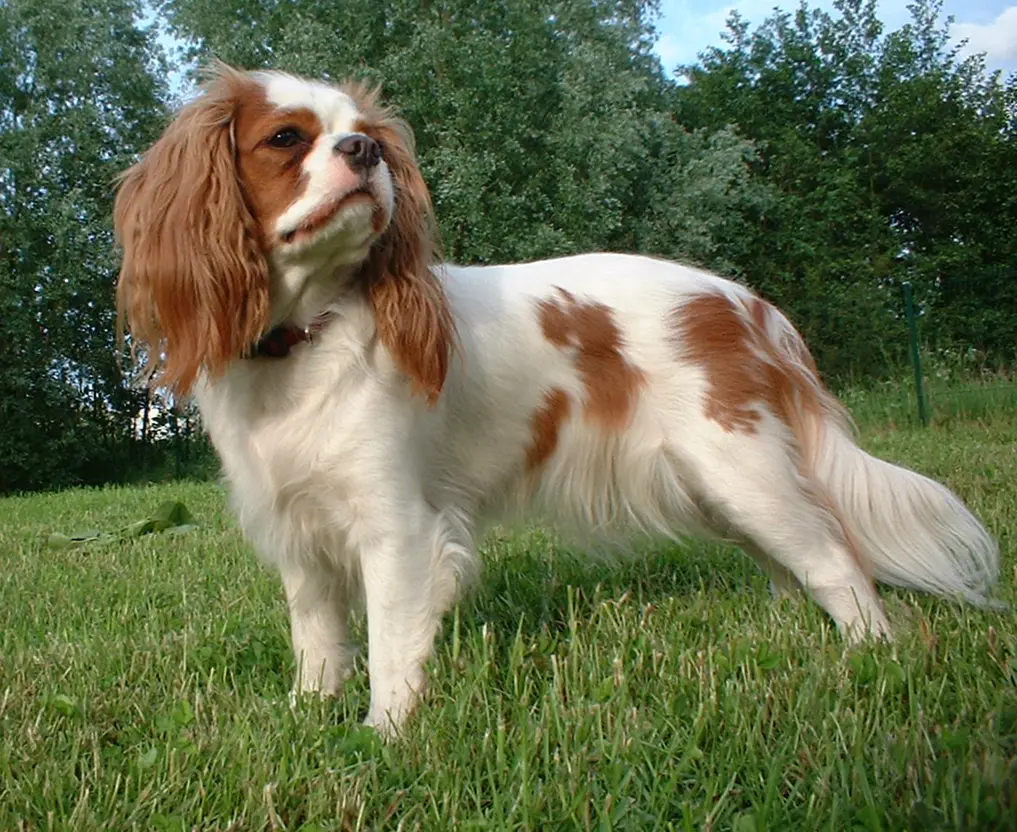
Sociable and gentle; playful outside, settles indoors.
Adult weight
5.4–8 kg
12–18 lb
Lifespan
11.8 yrs
Handler demand
Suits a first-time owner
Class · Lap dog
also Companion, Family

What it's like

In temperament the Cavalier is affectionate, gentle and sociable, keen to stay close to its people and seldom shy or aggressive. It is lively and playful outdoors yet settles readily indoors, and is generally friendly towards strangers.

Owners who rated their dogs' everyday behaviour found Cavaliers about average on independence and on friendliness with other dogs. Breed is only a small part of any one dog's personality, so meet the dog before you decide.
Day to day
Activity
Happy with modest walks
Intelligence
Learns readily, likes games
Handler demand
Suits a first-time owner
With people
Affection
A lap or leaning dog
Loyalty
Friendly with everyone
Independence
Keen to work with you
Around the home
Sensitivity
Needs a calm, predictable home
Voice
Quiet
Prey drive
Usually fine with small pets
Breed explains only about 9% of how individual dogs differ in behaviour1. Meet the dog. A good breeder breeds for temperament as well as health, and matches each puppy's personality to the right home2,3.
Is a Cavalier King Charles Spaniel right for you?
Take the breed matcher

Living with one

Heat is a real risk, so on hot days keep its exercise to the cool of the morning or evening.

Size and growth

A Cavalier King Charles Spaniel is a small dog, heavier than a Jack Russell and lighter than a Pug.

It is a graceful small dog with an almost flat skull, long, high-set, feathered ears, a short tapering muzzle and large, dark, round eyes. Its long, silky coat is feathered on the legs, chest and feet, and comes in Blenheim (rich chestnut on white), tricolour, black and tan, and ruby. Blenheim is named after the palace of the Dukes of Marlborough, whose family kept red and white spaniels. In that colour, a chestnut spot on the crown of the head is prized.

Puppy growth

Reference curve · community data appears as owners log
By about 3 months, a male Cavalier King Charles Spaniel puppy is already as heavy as a grown Chihuahua. They grow fastest between 3 and 4 months old.
Fully grown
10 mo
Both sexes, at 99% of adult weight8
Male
Female
Shaded: expected range
024682m4m6m9m12m18m
024682m3m4m6m9m12m18m
Age
Male
Female
2 months
1.6–2.4 kg 3.5–5.3 lb
1.7–2.6 kg 3.7–5.7 lb
3 months
2.2–3.2 kg 4.9–7.1 lb
2.2–3.3 kg 4.9–7.3 lb
4 months
2.9–4.4 kg 6.4–9.7 lb
3.0–4.4 kg 6.6–9.7 lb
5 months
3.5–5.2 kg 7.7–11.5 lb
6 months
4.0–5.9 kg 8.8–13.0 lb
3.9–5.8 kg 8.6–12.8 lb
7 months
4.3–6.4 kg 9.5–14.1 lb
4.3–6.3 kg 9.5–13.9 lb
8 months
4.6–6.8 kg 10.1–15.0 lb
4.5–6.7 kg 9.9–14.8 lb
9 months
4.8–7.1 kg 10.6–15.7 lb
4.7–6.9 kg 10.4–15.2 lb
10 months
4.9–7.3 kg 10.8–16.1 lb
4.8–7.1 kg 10.6–15.7 lb
11 months
5.0–7.4 kg 11.0–16.3 lb
4.9–7.3 kg 10.8–16.1 lb
12 months
5.1–7.6 kg 11.2–16.8 lb
5.0–7.4 kg 11.0–16.3 lb
15 months
5.3–7.8 kg 11.7–17.2 lb
5.2–7.7 kg 11.5–17.0 lb

Health and lifespan

Vets record these more often in Cavaliers than in crossbreeds. Dry eye is far more likely; corneal ulcers and skin fold inflammation are much more likely; balance disorder and gum disease are more likely. All five are rated moderate. These are figures for the breed as a whole, not a prediction for your dog.
Listed by likelihood level, highest first, then by how serious it is, then by name. These are the first 5 of 6 measured.
  • Dry eye
    Far more likely
    Impact: moderate
  • Corneal ulcers
    Much more likely
    Impact: moderate
  • Skin fold inflammation
    Much more likely
    Impact: moderate
  • Balance disorder
    More likely
    Impact: moderate
  • Gum disease
    More likely
    Impact: moderate

For your vet

Many Cavaliers inherit fewer but larger platelets without any bleeding problem, and clinic machines can read the count lower still. Mention it before bloodwork, as this has been mistaken for illness.

Flat face and breathing

The Cavalier King Charles Spaniel is one of the flat-faced breeds. In UK vet records, flat-faced dogs were more likely to have breathing and airway problems than dogs with a medium-length muzzle, and lived shorter lives on average. Noisy breathing at rest is worth raising with a vet.

Lifespan

In UK vet records, the typical Cavalier King Charles Spaniel lived to about 12 years, shorter than the typical small breed. Flat-faced breeds as a group live shorter lives than breeds with a longer muzzle.

Where it comes from

The Cavalier King Charles Spaniel revives the long-faced toy spaniels of Charles II's court, a type mid-19th-century show fashion for flat faces and domed skulls had nearly wiped out. From 1926 the American Roswell Eldridge offered prizes at Crufts for spaniels resembling the old paintings, and in 1928 a club wrote its standard around the dog Ann's Son. Separate registration with the Kennel Club followed in 194518.

The Cavalier King Charles Spaniel takes the first word of its name from the Royalist supporters of Charles I and Charles II. It is a separate breed from the King Charles Spaniel, the flat-faced breed whose stock it was recreated from. The breed stayed rare through the Second World War, but its following grew steadily afterwards, and the American Kennel Club recognised it in the nineteen-nineties. The Cavalier was bred as a companion, though some still show a spaniel's interest in chasing birds.

Breed standard

The Cavalier King Charles Spaniel is judged against standard no. 136, in group 9, Companion and Toy Dogs4.

Questions people ask

General guidance for dogs rather than a measured Cavalier King Charles Spaniel figure: most females have a first season somewhere between six and fifteen months, and cycles then settle to roughly every 180 days. Smaller breeds tend to start earlier and larger ones later, so a small breed is most likely at the early end.
Track your own Cavalier King Charles Spaniel
Log a minute a day and watch them sit on these curves. Free.

Sources

Something wrong on this page?
Parts of this page were written by AI ·