Chesapeake Bay Retriever
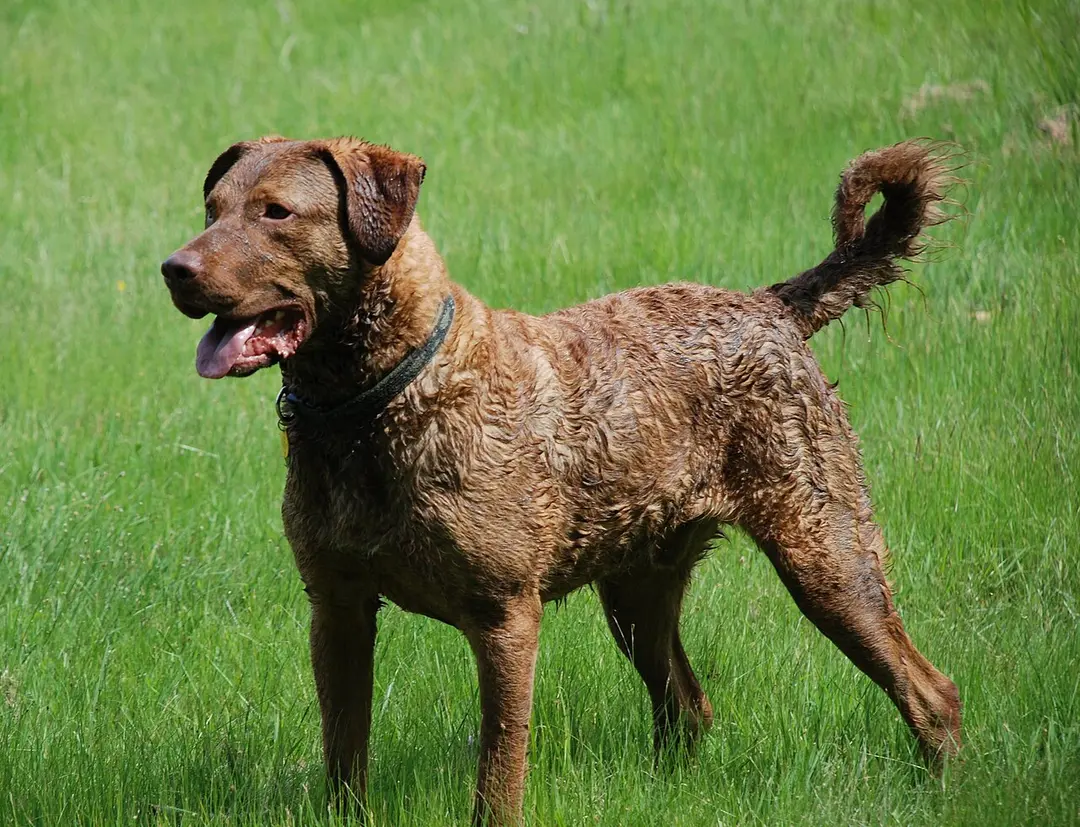
Affectionate and water-loving; often protective.
Adult male
29.5–36.5 kg
65–80 lb
Adult female
25–32 kg
55–71 lb
Lifespan
11.6 yrs
Class · Field
also Sport, Watchdog

What it's like

Chesapeakes are affectionate and bright with their own people but are often reserved with strangers, and many are more protective than is typical of retrievers. They are sensitive and also strong-willed, and they respond poorly to harsh handling. The breed keeps a strong working drive and a marked love of water.

Day to day
Activity
Needs lots of exercise
Intelligence
Needs daily brain work
Handler demand
Needs an experienced owner
With people
Affection
Affectionate on its own terms
Loyalty
Sticks close to its people
Independence
Cooperative, with its own ideas
Around the home
Sensitivity
Hardy, takes a busy home in its stride
Voice
Barks to alert, then settles
Prey drive
Chases; needs managing
Breed explains only about 9% of how individual dogs differ in behaviour1. Meet the dog. A good breeder breeds for temperament as well as health, and matches each puppy's personality to the right home2,3.
Is a Chesapeake Bay Retriever right for you?
Take the breed matcher

Living with one

It has a short coat. Most of the shedding comes when the seasons change. Plan on a brush once a week, plus daily brushing through the seasonal moult. It needs plenty of exercise compared with other breeds.

Size and growth

A Chesapeake Bay Retriever is a large dog, about the weight of a grown Labrador. Males end up clearly heavier than females.

It is a powerfully built dog with a broad skull and a deep chest, and its hindquarters stand as high as the shoulders or slightly higher. The eyes are a clear yellowish or amber. The coat sets the breed apart from other retrievers: a short, harsh, wavy outer layer lies over a dense, woolly undercoat, and its natural oil sheds water quickly. Colours run through shades of brown, sedge and deadgrass, a dull straw tone that blends into marsh grasses.

Puppy growth

Reference curve · community data appears as owners log
By about 5 months, a male Chesapeake Bay Retriever puppy is already as heavy as a grown Border Collie. They grow fastest between 3 and 4 months old. Most males grow into the size large-breed puppy foods are made for.
Fully grown
12 mo
Both sexes, at 99% of adult weight7
Male
Female
Shaded: expected range
0102030402m4m6m9m12m18m
0102030402m3m4m6m9m12m18m
Age
Male
Female
2 months
6.2–7.7 kg 13.7–17.0 lb
6.0–7.7 kg 13.2–17.0 lb
3 months
9.3–11.5 kg 20.5–25.4 lb
8.5–10.9 kg 18.7–24.0 lb
4 months
13.8–17.1 kg 30.4–37.7 lb
12.2–15.6 kg 26.9–34.4 lb
5 months
17.7–21.9 kg 39.0–48.3 lb
15.4–19.7 kg 34.0–43.4 lb
6 months
21.1–26.1 kg 46.5–57.5 lb
18.1–23.1 kg 39.9–50.9 lb
7 months
23.8–29.5 kg 52.5–65.0 lb
20.0–25.6 kg 44.1–56.4 lb
8 months
25.8–31.9 kg 56.9–70.3 lb
21.4–27.4 kg 47.2–60.4 lb
9 months
27.1–33.5 kg 59.7–73.9 lb
22.4–28.6 kg 49.4–63.1 lb
10 months
27.9–34.6 kg 61.5–76.3 lb
23.1–29.5 kg 50.9–65.0 lb
11 months
28.4–35.1 kg 62.6–77.4 lb
23.6–30.2 kg 52.0–66.6 lb
12 months
28.7–35.6 kg 63.3–78.5 lb
23.9–30.6 kg 52.7–67.5 lb
15 months
29.2–36.1 kg 64.4–79.6 lb
24.7–31.6 kg 54.5–69.7 lb

Lifespan

In UK vet records, the typical Chesapeake Bay Retriever lived to about 11 and a half years, about average for a large breed. Too few had died yet to pin the figure down, so it may turn out higher.

Where it comes from

The Chesapeake Bay Retriever took shape in the 19th century among duck-club owners on the Chesapeake Bay, whose winter water sits near freezing. The American Chesapeake Club traces it to Sailor and Canton, two Newfoundland pups saved from a sinking English brig in 1807, though no mating of the pair is recorded; Irish Water Spaniels and hounds are thought to have gone into the mix9,10.

The Chesapeake Bay Retriever was developed by Maryland wildfowlers and market hunters. They needed a dog that could retrieve ducks from rough, icy water for long days in the field. Over the nineteenth century, local strains around the bay were blended into a recognisable type. The American Kennel Club recognised the breed in the late nineteenth century, and Maryland later made it the official state dog.

Breed standard

The Chesapeake Bay Retriever is judged against standard no. 263, in group 8, Retrievers, Flushing Dogs and Water Dogs4.

Questions people ask

General guidance for dogs rather than a measured Chesapeake Bay Retriever figure: most females have a first season somewhere between six and fifteen months, and cycles then settle to roughly every 180 days. Smaller breeds tend to start earlier and larger ones later, so a large breed is most likely at the later end.
Track your own Chesapeake Bay Retriever
Log a minute a day and watch them sit on these curves. Free.

Sources

Something wrong on this page?
Parts of this page were written by AI ·