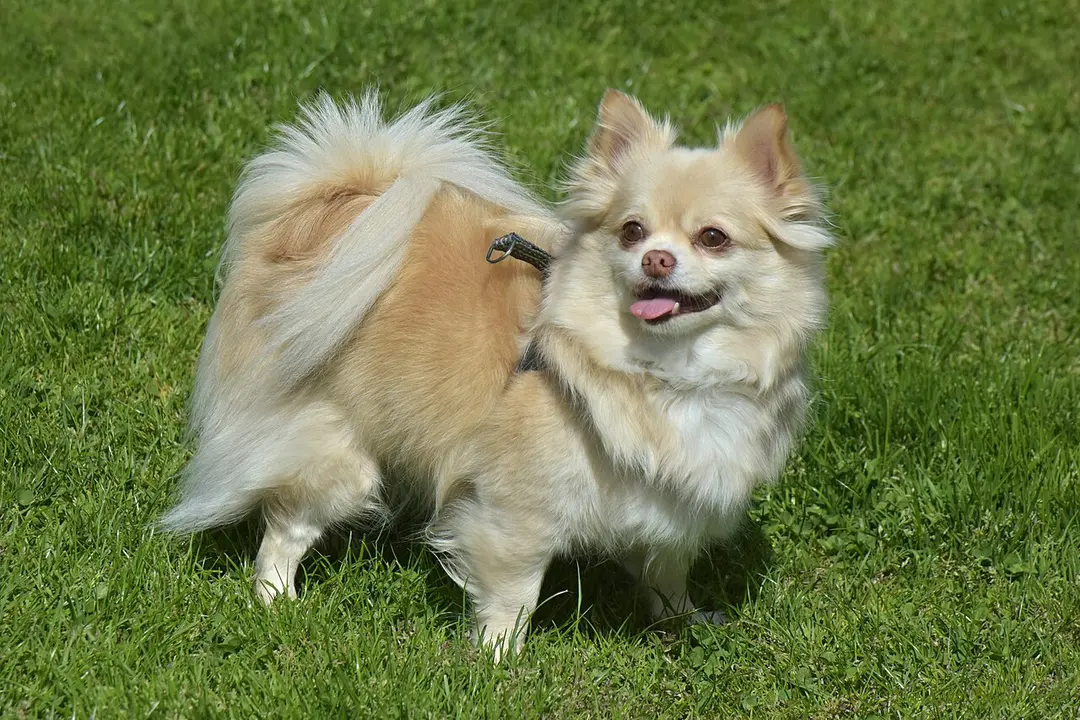
Chihuahua

Bold and quick to bark; often attached to one person.
Adult weight
1–3 kg
2.2–6.6 lb
Lifespan
11.8 yrs
Class · Lap dog
also Companion

What it's like

The Chihuahua is alert and bold, and quick to bark at unfamiliar sounds or people. It tends to attach itself closely to one person, is often reserved with strangers, and carries itself with a confidence out of proportion to its size.

Owners who rated their dogs' everyday behaviour found Chihuahuas more independent-minded than most, and less often among the friendliest with people or with other dogs. On calmness, they were about average. Breed is only a small part of any one dog's personality, so meet the dog before you decide.
Day to day
Activity
Happy with modest walks
Intelligence
Learns readily, likes games
Handler demand
Needs steady training
With people
Affection
A lap or leaning dog
Loyalty
Sticks close to its people
Independence
Decides for itself
Around the home
Sensitivity
Needs a calm, predictable home
Voice
Very vocal
Prey drive
Usually fine with small pets
Breed explains only about 9% of how individual dogs differ in behaviour1. Meet the dog. A good breeder breeds for temperament as well as health, and matches each puppy's personality to the right home2,3.
Is a Chihuahua right for you?
Take the breed matcher

Living with one

Bred for company, a Chihuahua needs a modest amount of exercise, and owners say it seeks constant activity less often than most. The coat can be short or long, and sheds through the year rather than in seasonal moults.

Size and growth

A Chihuahua is a toy dog, lighter even than a Yorkshire Terrier. It is one of the lightest toy breeds.

It is a very small, compact dog with a rounded, apple-shaped skull, a short pointed muzzle, large upright ears and full, round eyes. The smooth coat is short, close and glossy. The long coat is soft and flat or slightly wavy, with fringed ears, a ruff at the neck and a plumed tail. Almost any colour or pattern is accepted. In Britain the Kennel Club registers the two coat types as separate breeds.

Puppy growth

Reference curve · community data appears as owners log
Chihuahuas reach half their adult weight at about 4 months. They grow fastest between 3 and 4 months old.
Fully grown
10 mo
Both sexes, at 99% of adult weight8
Male
Female
Shaded: expected range
01232m4m6m9m12m18m
01232m3m4m6m9m12m18m
Age
Male
Female
2 months
0.3–1.0 kg 0.7–2.2 lb
0.4–1.1 kg 0.9–2.4 lb
3 months
0.4–1.2 kg 0.9–2.6 lb
0.4–1.3 kg 0.9–2.9 lb
4 months
0.5–1.6 kg 1.1–3.5 lb
0.6–1.7 kg 1.3–3.7 lb
5 months
0.6–1.9 kg 1.3–4.2 lb
6 months
0.7–2.1 kg 1.5–4.6 lb
7 months
0.8–2.3 kg 1.8–5.1 lb
8 months
0.8–2.4 kg 1.8–5.3 lb
9 months
0.8–2.5 kg 1.8–5.5 lb
10 months
0.9–2.6 kg 2.0–5.7 lb
11 months
0.9–2.7 kg 2.0–6.0 lb
0.9–2.6 kg 2.0–5.7 lb
12 months
0.9–2.7 kg 2.0–6.0 lb
15 months
1.0–2.9 kg 2.2–6.4 lb
0.9–2.8 kg 2.0–6.2 lb
18 months
1–3 kg 2.2–6.6 lb
1.0–2.9 kg 2.2–6.4 lb

Health and lifespan

Vets record these more often in Chihuahuas than in crossbreeds, and all are rated moderate. A kneecap slipping out of place is much more likely; corneal ulcers, dry eye and gum disease are more likely, and cherry eye slightly more likely. These are figures for the breed as a whole, not a prediction for your dog.
Listed by likelihood level, highest first, then by how serious it is, then by name.
  • Kneecap slipping out of place
    Much more likely
    Impact: moderate
  • Corneal ulcers
    More likely
    Impact: moderate
  • Dry eye
    More likely
    Impact: moderate
  • Gum disease
    More likely
    Impact: moderate
  • Cherry eye
    Slightly more likely
    Impact: moderate

Flat face and breathing

The Chihuahua is one of the flat-faced breeds. In UK vet records, flat-faced dogs were more likely to have breathing and airway problems than dogs with a medium-length muzzle, and lived shorter lives on average. Noisy breathing at rest is worth raising with a vet.

Lifespan

In UK vet records, the typical Chihuahua lived to about 12 years, shorter than the typical toy breed. Flat-faced breeds as a group live shorter lives than breeds with a longer muzzle.

Where it comes from

The Chihuahua is named after Mexico's largest state, and its FCI standard assumes its forebears were wild dogs that people of the Toltec era caught and tamed. Statues of a small dog called the Techichi, used to decorate buildings at Tula, look much like it. In the United States the AKC recognised it in 1904, and the bandleader Xavier Cugat made it fashionable in the 1940s and 1950s4,17.

The Chihuahua's recorded history begins in the mid-nineteenth century, when small dogs were found in and around the Mexican state that gave the breed its name, and American visitors and dealers began buying them near the border. Breeders in the United States then settled the type. The long-coated variety is thought to owe something to crosses with other toy breeds, though the details were not recorded. No working role is documented for the breed, which has been kept as a companion throughout its known history.

Breed standard

Kennel clubs do not all register this breed the same way.

Questions people ask

General guidance for dogs rather than a measured Chihuahua figure: most females have a first season somewhere between six and fifteen months, and cycles then settle to roughly every 180 days. Smaller breeds tend to start earlier and larger ones later, so a toy breed is most likely at the early end.
Track your own Chihuahua
Log a minute a day and watch them sit on these curves. Free.

Sources

Something wrong on this page?
Parts of this page were written by AI ·