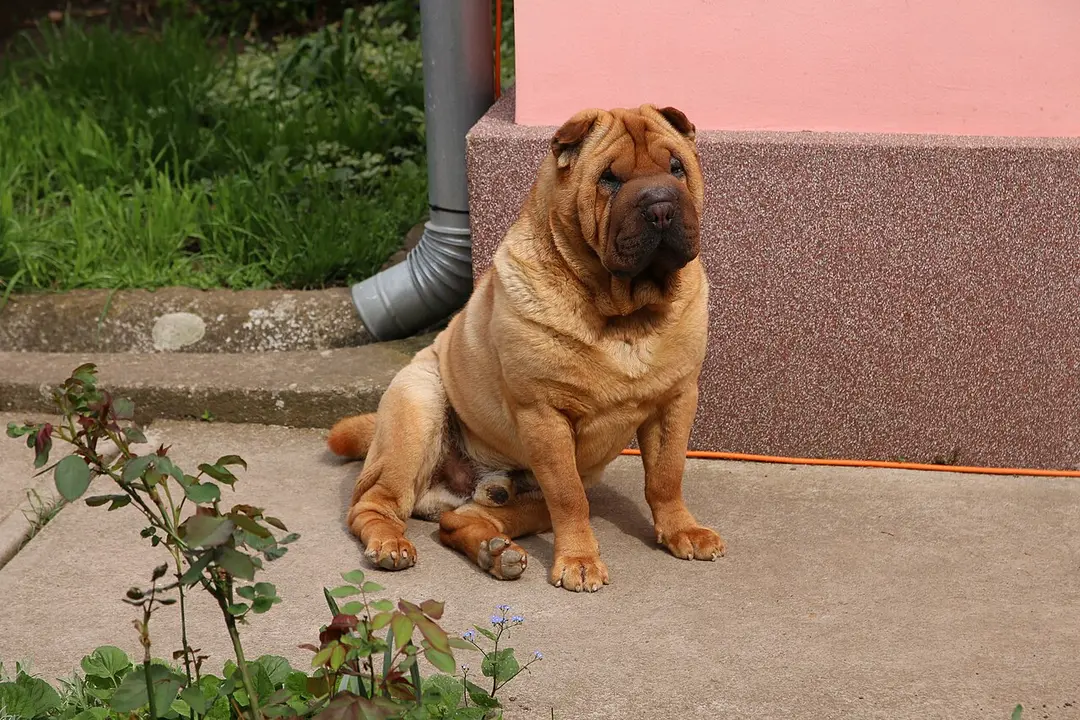
Chinese Shar-Pei

Generally quiet indoors; aloof with strangers.
Adult weight
20–27 kg
45–60 lb
Lifespan
10.6 yrs
Class · Watchdog
also Companion

What it's like

The Shar-Pei is calm and self-possessed. It is devoted to its own family and reserved, often aloof, with strangers. It has a strong guarding instinct and an independent mind, and is generally quiet in the house.

Day to day
Activity
Happy with modest walks
Intelligence
Learns readily, likes games
Handler demand
Needs an experienced owner
With people
Affection
Likes its own space
Loyalty
Sticks close to its people
Independence
Decides for itself
Around the home
Sensitivity
Average
Voice
Quiet
Prey drive
Chases; needs managing
Breed explains only about 9% of how individual dogs differ in behaviour1. Meet the dog. A good breeder breeds for temperament as well as health, and matches each puppy's personality to the right home2,3.
Is a Chinese Shar-Pei right for you?
Take the breed matcher

Living with one

A Shar-Pei's folds come from a substance built up in the skin, driven by extra activity of one gene. Adults generally show fewer folds than puppies, though how much varies from dog to dog. It needs a moderate amount of exercise compared with other breeds.

Size and growth

A Chinese Shar-Pei is a medium dog, heavier than a Border Collie and lighter than a Golden Retriever.

Its name is usually translated as ‘sand skin’, after the short, harsh coat, which feels rough when stroked against the grain. Two coat lengths are recognised: the very short horse coat and the slightly longer brush coat. The dog is compact and square. It has a broad head often likened to a hippopotamus's, a padded muzzle, small triangular ears set close to the skull and a thick, high-set tail carried in a curve or curl. Like the Chow Chow, it usually has a blue-black tongue.

Puppy growth

Reference curve · community data appears as owners log
By about 5 months, a male Chinese Shar-Pei puppy is already as heavy as a grown Staffordshire Bull Terrier. They grow fastest between 3 and 4 months old.
Fully grown
11 mo
Both sexes, at 99% of adult weight8
Male
Female
Shaded: expected range
01020302m4m6m9m12m18m
01020302m3m4m6m9m12m18m
Age
Male
Female
2 months
4.4–5.9 kg 9.7–13.0 lb
4.9–6.5 kg 10.8–14.3 lb
3 months
6.5–8.7 kg 14.3–19.2 lb
7.0–9.3 kg 15.4–20.5 lb
4 months
9.5–12.6 kg 20.9–27.8 lb
9.9–13.2 kg 21.8–29.1 lb
5 months
12.2–16.3 kg 26.9–35.9 lb
12.6–16.8 kg 27.8–37.0 lb
6 months
14.6–19.4 kg 32.2–42.8 lb
14.7–19.6 kg 32.4–43.2 lb
7 months
16.3–21.8 kg 35.9–48.1 lb
8 months
17.6–23.5 kg 38.8–51.8 lb
17.4–23.3 kg 38.4–51.4 lb
9 months
18.5–24.6 kg 40.8–54.2 lb
18.3–24.3 kg 40.3–53.6 lb
10 months
19.1–25.4 kg 42.1–56.0 lb
18.8–25.1 kg 41.4–55.3 lb
11 months
19.5–26.0 kg 43.0–57.3 lb
19.2–25.6 kg 42.3–56.4 lb
12 months
19.8–26.4 kg 43.7–58.2 lb
19.5–26.0 kg 43.0–57.3 lb
15 months
20.3–27.0 kg 44.8–59.5 lb
20.1–26.8 kg 44.3–59.1 lb

Health and lifespan

Vets record these more often in Shar-Peis than in crossbreeds, and none is rated serious. An inward-rolling eyelid (moderate) and an outward-drooping eyelid (minor) are far more likely. Skin fold inflammation (moderate) and demodectic mange in dogs under two (minor) are much more likely, and cherry eye (moderate) more likely. These are figures for the breed as a whole, not a prediction for your dog.
Listed by likelihood level, highest first, then by how serious it is, then by name. These are 5 of 12 measured; lab-confirmed figures only fill places the vet-record studies leave empty.
  • Inward-rolling eyelid
    Far more likely
    Impact: moderate
  • Outward-drooping eyelid
    Far more likely
    Impact: minor
  • Skin fold inflammation
    Much more likely
    Impact: moderate
  • Demodectic mange starting young, dogs under 2
    Much more likely
    Impact: minor
  • Cherry eye
    More likely
    Impact: moderate

Lifespan

In UK vet records, the typical Chinese Shar-Pei lived to about 10 and a half years, shorter than the typical medium breed.

Where it comes from

The Chinese Shar-Pei comes from the provinces along the South China Sea, probably from the town of Dialak in Kwun Tung. It was bred to hunt and to fight, and its loose, wrinkled skin kept an opponent from getting a firm grip. Mass culls of dogs under Communist rule brought it close to extinction; since its revival, breeders have worked to reduce excessive wrinkling and eye trouble5,15.

The Chinese Shar-Pei owes its survival largely to Hong Kong, where some dogs remained after numbers fell sharply on the mainland. In the early nineteen-seventies a Hong Kong breeder, Matgo Law, appealed through an American dog magazine for help in saving the breed. The dogs exported in response became the foundation of much of the breed's stock in the West. Besides hunting and, reportedly, fighting, the Shar-Pei had long served on farms in southern China, guarding homes and livestock.

Breed standard

The Chinese Shar-Pei is judged against standard no. 309, in group 2, Pinscher and Schnauzer, Molossoid and Swiss Mountain Dogs5.

Questions people ask

General guidance for dogs rather than a measured Chinese Shar-Pei figure: most females have a first season somewhere between six and fifteen months, and cycles then settle to roughly every 180 days. Smaller breeds tend to start earlier and larger ones later, so a medium-sized breed is most likely somewhere in the middle.
Track your own Chinese Shar-Pei
Log a minute a day and watch them sit on these curves. Free.

Sources

Something wrong on this page?
Parts of this page were written by AI ·