Curly-Coated Retriever
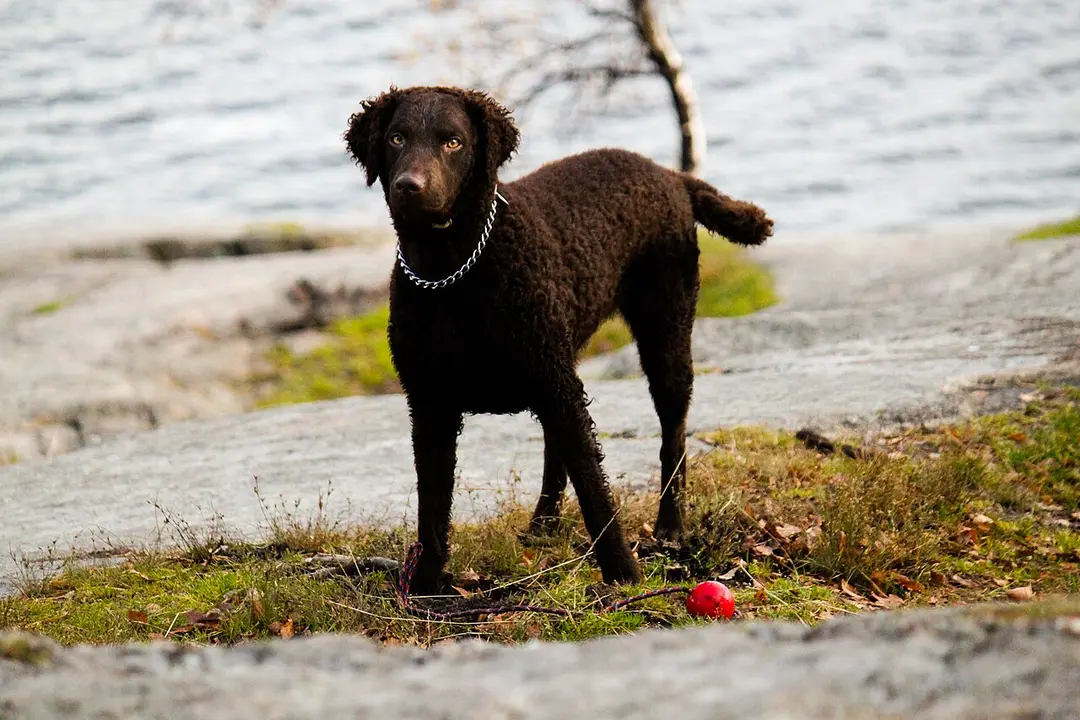
Independent and slow to mature; playful into adulthood.
Adult male
29–41 kg
64–90 lb
Adult female
27–36 kg
60–79 lb
Lifespan
12.2 yrs
Class · Field
also Sport, Family

What it's like

In temperament it is confident and intelligent, and is often described as more independent and reserved than the Labrador. It can be aloof with strangers while affectionate with its own people. It tends to mature slowly and keeps a playful streak well into adulthood.

Day to day
Activity
Needs lots of exercise
Intelligence
Learns readily, likes games
Handler demand
Needs steady training
With people
Affection
Likes its own space
Loyalty
Bonded to its family
Independence
Cooperative, with its own ideas
Around the home
Sensitivity
Average
Voice
Quiet
Prey drive
Chases; needs managing
Breed explains only about 9% of how individual dogs differ in behaviour1. Meet the dog. A good breeder breeds for temperament as well as health, and matches each puppy's personality to the right home2,3.
Is a Curly-Coated Retriever right for you?
Take the breed matcher

Living with one

It has a curly coat. Loose hair stays caught in the coat until it is brushed, stripped or clipped out. Plan on brushing a few times a week, plus clipping every 6–8 weeks. It needs plenty of exercise compared with other breeds.

Size and growth

A Curly-Coated Retriever is a large dog, about the weight of a grown Labrador. Males end up a little heavier than females.

The body is covered in a dense mass of small, crisp curls lying close to the skin, while the forehead, face and fronts of the legs carry short, smooth hair. Unlike the Poodle, it has no topknot. The coat is solid black or liver.

Puppy growth

Reference curve · community data appears as owners log
By about 5 months, a male Curly-Coated Retriever puppy is already as heavy as a grown Border Collie. They grow fastest between 3 and 4 months old. Most males grow into the size large-breed puppy foods are made for.
Fully grown
12 mo
Both sexes, at 99% of adult weight9
Male
Female
Shaded: expected range
02040602m4m6m9m12m18m
02040602m3m4m6m9m12m18m
Age
Male
Female
2 months
6.1–8.6 kg 13.4–19.0 lb
6.2–8.3 kg 13.7–18.3 lb
3 months
9.2–13.0 kg 20.3–28.7 lb
9.0–12.0 kg 19.8–26.5 lb
4 months
13.6–19.2 kg 30.0–42.3 lb
13.0–17.4 kg 28.7–38.4 lb
5 months
17.4–24.6 kg 38.4–54.2 lb
16.6–22.1 kg 36.6–48.7 lb
6 months
20.7–29.3 kg 45.6–64.6 lb
19.5–26.0 kg 43.0–57.3 lb
7 months
23.4–33.1 kg 51.6–73.0 lb
21.6–28.8 kg 47.6–63.5 lb
8 months
25.3–35.8 kg 55.8–78.9 lb
23.1–30.7 kg 50.9–67.7 lb
9 months
26.7–37.7 kg 58.9–83.1 lb
24.2–32.2 kg 53.4–71.0 lb
10 months
27.5–38.8 kg 60.6–85.5 lb
24.9–33.2 kg 54.9–73.2 lb
11 months
27.9–39.5 kg 61.5–87.1 lb
25.5–33.9 kg 56.2–74.7 lb
12 months
28.2–39.9 kg 62.2–88.0 lb
25.9–34.5 kg 57.1–76.1 lb
15 months
28.7–40.5 kg 63.3–89.3 lb
26.6–35.5 kg 58.6–78.3 lb

Lifespan

In UK vet records, the typical Curly-Coated Retriever lived to about 12 years, about average for a large breed. The group was small, so treat the figure as rough.

Where it comes from

England produced the Curly-Coated Retriever in the 1800s to fetch ducks from water, and some claim it as the oldest of the retrievers. Its waterproof coat of tight curls is thought to come from the extinct English Water Spaniel, with Poodle crosses said to have tightened the curl, and by 1860 it was already drawing crowds at the earliest English shows11,12.

The Curly-Coated Retriever was a favourite of English gamekeepers in the nineteenth century, valued for its stamina, hardiness and willingness to enter cold water. Its fortunes declined from the late nineteenth century, as first the Flat-Coated Retriever and then the Labrador displaced it in the shooting field, and both world wars left it scarce. A small band of breeders kept it going, and it found steady support abroad, notably in New Zealand and Australia, where it has been worked on duck and quail. It was bred as an all-round shooting dog, retrieving on land and from water and pushing through thick cover. It is an upstanding, elegant dog, more leggy than most other retrievers.

Breed standard

The Curly-Coated Retriever is judged against standard no. 110, in group 8, Retrievers, Flushing Dogs and Water Dogs4.

Questions people ask

General guidance for dogs rather than a measured Curly-Coated Retriever figure: most females have a first season somewhere between six and fifteen months, and cycles then settle to roughly every 180 days. Smaller breeds tend to start earlier and larger ones later, so a large breed is most likely at the later end.
Track your own Curly-Coated Retriever
Log a minute a day and watch them sit on these curves. Free.

Sources

Something wrong on this page?
Parts of this page were written by AI ·