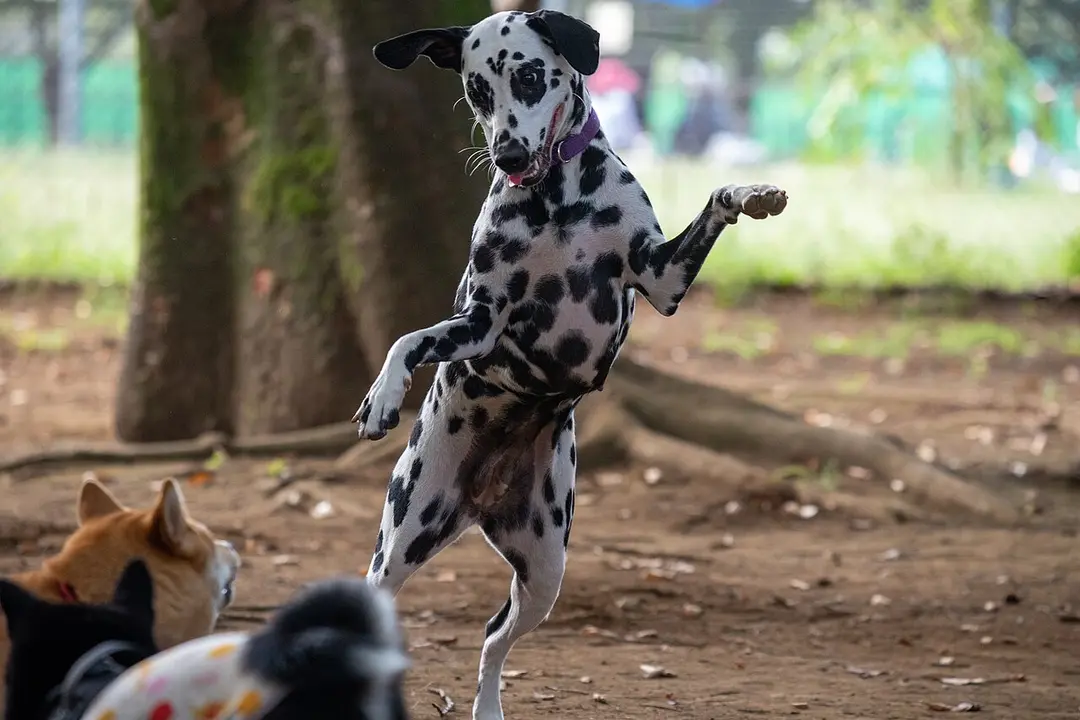
Dalmatian

Lively and playful at home, reserved with strangers.
Adult weight
20–32 kg
45–70 lb
Lifespan
13.2 yrs
Class · Sport
also Family

What it's like

In temperament the Dalmatian is lively, playful and outgoing with its own people, yet carries itself with a certain dignity and can be reserved with strangers. It is reputed to have an affinity for horses.

Day to day
Activity
Needs lots of exercise
Intelligence
Learns readily, likes games
Handler demand
Needs steady training
With people
Affection
Affectionate on its own terms
Loyalty
Sticks close to its people
Independence
Cooperative, with its own ideas
Around the home
Sensitivity
Average
Voice
Barks to alert, then settles
Prey drive
Chases; needs managing
Breed explains only about 9% of how individual dogs differ in behaviour1. Meet the dog. A good breeder breeds for temperament as well as health, and matches each puppy's personality to the right home2,3.
Is a Dalmatian right for you?
Take the breed matcher

Living with one

Bred to follow a scent for hours, it needs plenty of exercise.

Size and growth

A Dalmatian is a medium dog, heavier than a Border Collie and lighter than a Golden Retriever. It is one of the heaviest medium breeds. Its weight is an estimate, not a published figure.

It is a lean, muscular and well-balanced dog built for endurance rather than speed, with a deep chest, a long tail that tapers towards the tip, and fairly high-set ears carried close to the head. The short, hard, glossy coat is pure white with distinct, rounded spots of black or liver brown, and the nose and eye rims usually match the colour of the spots. Puppies are born white, and their spots develop later.

Two types

The two types differ in height only, so there is one growth curve, on the record's own band (estimated: the AKC breed page's 45-70 lb, one range for both sexes).

UK / FCI type

FCI 153
Height at the withers
Males
56–62 cm
Females
54–60 cm4
Publishes no weight.

American type

AKC standard
Height at the withers
Males
48.3–58.4 cm
Females
48.3–58.4 cm5
Publishes no weight.

Puppy growth

Reference curve · community data appears as owners log
By about 5 months, a male Dalmatian puppy is already as heavy as a grown Staffordshire Bull Terrier. They grow fastest between 3 and 4 months old.
Fully grown
11 mo
Both sexes, at 99% of adult weight7
Male
Female
Shaded: expected range
0102030402m4m6m9m12m18m
0102030402m3m4m6m9m12m18m
Age
Male
Female
2 months
4.4–6.9 kg 9.7–15.2 lb
4.9–7.6 kg 10.8–16.8 lb
3 months
6.5–10.2 kg 14.3–22.5 lb
7.0–10.8 kg 15.4–23.8 lb
4 months
9.5–14.8 kg 20.9–32.6 lb
9.9–15.5 kg 21.8–34.2 lb
5 months
12.2–19.0 kg 26.9–41.9 lb
12.6–19.6 kg 27.8–43.2 lb
6 months
14.6–22.7 kg 32.2–50.0 lb
14.7–23.0 kg 32.4–50.7 lb
7 months
16.3–25.5 kg 35.9–56.2 lb
16.3–25.4 kg 35.9–56.0 lb
8 months
17.6–27.4 kg 38.8–60.4 lb
17.4–27.2 kg 38.4–60.0 lb
9 months
18.5–28.8 kg 40.8–63.5 lb
18.3–28.5 kg 40.3–62.8 lb
10 months
19.1–29.7 kg 42.1–65.5 lb
18.8–29.4 kg 41.4–64.8 lb
11 months
19.5–30.4 kg 43.0–67.0 lb
19.2–30.0 kg 42.3–66.1 lb
12 months
19.8–30.8 kg 43.7–67.9 lb
19.5–30.4 kg 43.0–67.0 lb
15 months
20.3–31.6 kg 44.8–69.7 lb
20.1–31.4 kg 44.3–69.2 lb

Health and lifespan

In vet and lab records from the UK and the Canary Islands, the conditions below turn up more often in Dalmatians than in crossbreeds. None of them is rated serious. These are figures for the breed as a whole, not a prediction for your dog.
Listed by likelihood level, highest first, then by how serious it is, then by name.
  • Underactive thyroid
    More likely
    Impact: moderate
  • Button tumour
    Lab-confirmed cases
    More likely
    Impact: minor
Lab-confirmed: compares dogs whose tumour samples went to a lab with all dogs on the islands' identification register, so the figures run higher than vet-record ones.

For your vet

In one group tested, every Dalmatian carried two copies of a gene variant that gives the breed unusual urine chemistry: they pass uric acid where most dogs pass allantoin.

Lifespan

In UK vet records, the typical Dalmatian lived to about 13 years, about average for a medium breed.

Where it comes from

The Dalmatian's origin is disputed: the FCI points to Dalmatia, citing a Lošinj altar painting of the early 1600s and Croatian church chronicles of 1719 and 1737, while The Kennel Club finds little evidence for it. Its documented work was as a coach dog, running beside carriages and guarding passengers, cargo and, at night, the stables, and fire brigades sent it in front of horse-drawn engines to clear the road4,13.

The Dalmatian took its modern shape in England, where from the eighteenth century it became a fashionable sight beside the carriages of the well-to-do. British breeders fixed its type, and it appeared in the show ring from the later nineteenth century, with a breed club formed in England by the century's close. In the United States the link with fire brigades outlived the horse-drawn engine, and the spotted dog is still kept as a mascot in some firehouses. Its fame widened through Dodie Smith's children's novel and the Disney films that followed.

Breed standard

The American standard asks for a shorter dog than the UK and international ones.

Questions people ask

General guidance for dogs rather than a measured Dalmatian figure: most females have a first season somewhere between six and fifteen months, and cycles then settle to roughly every 180 days. Smaller breeds tend to start earlier and larger ones later, so a medium-sized breed is most likely somewhere in the middle.
Track your own Dalmatian
Log a minute a day and watch them sit on these curves. Free.

Sources

Something wrong on this page?
Parts of this page were written by AI ·