Dandie Dinmont Terrier
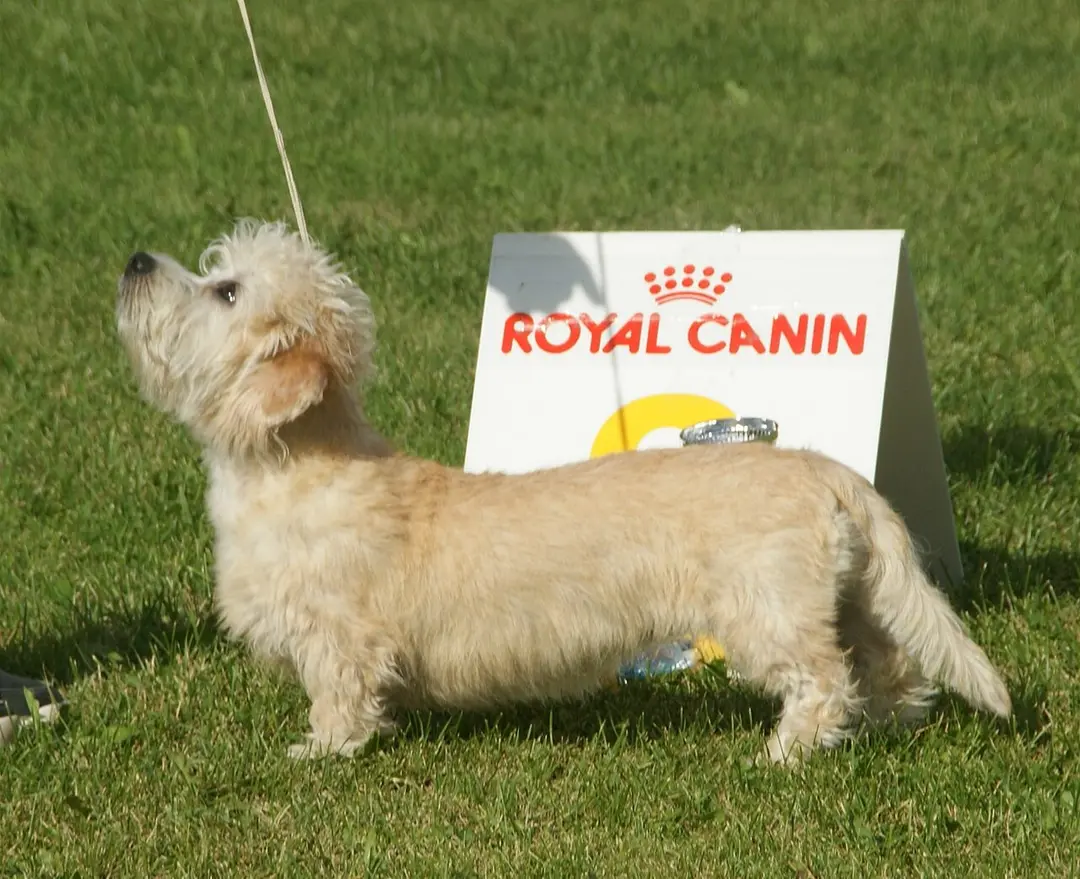
Calm at home, bold when roused, with a deep bark.
Adult weight
8.2–11 kg
18–24 lb
Lifespan
12.8 yrs
Class · Companion

What it's like

The Dandie Dinmont is calm and dignified at home but bold and determined when roused, with a deep bark. It is affectionate with its own family, often reserved with strangers, and independent enough to follow its own judgement.

Day to day
Activity
A good daily walk and play
Intelligence
Learns readily, likes games
Handler demand
Needs steady training
With people
Affection
Affectionate on its own terms
Loyalty
Bonded to its family
Independence
Decides for itself
Around the home
Sensitivity
Average
Voice
Barks to alert, then settles
Prey drive
Likely to chase small pets
Breed explains only about 9% of how individual dogs differ in behaviour1. Meet the dog. A good breeder breeds for temperament as well as health, and matches each puppy's personality to the right home2,3.
Is a Dandie Dinmont Terrier right for you?
Take the breed matcher

Living with one

It needs a moderate amount of exercise compared with other breeds.

Size and growth

A Dandie Dinmont Terrier is a small dog, about the weight of a grown Pug.

Built for work underground, it is long and low, with short, strong legs, the forelegs slightly shorter than the hind. The back dips behind the shoulders and then arches over the loin. The large, rounded head carries a silky topknot of pale hair, the ears hang close to the cheeks, and the tail curves like a scimitar. The coat mixes harder and softer hair to give a crisp texture. Pepper runs from dark bluish black to pale silvery grey, and Mustard from reddish brown to pale fawn.

Puppy growth

Reference curve · community data appears as owners log
By about 5 months, a male Dandie Dinmont Terrier puppy is already as heavy as a grown Jack Russell. They grow fastest between 3 and 4 months old.
Fully grown
10 mo
Both sexes, at 99% of adult weight6
Male
Female
Shaded: expected range
0510152m4m6m9m12m18m
0510152m3m4m6m9m12m18m
Age
Male
Female
2 months
2.1–2.8 kg 4.6–6.2 lb
2.3–3.1 kg 5.1–6.8 lb
3 months
2.8–3.8 kg 6.2–8.4 lb
3.0–4.0 kg 6.6–8.8 lb
4 months
4.0–5.3 kg 8.8–11.7 lb
4.0–5.4 kg 8.8–11.9 lb
5 months
4.9–6.6 kg 10.8–14.6 lb
4.9–6.5 kg 10.8–14.3 lb
6 months
5.7–7.6 kg 12.6–16.8 lb
5.5–7.3 kg 12.1–16.1 lb
7 months
6.3–8.3 kg 13.9–18.3 lb
6.0–8.0 kg 13.2–17.6 lb
8 months
6.7–8.9 kg 14.8–19.6 lb
6.4–8.6 kg 14.1–19.0 lb
9 months
7.0–9.4 kg 15.4–20.7 lb
6.8–9.0 kg 15.0–19.8 lb
10 months
7.3–9.7 kg 16.1–21.4 lb
7.0–9.3 kg 15.4–20.5 lb
11 months
7.5–9.9 kg 16.5–21.8 lb
7.2–9.6 kg 15.9–21.2 lb
12 months
7.6–10.1 kg 16.8–22.3 lb
7.4–9.9 kg 16.3–21.8 lb
15 months
7.9–10.6 kg 17.4–23.4 lb
7.8–10.4 kg 17.2–22.9 lb
18 months
8.2–11 kg 18–24 lb
8.1–10.8 kg 17.9–23.8 lb

Lifespan

In UK vet records, the typical Dandie Dinmont Terrier lived to about 13 years, shorter than the typical small breed. The group was small, so treat the figure as rough.

Where it comes from

The Dandie Dinmont Terrier comes from the Border country between Scotland and England, where it was bred to go to ground after otter and badger. Its name is that of a farmer in Walter Scott's 1815 novel Guy Mannering, whose terriers were all called Pepper or Mustard, still the names of its two colours. Whether Scott drew the character from one real farmer or from several is disputed8,9.

The Dandie Dinmont Terrier became widely known after Scott's novel Guy Mannering appeared, and during the nineteenth century it moved from the farm and the hunt towards the show ring. Its admirers founded a breed club in the eighteen-seventies, among the earliest for any breed, and the standard they drew up has changed relatively little since. Despite this long history the breed has remained uncommon, and the Kennel Club lists it as one of its vulnerable native breeds.

Breed standard

The Dandie Dinmont Terrier is judged against standard no. 168, in group 3, Terriers10.

Questions people ask

General guidance for dogs rather than a measured Dandie Dinmont Terrier figure: most females have a first season somewhere between six and fifteen months, and cycles then settle to roughly every 180 days. Smaller breeds tend to start earlier and larger ones later, so a small breed is most likely at the early end.
Track your own Dandie Dinmont Terrier
Log a minute a day and watch them sit on these curves. Free.

Sources

Something wrong on this page?
Parts of this page were written by AI ·