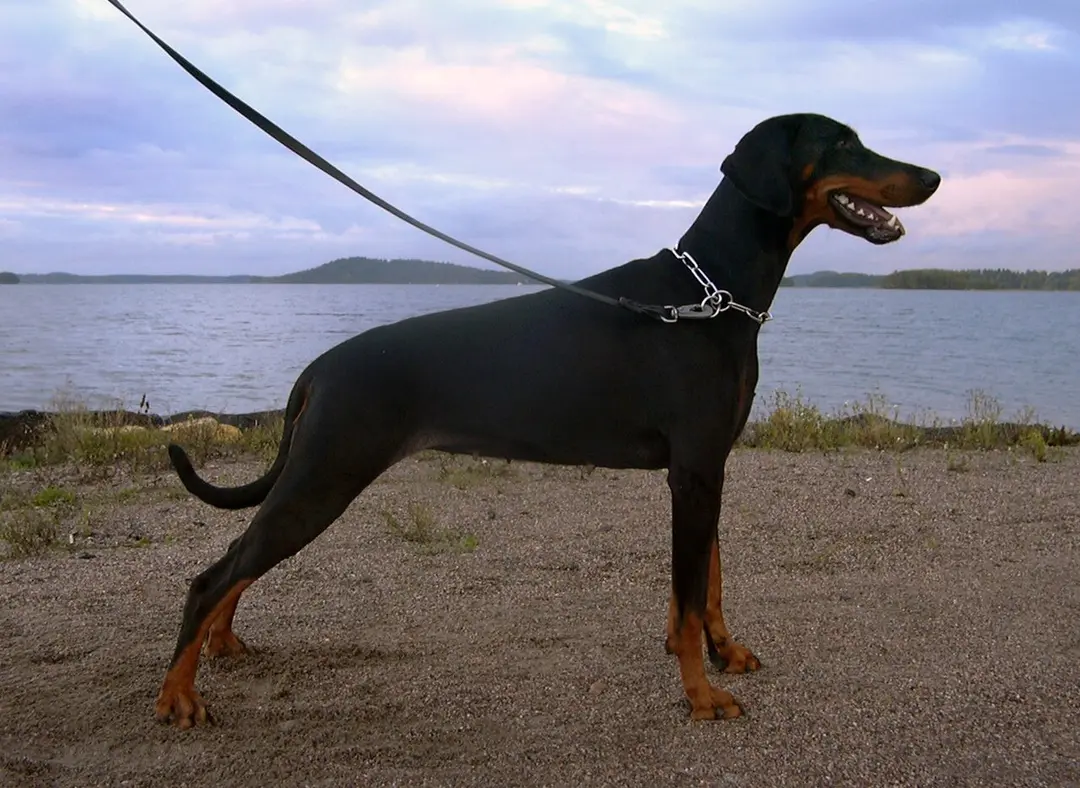
Doberman Pinscher

Alert and quick to learn, attached to its own household.
Adult male
40–45 kg
88–99 lb
Adult female
32–35 kg
71–77 lb
Lifespan
11.2 yrs
Class · Watchdog
also Sport, Companion

What it's like

Tail docking, once standard, is now banned in Britain, as ear cropping long has been, so dogs born here keep natural drop ears and a full tail. In temperament the Doberman is alert, energetic and quick to learn, closely attached to its household and typically reserved with strangers. Modern breeding is generally held to have softened the hard edge of early lines.

Owners who rated their dogs' everyday behaviour found Dobermans close to the typical dog on independence, calmness, and friendliness with people and with other dogs. Breed is only a small part of any one dog's personality, so meet the dog before you decide.
Day to day
Activity
Needs lots of exercise
Intelligence
Needs daily brain work
Handler demand
Needs an experienced owner
With people
Affection
A lap or leaning dog
Loyalty
Sticks close to its people
Independence
Keen to work with you
Around the home
Sensitivity
Needs a calm, predictable home
Voice
Barks to alert, then settles
Prey drive
Chases; needs managing
Breed explains only about 9% of how individual dogs differ in behaviour1. Meet the dog. A good breeder breeds for temperament as well as health, and matches each puppy's personality to the right home2,3.
Is a Doberman Pinscher right for you?
Take the breed matcher

Living with one

Owners say their Dobermans seek constant activity more often than most, so plan for plenty of exercise. The short coat sheds through the year and needs a weekly brush.

Size and growth

A Doberman Pinscher is a medium dog, about the weight of a grown German Shepherd. Males end up clearly heavier than females. It is one of the heaviest medium breeds.

It is a compact, square-built dog with a deep chest, a long wedge-shaped head and a smooth, close coat, usually black or brown with crisp rust markings on the muzzle, chest and legs.

Puppy growth

Reference curve · community data appears as owners log
Doberman Pinschers reach half their adult weight at about 5 months. They grow fastest between 4 and 5 months old. They keep growing past their first birthday, longer than a Beagle does. Most males grow into the size large-breed puppy foods are made for.
Fully grown
13 mo
Both sexes, at 99% of adult weight5
Male
Female
Shaded: expected range
02040602m4m6m9m12m18m
02040602m3m4m6m9m12m18m
Age
Male
Female
2 months
7.0–7.8 kg 15.4–17.2 lb
7.4–8.1 kg 16.3–17.9 lb
3 months
11.2–12.6 kg 24.7–27.8 lb
10.6–11.6 kg 23.4–25.6 lb
4 months
16.6–18.7 kg 36.6–41.2 lb
15.4–16.9 kg 34.0–37.3 lb
5 months
22.5–25.3 kg 49.6–55.8 lb
19.6–21.5 kg 43.2–47.4 lb
6 months
27.9–31.4 kg 61.5–69.2 lb
23.1–25.2 kg 50.9–55.6 lb
7 months
32.2–36.2 kg 71.0–79.8 lb
25.6–28.0 kg 56.4–61.7 lb
8 months
35.1–39.5 kg 77.4–87.1 lb
27.3–29.9 kg 60.2–65.9 lb
9 months
37.0–41.7 kg 81.6–91.9 lb
28.6–31.3 kg 63.1–69.0 lb
10 months
38.2–43.0 kg 84.2–94.8 lb
29.5–32.3 kg 65.0–71.2 lb
11 months
39.0–43.8 kg 86.0–96.6 lb
30.2–33.0 kg 66.6–72.8 lb
12 months
39.4–44.3 kg 86.9–97.7 lb
30.7–33.5 kg 67.7–73.9 lb
15 months
39.9–44.8 kg 88.0–98.8 lb
31.5–34.5 kg 69.4–76.1 lb

Health and lifespan

Vets record these more often in Dobermans than in crossbreeds. Underactive thyroid (moderate) stands out as far more likely, and bone cancer (life-limiting) is much more likely. An inward-rolling eyelid (moderate) and fatty lumps (minor) are more likely. One listed condition comes from lab-confirmed cases rather than vet records: melanoma of the eye or eyelid (serious) is much more likely there, though lab figures run higher than vet-record ones. These are figures for the breed as a whole, not a prediction for your dog.
Listed by likelihood level, highest first, then by how serious it is, then by name. These are 5 of 8 measured; lab-confirmed figures only fill places the vet-record studies leave empty.
  • Underactive thyroid
    Far more likely
    Impact: moderate
  • Bone cancer
    Much more likely
    Impact: life-limiting
  • Melanoma of the eye or eyelid
    Lab-confirmed cases
    Much more likely
    Impact: serious
  • Inward-rolling eyelid
    More likely
    Impact: moderate
  • Fatty lumps
    More likely
    Impact: minor
Lab-confirmed: compares dogs whose tumour samples went to a lab with dogs seen in general practice, so the figures run higher than vet-record ones.

Lifespan

In UK vet records, the typical Doberman Pinscher lived to about 11 years, shorter than the typical medium breed.

Where it comes from

The Doberman Pinscher is the only German breed named after its original breeder: Louis Dobermann, who collected taxes in Apolda and wanted a protector at work. According to the FCI he bred it in the 1870s from butcher's dogs of an early Rottweiler type and a black-and-rust Thuringian shepherd dog. Police use earned it the nickname 'Gendarme dog', and the German Kennel Club recognised it in 18994,15.

The Doberman Pinscher took its settled form after Louis Dobermann's death, when Apolda breeders, notably Otto Göller, refined his sharp-tempered dogs into a steadier, more elegant type. Later crosses are thought to have included the Manchester Terrier and Greyhound. In Germany 'Pinscher' was eventually dropped from the name, and the Kennel Club in Britain uses the spelling Dobermann. Bred as a personal guard, it went on to police, army and tracking work; the United States Marine Corps used Dobermans in the Pacific during the Second World War, and a memorial on Guam honours them.

Breed standard

The Doberman Pinscher is judged against standard no. 143, in group 2, Pinscher and Schnauzer, Molossoid and Swiss Mountain Dogs4.

Questions people ask

General guidance for dogs rather than a measured Doberman Pinscher figure: most females have a first season somewhere between six and fifteen months, and cycles then settle to roughly every 180 days. Smaller breeds tend to start earlier and larger ones later, so a medium-sized breed is most likely somewhere in the middle.
Track your own Doberman Pinscher
Log a minute a day and watch them sit on these curves. Free.

Sources

Something wrong on this page?
Parts of this page were written by AI ·