Dogue de Bordeaux
What it's like
At home it is calm and even-tempered, and it forms a strong bond with its family. Its standard describes a vigilant, courageous guard that is slow to provoke and not aggressive by nature. It can be wary of strangers and stubborn.
Living with one
Size and growth
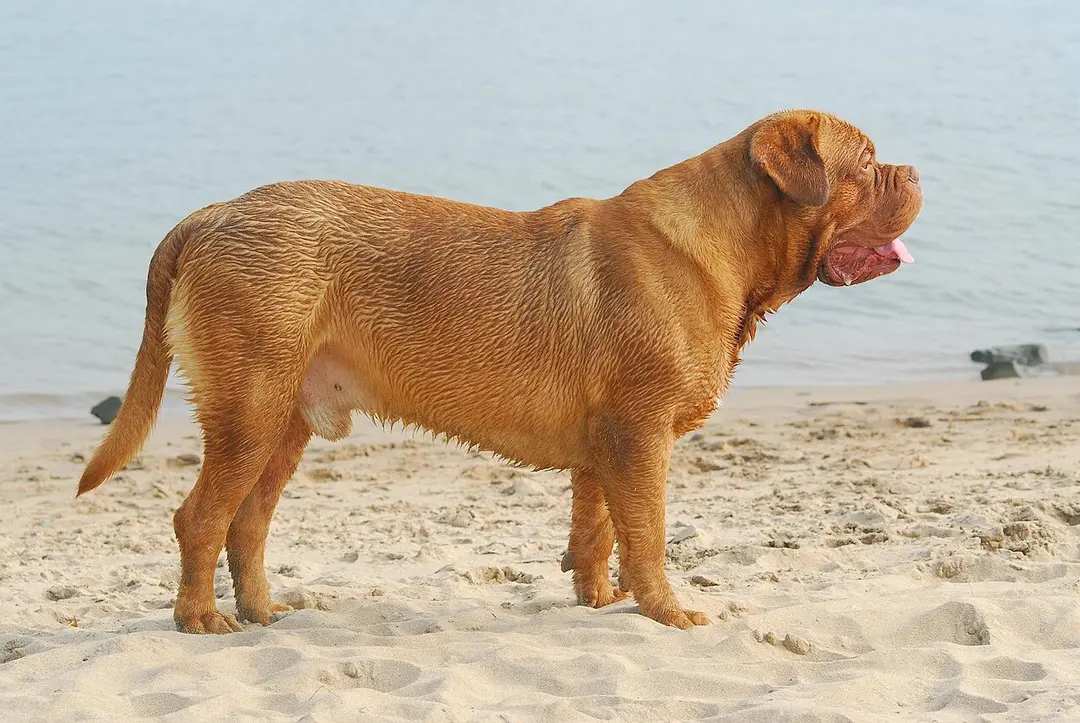
Its head is very large for its body, with a short, upturned muzzle, an undershot jaw and loose skin that falls into wrinkles. The short, fine coat is soft to the touch and comes only in shades of fawn, from pale isabelle to deep mahogany. There is often a black or brown mask, and small white markings on the chest and feet are allowed.
Puppy growth
Health and lifespan
- Inward-rolling eyelidFar more likelyImpact: moderate
- Outward-drooping eyelidFar more likelyImpact: minor
- Blood-vessel cancerMuch more likelyImpact: life-limiting
- Underactive thyroidMuch more likelyImpact: moderate
- Demodectic mange starting young, dogs under 2Much more likelyImpact: minor
Flat face and breathing
Lifespan
Where it comes from
The Dogue de Bordeaux was among the dogs exhibited at the first dog show held in Paris, in the eighteen-sixties, and the veterinarian Pierre Mégnin wrote an early description of the breed towards the end of the nineteenth century. Its post-war recovery owed much to the French enthusiast Raymond Triquet. From the late twentieth century it spread well beyond France, helped by its role opposite Tom Hanks in the Hollywood film Turner & Hooch. The breed was developed to guard and to grip and hold large animals, and it is a powerful, thickset mastiff, broad and fairly close to the ground.
Breed standard
Questions people ask
Compare with related
Sources
- 1Morrill et al., 2022. Ancestry-inclusive dog genomics challenges popular breed stereotypes. Science 376: eabk0639 (Darwin's Ark). ↑
- 2Dogs Trust. Finding a good, responsible breeder. ↑
- 3American Kennel Club. Screening puppy buyers: how top breeders find the best homes. ↑
- 4American Kennel Club. Dogue de Bordeaux: Dog Breed Information (Grooming / Exercise / Training). ↑
- 5
- 6
- 7Hawthorne et al., 2004. Body-weight changes during growth in puppies of different breeds. Journal of Nutrition 134(8 Suppl): 2027S–2030S (WALTHAM). ↑
- 8AAFCO, 2016. AAFCO Dog and Cat Food Nutrient Profiles. Association of American Feed Control Officials. ↑
- 9
- 10
- 11
- 12
- 13
- 14