English Setter
What it's like
In temperament the English Setter is gentle, affectionate and sociable, and usually friendly with strangers and other dogs. It keeps a strong instinct for finding birds and plenty of stamina, and is often slow to mature. The Kennel Club has at times listed it as a vulnerable native breed.
Living with one
Size and growth
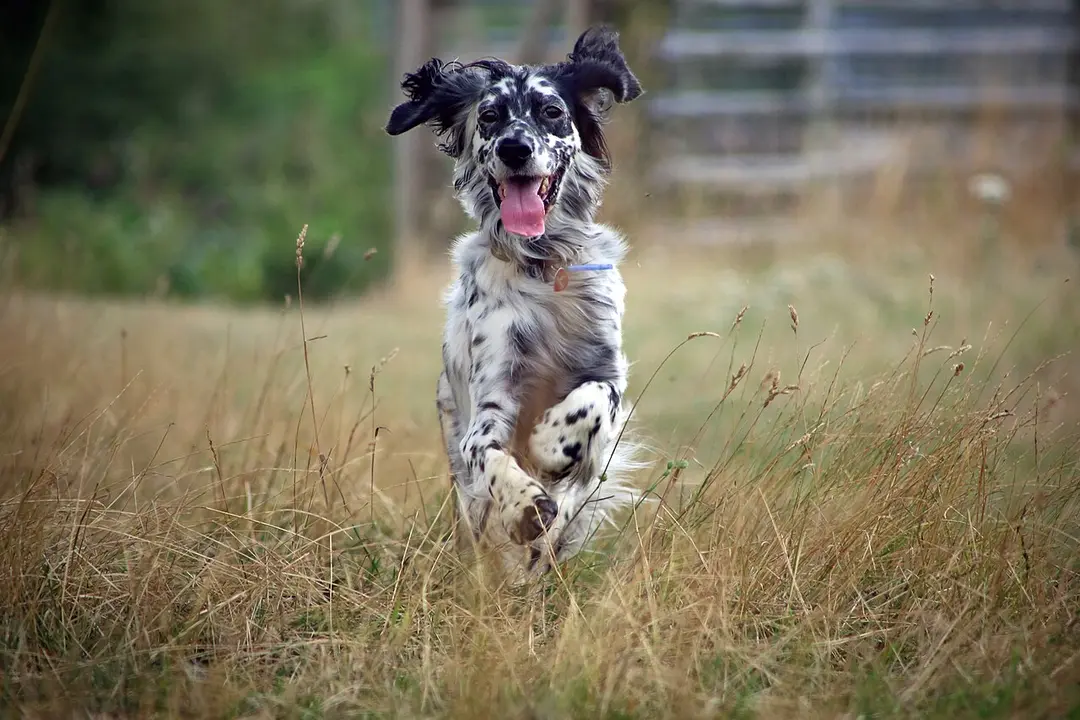
The breed is elegant and athletic, with a long, lean head, dark eyes and a flat, silky coat. Feathering runs along the ears, chest, legs and belly, and along the tail, which is carried level and known as the flag. The coat is flecked with colour, a pattern called belton, a name Laverack is said to have taken from a village in Northumberland. It comes in blue, orange, lemon and liver, or as a tricolour.
Puppy growth
Lifespan
Where it comes from
The English Setter's later history is one of divergence. Laverack's line became the basis of the show type, while Llewellin's dogs excelled at field trials, and his name passed to a lighter, faster working strain, especially in the United States. Show setters today are heavier-boned and fuller-coated, while working setters are leaner and quicker. Early setters crouched on finding game so that a net could be drawn over the birds. Once shooting replaced netting, they held a point for the gun instead.
Breed standard
Questions people ask
Compare with related
Sources
- 1Morrill et al., 2022. Ancestry-inclusive dog genomics challenges popular breed stereotypes. Science 376: eabk0639 (Darwin's Ark). ↑
- 2Dogs Trust. Finding a good, responsible breeder. ↑
- 3American Kennel Club. Screening puppy buyers: how top breeders find the best homes. ↑
- 4
- 5American Kennel Club. English Setter breed page. ↑
- 6
- 7AAFCO, 2016. AAFCO Dog and Cat Food Nutrient Profiles. Association of American Feed Control Officials. ↑
- 8Hawthorne et al., 2004. Body-weight changes during growth in puppies of different breeds. Journal of Nutrition 134(8 Suppl): 2027S–2030S (WALTHAM). ↑
- 9
- 10The Kennel Club. English Setter. ↑
- 11American Kennel Club. English Setter breed history. ↑