Fila Brasileiro
What it's like
The breed is devoted and protective towards its own household and patient with familiar children, yet openly hostile to strangers. Brazilians call this trait ojeriza, and the standard treats it as typical of the breed rather than as a fault, so show judges are not expected to handle the dog. At home it is generally calm and quiet but reacts quickly to intruders.
Living with one
Size and growth
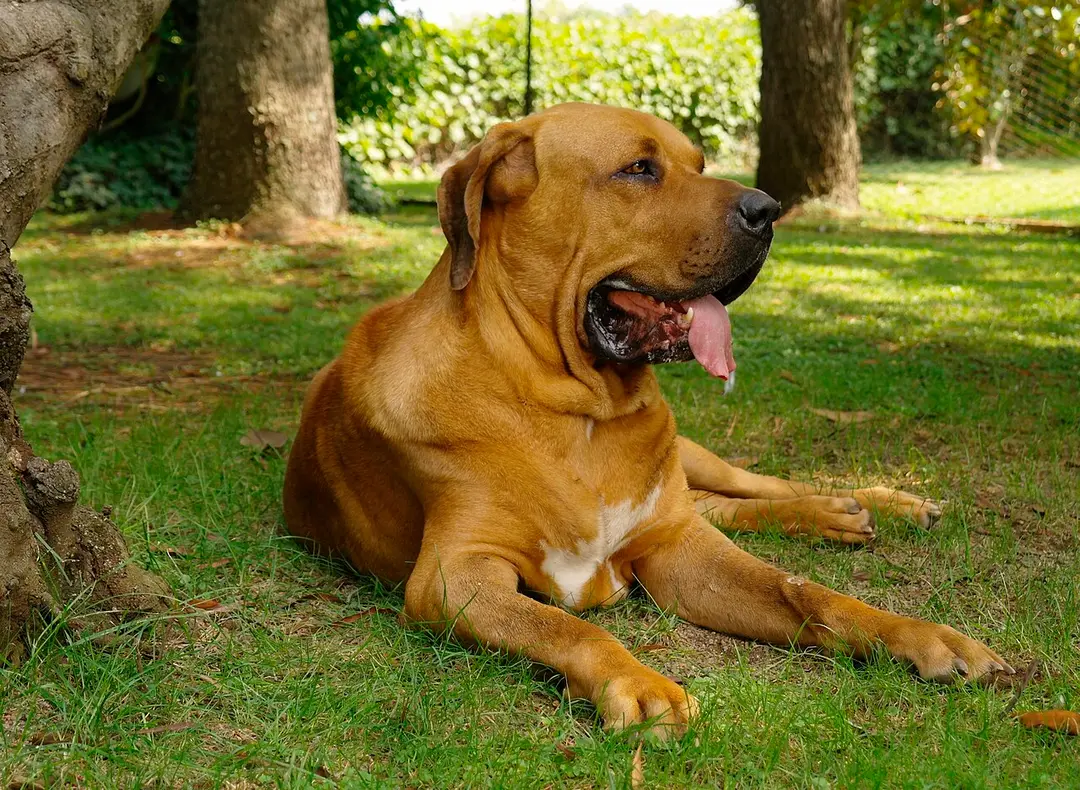
It is a large, heavy-boned molosser with a long body, a broad head and hindquarters set slightly higher than the withers. Its defining feature is thick, loose skin that hangs in a marked dewlap at the throat and folds along the neck. The coat is short, smooth and dense, and is commonly fawn, brindle or black, sometimes with a dark mask. Its characteristic gait is a pace, moving both legs on one side together, often likened to a camel's.
Puppy growth
Lifespan
Where it comes from
The Fila Brasileiro took its modern form in the twentieth century, when Brazilian enthusiasts set out to record and preserve the working farm dogs of the interior. A written standard was drawn up in the mid-twentieth century, and it later gained international recognition. Disputes over correct type later produced rival breed bodies within Brazil, each keeping its own standard, and the split remains.
Breed standard
Questions people ask
Compare with related
Sources
- 1Morrill et al., 2022. Ancestry-inclusive dog genomics challenges popular breed stereotypes. Science 376: eabk0639 (Darwin's Ark). ↑
- 2Dogs Trust. Finding a good, responsible breeder. ↑
- 3American Kennel Club. Screening puppy buyers: how top breeders find the best homes. ↑
- 4
- 5Hawthorne et al., 2004. Body-weight changes during growth in puppies of different breeds. Journal of Nutrition 134(8 Suppl): 2027S–2030S (WALTHAM). ↑
- 6AAFCO, 2016. AAFCO Dog and Cat Food Nutrient Profiles. Association of American Feed Control Officials. ↑
- 7CAFIB. Histórico. ↑
- 8GOV.UK. Banned dogs. ↑