French Bulldog
What it's like
In temperament the French Bulldog is affectionate, playful and alert, closely attached to its people and inclined to follow them from room to room. It tends to bark less than many small breeds but makes an attentive watchdog, and it can be stubborn when training does not interest it.
Living with one
Size and growth
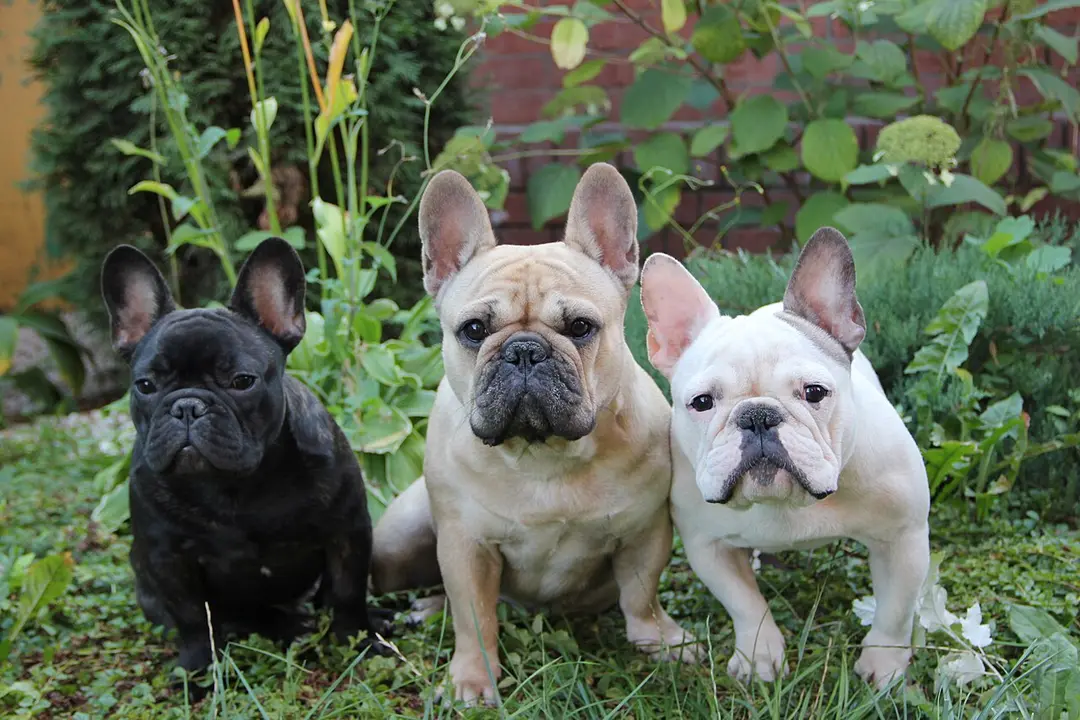
It is compact, muscular and heavy-boned for its size, with a broad square head, a short flat muzzle, a wrinkled face and large upright bat ears that are the breed's trademark. The tail is short, either straight or screwed. The smooth, fine coat comes in colours including brindle, fawn, cream and pied, often with a dark mask.
Puppy growth
Health and lifespan
- Breathing obstruction from a short muzzleFar more likelyImpact: life-limiting
- Narrowed nostrilsFar more likelyImpact: moderate
- Skin fold inflammationFar more likelyImpact: moderate
- Ear dischargeFar more likelyImpact: minor
- Difficult birthMuch more likelyImpact: serious
Flat face and breathing
Lifespan
Where it comes from
The French Bulldog moved quickly from the Paris streets into fashionable homes across Europe and North America around the turn of the twentieth century, valued as a small, sturdy town dog. In Britain, some bulldog breeders resisted it at first, seeing it as an undersized version of their own breed, but the Kennel Club recognised it as a separate breed early in the twentieth century. One French Bulldog, Gamin de Pycombe, was among the dogs lost with the Titanic. The breed was developed as a companion, and that has remained its role.
Breed standard
Questions people ask
Compare with related
Sources
- 1Morrill et al., 2022. Ancestry-inclusive dog genomics challenges popular breed stereotypes. Science 376: eabk0639 (Darwin's Ark). ↑
- 2Dogs Trust. Finding a good, responsible breeder. ↑
- 3American Kennel Club. Screening puppy buyers: how top breeders find the best homes. ↑
- 4
- 5
- 6The Kennel Club. French Bulldog breed standard. ↑
- 7
- 8Hawthorne et al., 2004. Body-weight changes during growth in puppies of different breeds. Journal of Nutrition 134(8 Suppl): 2027S–2030S (WALTHAM). ↑
- 9
- 10
- 11
- 12
- 13
- 14French Bull Dog Club of America. Breed history. ↑