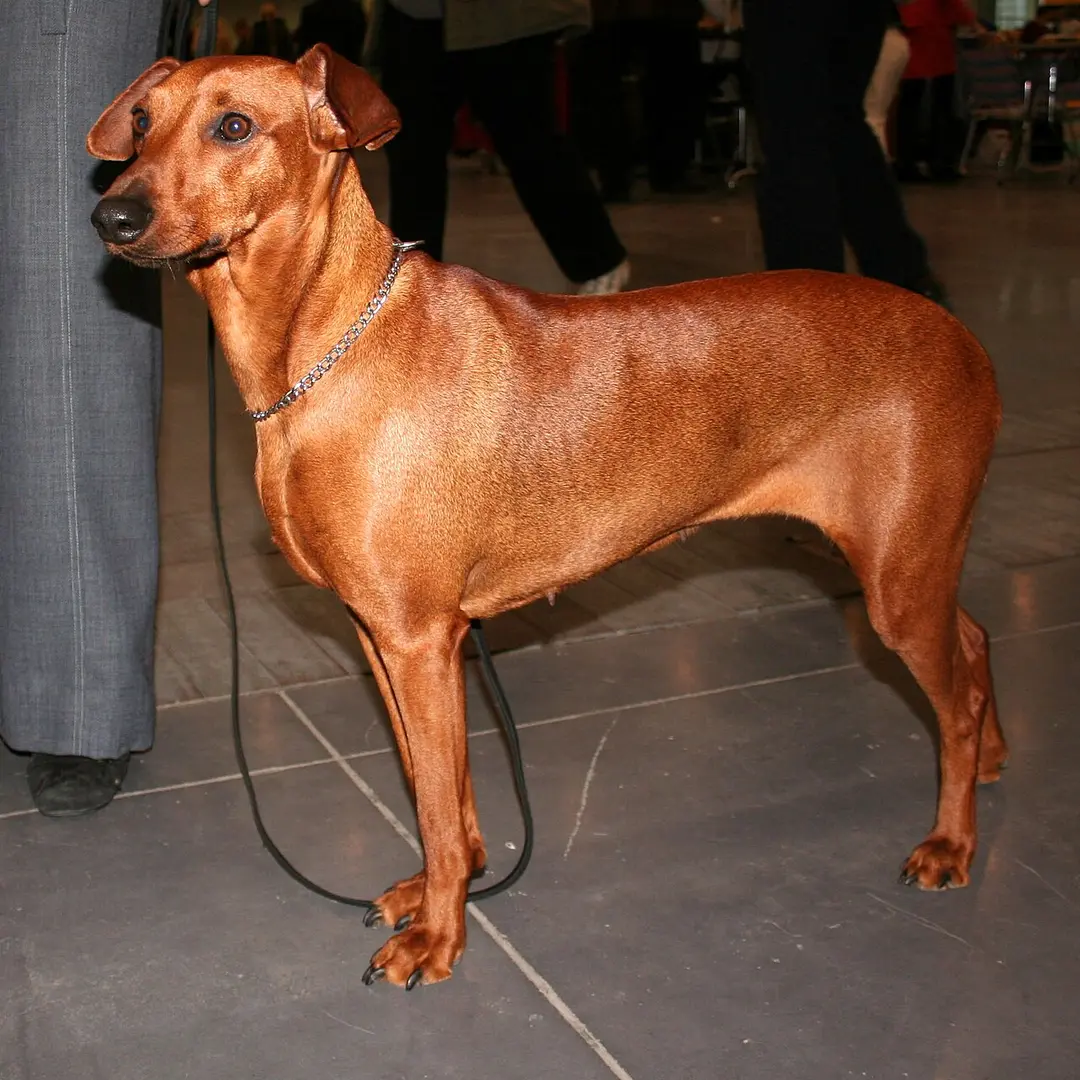
German Pinscher

Keen watchdog, affectionate at home but strong-willed.
Adult weight
14–20 kg
31–44 lb
Lifespan
12–14 yrs
Class · Watchdog
also Sport

What it's like

The breed is alert, energetic and quick to notice anything unusual, which makes it a keen watchdog. It is affectionate with its own household but reserved with strangers, and it can be strong-willed and persistent. Its hunting instinct remains sharp, so small animals may be treated as quarry.

Day to day
Activity
Needs lots of exercise
Intelligence
Needs daily brain work
Handler demand
Needs an experienced owner
With people
Affection
Affectionate on its own terms
Loyalty
Sticks close to its people
Independence
Decides for itself
Around the home
Sensitivity
Average
Voice
Barks to alert, then settles
Prey drive
Likely to chase small pets
Breed explains only about 9% of how individual dogs differ in behaviour1. Meet the dog. A good breeder breeds for temperament as well as health, and matches each puppy's personality to the right home2,3.
Is a German Pinscher right for you?
Take the breed matcher

Living with one

It has a short coat. It sheds through the year rather than in big seasonal moults. Plan on a brush once a week. It needs a moderate amount of exercise compared with other breeds.

Size and growth

A German Pinscher is a medium dog, about the weight of a grown Border Collie.

In appearance it is a compact, square, muscular dog with a long wedge-shaped head, dark oval eyes and a short, dense, glossy coat that lies flat. Colours include black with red or tan markings and solid shades of red, from a light red to deep stag red. In Britain the ears are left natural, folding forward in a V, and the tail is left long.

Puppy growth

Reference curve · community data appears as owners log
By about 5 months, a male German Pinscher puppy is already as heavy as a grown Pug. They grow fastest between 3 and 4 months old.
Fully grown
11 mo
Both sexes, at 99% of adult weight6
Male
Female
Shaded: expected range
051015202m4m6m9m12m18m
051015202m3m4m6m9m12m18m
Age
Male
Female
2 months
3.0–4.4 kg 6.6–9.7 lb
3.4–4.8 kg 7.5–10.6 lb
3 months
4.5–6.4 kg 9.9–14.1 lb
4.8–6.8 kg 10.6–15.0 lb
4 months
6.5–9.3 kg 14.3–20.5 lb
6.8–9.7 kg 15.0–21.4 lb
5 months
8.4–12.0 kg 18.5–26.5 lb
8.6–12.3 kg 19.0–27.1 lb
6 months
10.0–14.3 kg 22.0–31.5 lb
10.1–14.4 kg 22.3–31.7 lb
7 months
11.2–16.0 kg 24.7–35.3 lb
8 months
12.1–17.3 kg 26.7–38.1 lb
12.0–17.1 kg 26.5–37.7 lb
9 months
12.7–18.1 kg 28.0–39.9 lb
12.5–17.9 kg 27.6–39.5 lb
10 months
13.1–18.7 kg 28.9–41.2 lb
12.9–18.5 kg 28.4–40.8 lb
11 months
13.4–19.1 kg 29.5–42.1 lb
13.2–18.9 kg 29.1–41.7 lb
12 months
13.6–19.4 kg 30.0–42.8 lb
13.4–19.1 kg 29.5–42.1 lb
15 months
13.9–19.9 kg 30.6–43.9 lb
13.8–19.7 kg 30.4–43.4 lb

Health and lifespan

In lab records from the Canary Islands, button tumour turns up more often in German Pinschers than in crossbreeds: it is much more likely. It is not rated serious. These are figures for the breed as a whole, not a prediction for your dog.
Listed by likelihood level, highest first, then by how serious it is, then by name.
  • Button tumour
    Lab-confirmed cases
    Much more likely
    Impact: minor
Lab-confirmed: compares dogs whose tumour samples went to a lab with all dogs on the islands' identification register, so the figures run higher than vet-record ones.

Lifespan

No vet study has measured how long German Pinschers live yet. The 12–14 years shown is a general figure without a published source.

Where it comes from

The German Pinscher and the Schnauzer come from the same stock, and the smooth-coated dogs were already in the German stud book by 1880. It was first a ratter, and the Kennel Club says its name, meaning 'to bite' or 'to grip', comes from that work. After the Second World War, Werner Jung saved it from near extinction with one older bitch, Kitti, and larger Miniature Pinschers4,8,9.

The German Pinscher is often described as a forerunner of the Dobermann and the Miniature Pinscher, and its smooth-coated type stayed close to the farm dog of the nineteenth century. It nearly disappeared after the Second World War and was rebuilt from very few dogs, and it reached Britain and North America only in the later twentieth century, gaining American Kennel Club recognition in the early two-thousands. It was kept on farms and in stables to kill rats and other vermin and to warn of strangers.

Breed standard

The German Pinscher is judged against standard no. 184, in group 2, Pinscher and Schnauzer, Molossoid and Swiss Mountain Dogs4.

Questions people ask

General guidance for dogs rather than a measured German Pinscher figure: most females have a first season somewhere between six and fifteen months, and cycles then settle to roughly every 180 days. Smaller breeds tend to start earlier and larger ones later, so a medium-sized breed is most likely somewhere in the middle.
Track your own German Pinscher
Log a minute a day and watch them sit on these curves. Free.

Sources

Uncited on this page: Lifespan — no reviewed source yet, so it is a general reference figure rather than a published one.
Something wrong on this page?
Parts of this page were written by AI ·