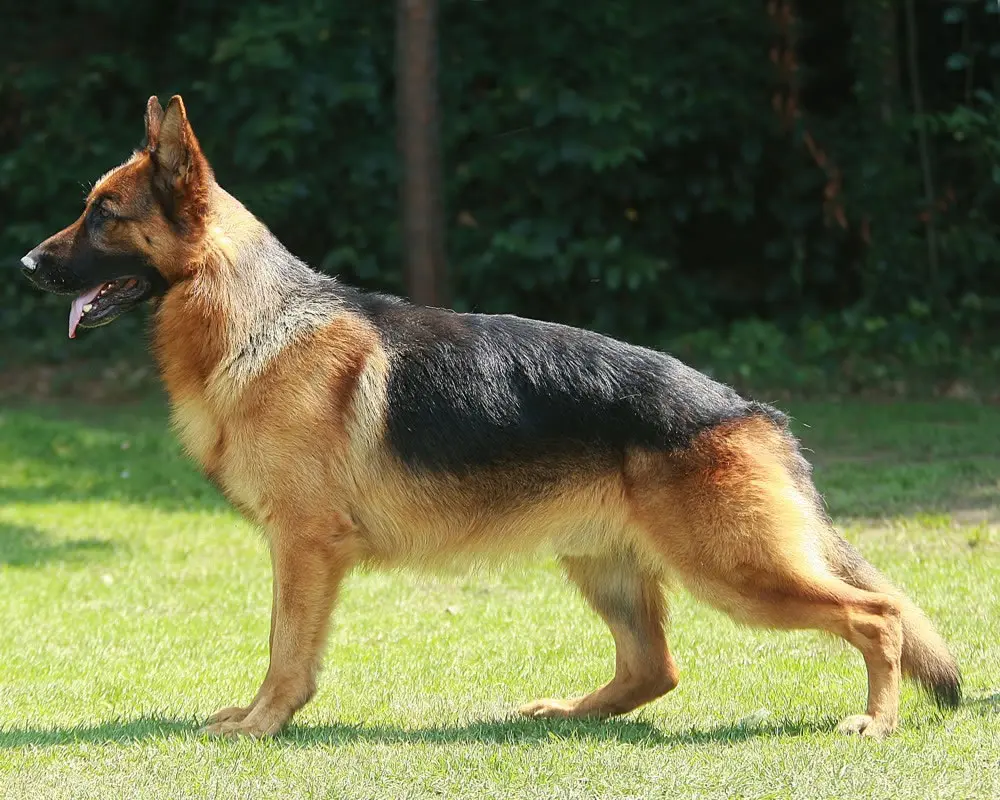
German Shepherd

Alert and self-assured, devoted to its own people.
Adult male
36–45.5 kg
79–100 lb
Adult female
30.6–39.5 kg
67–87 lb
Lifespan
11.3 yrs
Class · Watchdog
also Working, Sport

What it's like

The breed is alert, watchful and self-assured, devoted to its own people and reserved with strangers. One of the first canine film stars, Rin Tin Tin, was a German Shepherd found as a puppy by an American serviceman in war-torn France during the First World War.

Owners who rated their dogs' everyday behaviour found German Shepherds less independent-minded than most, and a little less often among the friendliest with people. On calmness and with other dogs, they were about average. Breed is only a small part of any one dog's personality, so meet the dog before you decide.
Day to day
Activity
Needs lots of exercise
Intelligence
Needs daily brain work
Handler demand
Needs an experienced owner
With people
Affection
Affectionate on its own terms
Loyalty
Sticks close to its people
Independence
Keen to work with you
Around the home
Sensitivity
Needs a calm, predictable home
Voice
Barks to alert, then settles
Prey drive
Chases; needs managing
Breed explains only about 9% of how individual dogs differ in behaviour1. Meet the dog. A good breeder breeds for temperament as well as health, and matches each puppy's personality to the right home2,3.
Is a German Shepherd right for you?
Take the breed matcher

Living with one

Bred to herd stock all day, it needs plenty of exercise, and owners say it seeks constant activity more often than most.

Size and growth

A German Shepherd is a large dog, heavier than a Labrador and lighter than a Rottweiler. Males end up clearly heavier than females.

It is a strong, muscular dog, slightly longer than it is tall, with erect pointed ears, a wedge-shaped head and a bushy tail carried low. The weather-resistant double coat is most often black and tan or sable, sometimes solid black, and some registries also recognise a long-coated variety. Show and working lines have drifted apart, and the show dog usually has a more steeply sloping back.

Puppy growth

Reference curve · community data appears as owners log
By about 5 months, a male German Shepherd puppy is already as heavy as a grown Border Collie. They grow fastest between 4 and 5 months old. They keep growing past their first birthday, longer than a Beagle does. Most males grow into the size large-breed puppy foods are made for.
Fully grown
13 mo
Both sexes, at 99% of adult weight7
Male
Female
Shaded: expected range
02040602m4m6m9m12m18m
02040602m3m4m6m9m12m18m
Age
Male
Female
2 months
6.3–7.9 kg 13.9–17.4 lb
7.0–9.1 kg 15.4–20.1 lb
3 months
10.1–12.7 kg 22.3–28.0 lb
10.2–13.1 kg 22.5–28.9 lb
4 months
14.9–18.9 kg 32.8–41.7 lb
14.7–19.0 kg 32.4–41.9 lb
5 months
20.3–25.6 kg 44.8–56.4 lb
18.8–24.2 kg 41.4–53.4 lb
6 months
25.1–31.8 kg 55.3–70.1 lb
22.1–28.5 kg 48.7–62.8 lb
7 months
28.9–36.6 kg 63.7–80.7 lb
24.4–31.6 kg 53.8–69.7 lb
8 months
31.6–39.9 kg 69.7–88.0 lb
26.1–33.7 kg 57.5–74.3 lb
9 months
33.3–42.1 kg 73.4–92.8 lb
27.4–35.4 kg 60.4–78.0 lb
10 months
34.4–43.5 kg 75.8–95.9 lb
28.2–36.5 kg 62.2–80.5 lb
11 months
35.1–44.3 kg 77.4–97.7 lb
28.9–37.2 kg 63.7–82.0 lb
12 months
35.5–44.8 kg 78.3–98.8 lb
29.3–37.8 kg 64.6–83.3 lb
15 months
35.9–45.3 kg 79.1–99.9 lb
30.2–38.9 kg 66.6–85.8 lb

Health and lifespan

Vets record these more often in German Shepherds than in crossbreeds. Blood-vessel cancer (life-limiting) and elbow joint disease (serious) are much more likely, and limb arthritis (serious) more likely. A blood blister in the ear flap and underactive thyroid (both moderate) are slightly more likely. These are figures for the breed as a whole, not a prediction for your dog.
Listed by likelihood level, highest first, then by how serious it is, then by name. These are 5 of 7 measured; lab-confirmed figures only fill places the vet-record studies leave empty.
  • Blood-vessel cancer
    Much more likely
    Impact: life-limiting
  • Elbow joint disease
    Much more likely
    Impact: serious
  • Joint wear-and-tear arthritis in the limbs
    More likely
    Impact: serious
  • Blood blister in the ear flap
    Slightly more likely
    Impact: moderate
  • Underactive thyroid
    Slightly more likely
    Impact: moderate

For your vet

Some German Shepherds carry the MDR1 mutation, which can make them react severely to some common drugs. Only a test shows whether yours has it, so share the result with your vet.

Lifespan

In UK vet records, the typical German Shepherd lived to about 11 and a half years, shorter than the typical large breed.

Where it comes from

The German Shepherd was standardised by Captain Max von Stephanitz, who bought a working sheepdog, renamed him Horand von Grafrath and made him the first dog registered by his club, founded in 1899. He ranked usefulness and intelligence above beauty and steered the breed into messenger, rescue, sentry and guard work. First World War hostility to all things German made it the Alsatian in England4,19.

The German Shepherd Dog grew out of the varied herding dogs of nineteenth-century Germany, which gathered and guarded flocks on open, unfenced land at a steady, tireless trot. As shepherding declined, the breed's trainability took it into police, military and customs work, and later into guiding blind people. The first guide dogs trained in Britain, in the early nineteen-thirties, were German Shepherds. In Britain the name Alsatian, adopted after the First World War, stayed in use for decades before the Kennel Club restored the original name.

Breed standard

The German Shepherd is judged against standard no. 166, in group 1, Sheepdogs and Cattledogs4.

Questions people ask

General guidance for dogs rather than a measured German Shepherd figure: most females have a first season somewhere between six and fifteen months, and cycles then settle to roughly every 180 days. Smaller breeds tend to start earlier and larger ones later, so a large breed is most likely at the later end.
Track your own German Shepherd
Log a minute a day and watch them sit on these curves. Free.

Sources

Something wrong on this page?
Parts of this page were written by AI ·