German Shorthaired Pointer
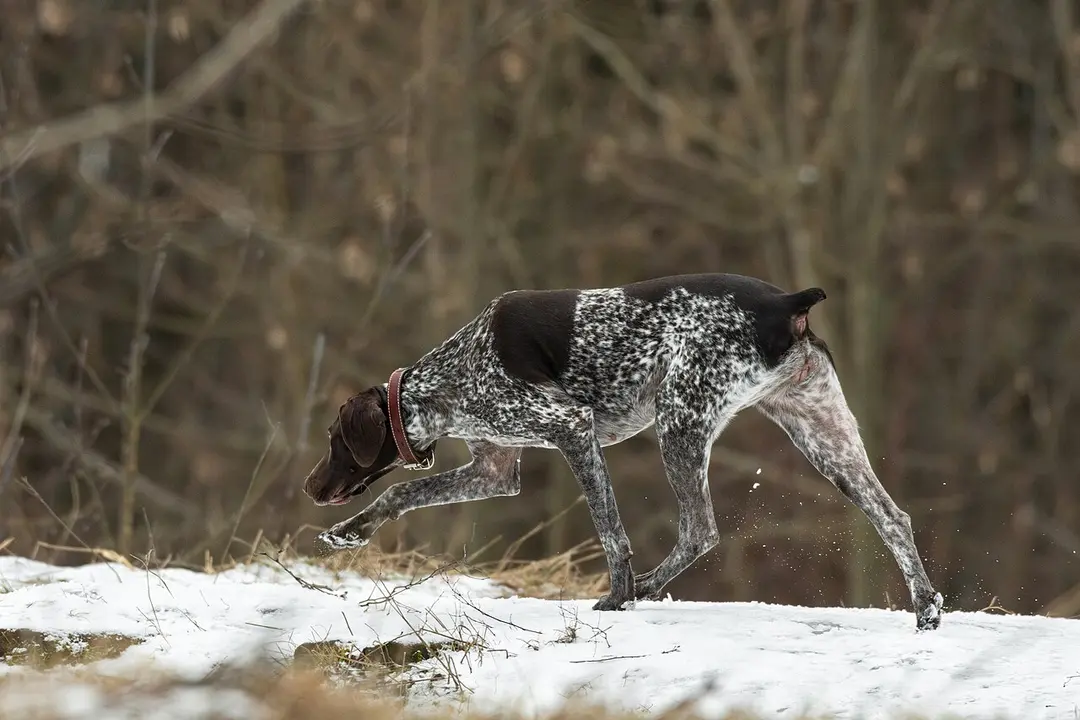
Friendly and driven; restless with too little to do.
Adult male
25–32 kg
55–71 lb
Adult female
20–27 kg
44–60 lb
Lifespan
13.4 yrs
Class · Field
also Sport

What it's like

In temperament it is friendly, intelligent and willing, with plenty of drive and stamina. It is usually affectionate with its household and sociable with other dogs, though its hunting instinct is strong and it can be boisterous and restless when it has too little to do.

Day to day
Activity
Needs lots of exercise
Intelligence
Needs daily brain work
Handler demand
Needs an experienced owner
With people
Affection
A lap or leaning dog
Loyalty
Bonded to its family
Independence
Cooperative, with its own ideas
Around the home
Sensitivity
Needs a calm, predictable home
Voice
Barks to alert, then settles
Prey drive
Likely to chase small pets
Breed explains only about 9% of how individual dogs differ in behaviour1. Meet the dog. A good breeder breeds for temperament as well as health, and matches each puppy's personality to the right home2,3.
Is a German Shorthaired Pointer right for you?
Take the breed matcher

Living with one

A GSP's short hairs work their way into fabric and carpet and are hard to get out. A quick brush every few days, more often at certain times of year, catches loose hair before it spreads. Bred to quarter ground all day, it needs plenty of exercise.

Size and growth

A German Shorthaired Pointer is a medium dog, heavier than a Border Collie and lighter than a Golden Retriever. Males end up clearly heavier than females. It is one of the heaviest medium breeds.

It is a lean, athletic dog with a clean-cut head, brown eyes, broad hanging ears and a short, dense coat that feels harsh to the touch. The colours are liver or black, solid or mixed with white in patches and ticking, though not every kennel club accepts black.

Two types

The two types differ in height only, so there is one growth curve, on the record's own band (breed club figure)6.

UK / FCI type

FCI 119
Height at the withers
Males
62–66 cm
Females
58–63 cm5
Publishes no weight.

American type

AKC standard
Height at the withers
Males
58.4–63.5 cm
Females
53.3–58.4 cm7
Its weights are the ones used on this page.

Puppy growth

Reference curve · community data appears as owners log
By about 5 months, a male German Shorthaired Pointer puppy is already as heavy as a grown Staffordshire Bull Terrier. They grow fastest between 3 and 4 months old. The biggest males grow into the size large-breed puppy foods are made for.
Fully grown
11 mo
Both sexes, at 99% of adult weight10
Male
Female
Shaded: expected range
0102030402m4m6m9m12m18m
0102030402m3m4m6m9m12m18m
Age
Male
Female
2 months
5.4–7.0 kg 11.9–15.4 lb
4.8–6.5 kg 10.6–14.3 lb
3 months
8.0–10.3 kg 17.6–22.7 lb
6.8–9.2 kg 15.0–20.3 lb
4 months
11.6–14.9 kg 25.6–32.8 lb
9.7–13.1 kg 21.4–28.9 lb
5 months
14.9–19.1 kg 32.8–42.1 lb
12.3–16.6 kg 27.1–36.6 lb
6 months
17.8–22.8 kg 39.2–50.3 lb
14.4–19.5 kg 31.7–43.0 lb
7 months
20.0–25.6 kg 44.1–56.4 lb
16.0–21.6 kg 35.3–47.6 lb
8 months
21.6–27.6 kg 47.6–60.8 lb
17.1–23.1 kg 37.7–50.9 lb
9 months
22.7–29.0 kg 50.0–63.9 lb
17.9–24.2 kg 39.5–53.4 lb
10 months
23.4–29.9 kg 51.6–65.9 lb
18.5–24.9 kg 40.8–54.9 lb
11 months
23.9–30.6 kg 52.7–67.5 lb
18.9–25.5 kg 41.7–56.2 lb
12 months
24.2–31.0 kg 53.4–68.3 lb
19.1–25.8 kg 42.1–56.9 lb
15 months
24.8–31.8 kg 54.7–70.1 lb
19.7–26.6 kg 43.4–58.6 lb

Health and lifespan

In UK lab records, blood-vessel cancer of the spleen turns up more often in German Shorthaired Pointers than in crossbreeds: it is more likely. It can shorten a life. These are figures for the breed as a whole, not a prediction for your dog.
Listed by likelihood level, highest first, then by how serious it is, then by name.
  • Blood-vessel cancer of the spleen
    Lab-confirmed cases
    More likely
    Impact: life-limiting
Lab-confirmed: compares dogs whose tumour samples went to a lab with dogs seen in general practice, so the figures run higher than vet-record ones.

Lifespan

In UK vet records, the typical German Shorthaired Pointer lived to about 13 and a half years, about average for a medium breed.

Where it comes from

The German Shorthaired Pointer descends from pointing dogs, first used to find birds for nets and falcons, that reached the German courts from France, Spain and Flanders. The double-barrelled gun of 1750, which let birds be shot on the wing over the dog, set off its growth into an all-purpose gundog, and Prince Albrecht zu Solms-Braunfels later drew up its breed points and judging rules4,5.

The German Shorthaired Pointer took its modern form in the second half of the nineteenth century, when German breeders set out to make a versatile dog for work in the field. Some crossed in English Pointer blood for speed and style, a step not every breeder welcomed, and a breed stud book was opened. It became established in Britain after the Second World War, partly through dogs brought home by servicemen. It was bred to range ahead of the gun, hold a steady point, retrieve shot game from land or water and track wounded quarry, and in Britain it is classed among the hunt, point and retrieve breeds.

Breed standard

The American standard asks for a shorter dog than the UK and international ones.

Questions people ask

General guidance for dogs rather than a measured German Shorthaired Pointer figure: most females have a first season somewhere between six and fifteen months, and cycles then settle to roughly every 180 days. Smaller breeds tend to start earlier and larger ones later, so a medium-sized breed is most likely somewhere in the middle.
Track your own German Shorthaired Pointer
Log a minute a day and watch them sit on these curves. Free.

Sources

Something wrong on this page?
Parts of this page were written by AI ·