German Wirehaired Pointer
What it's like
Temperamentally it is affectionate and eager with its own people, energetic and determined at work, and often reserved with strangers. It is often described as a one-person dog and tends to form a strong bond with its household. Its German name, Drahthaar, simply means wire hair.
Living with one
Size and growth
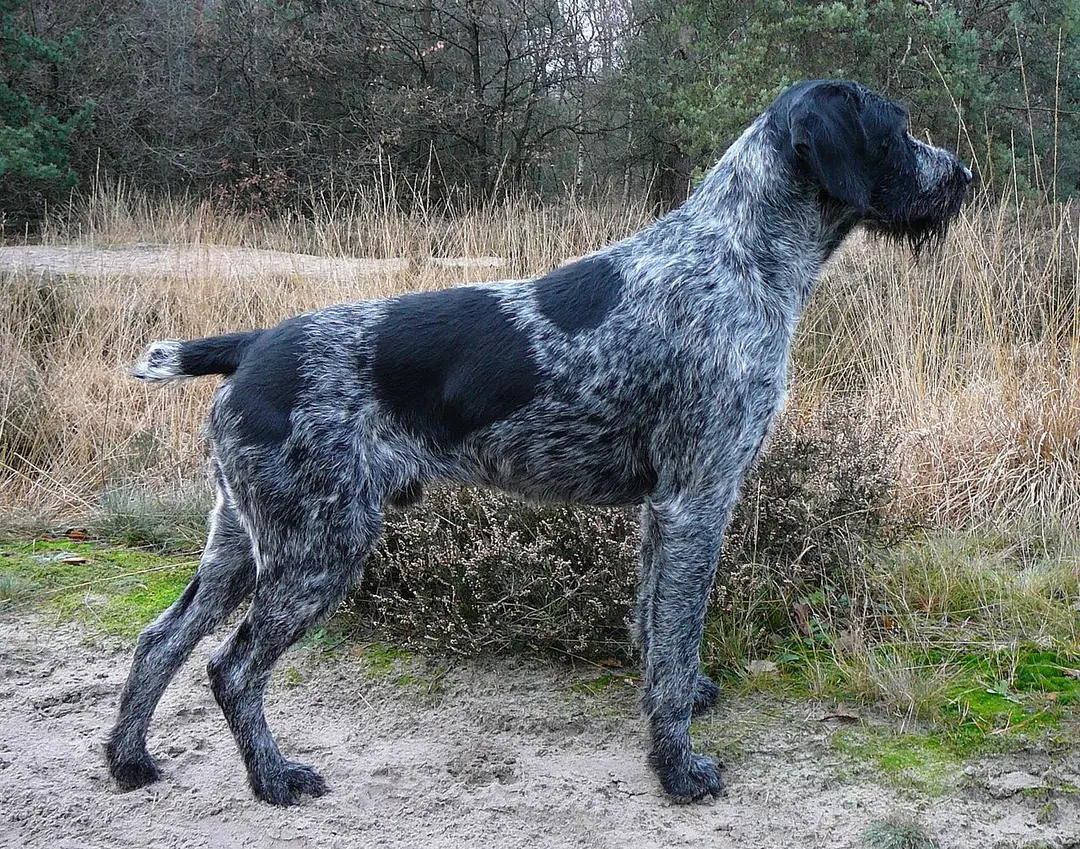
In appearance it is a sturdy, slightly longer-than-tall dog with a firm, close-lying wire coat over an undercoat that is dense in winter and thin in summer. Bushy eyebrows and a beard give the face an earnest look. Colours are usually liver and white, often flecked or roan, or solid liver.
Puppy growth
Lifespan
Where it comes from
The German Wirehaired Pointer took shape around the turn of the twentieth century, when a breed club for the Deutsch Drahthaar was founded in Germany and set strict working tests as a condition of breeding. Several rough-coated breeds are usually named among its ancestors, including the Pudelpointer and the Stichelhaar. The breed was recognised in the United States in the mid-twentieth century and later reached Britain. It was bred to do the whole of a hunter's work rather than one task: to quarter ground and point game, retrieve on land and from water, and follow the trail of wounded game.
Breed standard
Questions people ask
Compare with related
Sources
- 1Morrill et al., 2022. Ancestry-inclusive dog genomics challenges popular breed stereotypes. Science 376: eabk0639 (Darwin's Ark). ↑
- 2Dogs Trust. Finding a good, responsible breeder. ↑
- 3American Kennel Club. Screening puppy buyers: how top breeders find the best homes. ↑
- 4
- 5American Kennel Club. German Wirehaired Pointer breed page. ↑
- 6
- 7AAFCO, 2016. AAFCO Dog and Cat Food Nutrient Profiles. Association of American Feed Control Officials. ↑
- 8Hawthorne et al., 2004. Body-weight changes during growth in puppies of different breeds. Journal of Nutrition 134(8 Suppl): 2027S–2030S (WALTHAM). ↑
- 9
- 10The Kennel Club. German Wirehaired Pointer. ↑