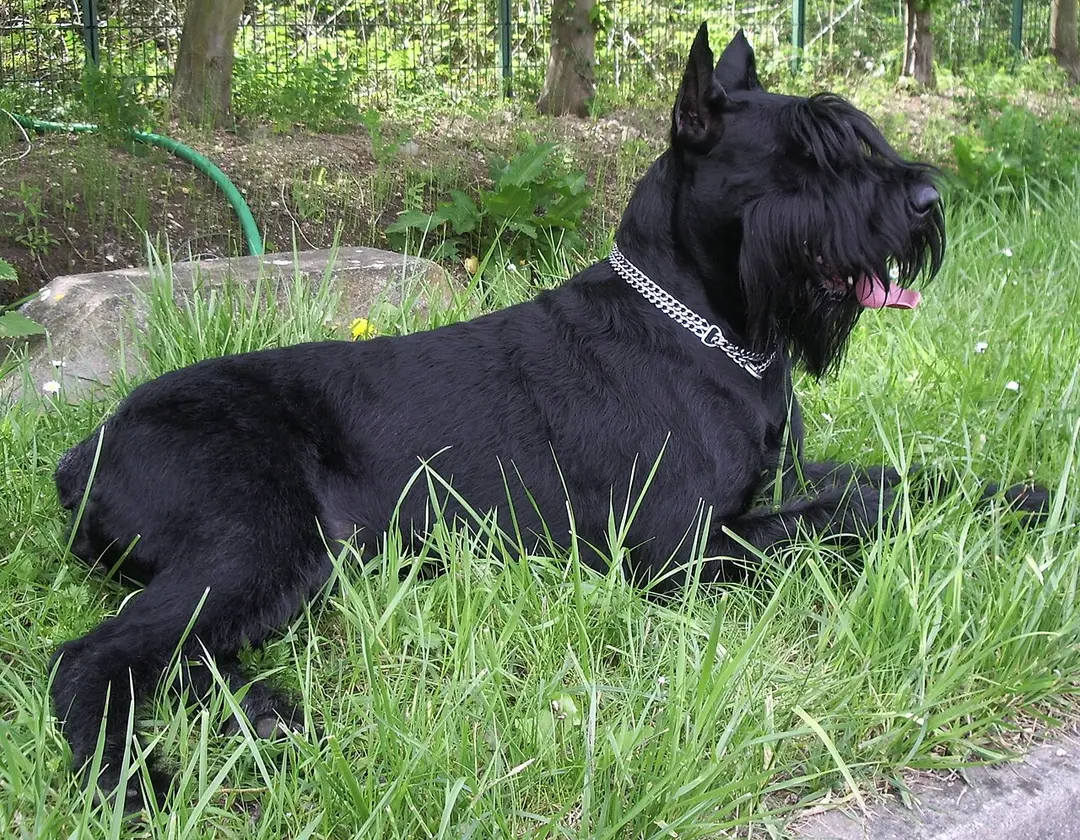
Giant Schnauzer

Bold and territorial; can turn wilful without regular work.
Adult weight
35–47 kg
77–104 lb
Lifespan
12.1 yrs
Class · Watchdog
also Sport, Working

What it's like

In temperament the Giant Schnauzer is bold, alert and strongly territorial, reserved with strangers and devoted to its household. It is energetic and quick to learn, and it can become wilful without regular work and firm, consistent handling.

Day to day
Activity
Needs lots of exercise
Intelligence
Needs daily brain work
Handler demand
Needs an experienced owner
With people
Affection
Likes its own space
Loyalty
Sticks close to its people
Independence
Cooperative, with its own ideas
Around the home
Sensitivity
Average
Voice
Barks to alert, then settles
Prey drive
Chases; needs managing
Breed explains only about 9% of how individual dogs differ in behaviour1. Meet the dog. A good breeder breeds for temperament as well as health, and matches each puppy's personality to the right home2,3.
Is a Giant Schnauzer right for you?
Take the breed matcher

Living with one

It has a wire or harsh coat. Loose hair stays caught in the coat until it is brushed, stripped or clipped out. Plan on a brush once a week, plus hand-stripping two or three times a year. It needs a moderate amount of exercise compared with other breeds.

Size and growth

A Giant Schnauzer is a large dog, about the weight of a grown German Shepherd. It is one of the heaviest large breeds.

It is a powerful, square-built dog with a long head, bushy eyebrows and a full beard and moustache. These give the breed its name, which comes from the German word for snout. The coat is harsh and wiry over a soft undercoat and comes in solid black or pepper and salt. It sheds relatively little but needs regular stripping or clipping to keep its outline.

Puppy growth

Reference curve · community data appears as owners log
By about 5 months, a male Giant Schnauzer puppy is already as heavy as a grown Border Collie. They grow fastest between 4 and 5 months old. They keep growing past their first birthday, longer than a Beagle does. Most males grow into the size large-breed puppy foods are made for.
Fully grown
13 mo
Both sexes, at 99% of adult weight5
Male
Female
Shaded: expected range
02040602m4m6m9m12m18m
02040602m3m4m6m9m12m18m
Age
Male
Female
2 months
6.1–8.2 kg 13.4–18.1 lb
3 months
9.8–13.2 kg 21.6–29.1 lb
4 months
14.5–19.5 kg 32.0–43.0 lb
5 months
19.7–26.5 kg 43.4–58.4 lb
6 months
24.4–32.8 kg 53.8–72.3 lb
7 months
28.1–37.8 kg 61.9–83.3 lb
8 months
30.7–41.3 kg 67.7–91.1 lb
9 months
32.4–43.5 kg 71.4–95.9 lb
10 months
33.5–44.9 kg 73.9–99.0 lb
11 months
34.1–45.8 kg 75.2–101.0 lb
12 months
34.5–46.3 kg 76.1–102.1 lb
15 months
34.9–46.8 kg 76.9–103.2 lb

Health and lifespan

In UK lab records, the conditions below turn up more often in Giant Schnauzers than in crossbreeds. Toe melanoma stands out as far more likely. Toe melanoma is also the most serious on the list. These are figures for the breed as a whole, not a prediction for your dog.
Listed by likelihood level, highest first, then by how serious it is, then by name.
  • Toe melanoma
    Lab-confirmed cases
    Far more likely
    Impact: serious
  • Skin melanoma
    Lab-confirmed cases
    Much more likely
    Impact: moderate
Lab-confirmed: compares dogs whose tumour samples went to a lab with dogs seen in general practice, so the figures run higher than vet-record ones.

Lifespan

In UK vet records, the typical Giant Schnauzer lived to about 12 years, about average for a large breed.

Where it comes from

Cattle farmers around Munich wanted a strong drover, and they built the Giant Schnauzer by crossing the Standard Schnauzer with Rottweiler, Great Dane and sheepdogs; it was long known as the Munich Schnauzer. Once rail replaced the cattle drives it moved into guarding and police work, and in 1925 it was officially recognised as a working dog4,9.

The Giant Schnauzer's working life in Bavaria and Württemberg took it well beyond the cattle drives, and it is said to have guarded breweries, butchers' yards and stockyards in towns across the region. It later gained wider notice in Germany through police work in the early twentieth century. It stayed uncommon elsewhere for decades and reached Britain and America relatively late. Today it is still trained for protection, tracking and obedience work, as well as being kept as a companion.

Breed standard

The Giant Schnauzer is judged against standard no. 181, in group 2, Pinscher and Schnauzer, Molossoid and Swiss Mountain Dogs4.

Questions people ask

General guidance for dogs rather than a measured Giant Schnauzer figure: most females have a first season somewhere between six and fifteen months, and cycles then settle to roughly every 180 days. Smaller breeds tend to start earlier and larger ones later, so a large breed is most likely at the later end.
Track your own Giant Schnauzer
Log a minute a day and watch them sit on these curves. Free.

Sources

Something wrong on this page?
Parts of this page were written by AI ·