Great Pyrenees

Calm with family, independent, and known to bark at night.
Adult weight
55–75 kg
121–165 lb
Lifespan
10.9 yrs
Class · Watchdog
also Working

What it's like

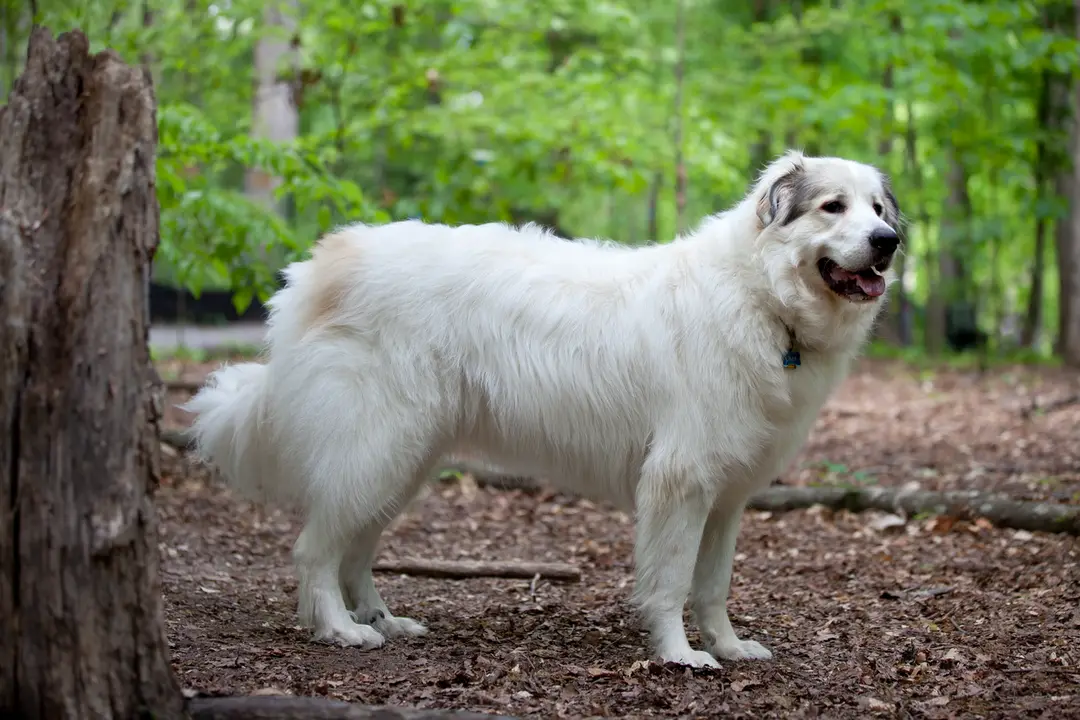
The Great Pyrenees is a large, powerful dog with a dense, weather-resistant double coat, mainly white and sometimes marked with grey, badger, reddish brown or tan on the head, ears and base of the tail. The coat thickens into a mane at the neck, and the tail is long and plumed. Double dewclaws on the hind legs are a required feature of the standard. Calm and patient with its own household, it is also independent, watchful and reserved with strangers, and known for barking at night.

Owners in a large survey found Great Pyrenees dogs tend to be calmer, friendlier with other dogs and more independent-minded than dogs in general. On friendliness with people, they were about average. Breed is only a small part of any one dog's personality, so meet the dog before you decide.
Day to day
Activity
Happy with modest walks
Intelligence
Learns readily, likes games
Handler demand
Needs an experienced owner
With people
Affection
Affectionate on its own terms
Loyalty
Sticks close to its people
Independence
Decides for itself
Around the home
Sensitivity
Hardy, takes a busy home in its stride
Voice
Very vocal
Prey drive
Usually fine with small pets
Breed explains only about 9% of how individual dogs differ in behaviour1. Meet the dog. A good breeder breeds for temperament as well as health, and matches each puppy's personality to the right home2,3.
Is a Great Pyrenees right for you?
Take the breed matcher

Living with one

It has a long coat. Most of the shedding comes when the seasons change. Plan on daily brushing. It needs a modest amount of exercise compared with other breeds.

Size and growth

A Great Pyrenees is a giant dog, about the weight of a grown Great Dane. It is one of the heaviest giant breeds.

Puppy growth

Reference curve · community data appears as owners log
By about 5 months, a male Great Pyrenees puppy is already as heavy as a grown Labrador. They grow fastest between 4 and 5 months old. They keep growing past their first birthday, longer than a Beagle does. Most males grow into the size large-breed puppy foods are made for.
Fully grown
13 mo
Both sexes, at 99% of adult weight6
Male
Female
Shaded: expected range
0204060802m4m6m9m12m18m
0204060802m3m4m6m9m12m18m
Age
Male
Female
2 months
9.6–13.1 kg 21.2–28.9 lb
3 months
15.4–21.0 kg 34.0–46.3 lb
4 months
22.8–31.1 kg 50.3–68.6 lb
5 months
31.0–42.2 kg 68.3–93.0 lb
6 months
38.4–52.3 kg 84.7–115.3 lb
7 months
44.2–60.3 kg 97.4–132.9 lb
8 months
48.3–65.8 kg 106.5–145.1 lb
9 months
50.9–69.5 kg 112.2–153.2 lb
10 months
52.6–71.7 kg 116.0–158.1 lb
11 months
53.6–73.0 kg 118.2–160.9 lb
12 months
54.2–73.9 kg 119.5–162.9 lb
15 months
54.8–74.7 kg 120.8–164.7 lb
18 months
54.9–74.9 kg 121.0–165.1 lb

Lifespan

In UK vet records, the typical Great Pyrenees lived to about 11 years, longer than the typical giant breed. The group was small, so treat the figure as rough.

Where it comes from

The Great Pyrenees has guarded flocks in the Pyrenees since at least the Middle Ages, when it also watched over castles; Gaston Phoebus mentions it in the 14th century. Louis XIV's court took it up and, the Kennel Club says, the king named it the Royal Dog of France; its standard, registered in 1923, has changed little since4,9.

The Great Pyrenees, known in Britain as the Pyrenean Mountain Dog and in France often called the patou, comes from the mountains along the French–Spanish border. As wolves and bears grew scarce, working numbers dwindled, and the modern breed owes much to French enthusiasts who sought out surviving mountain dogs in the early twentieth century. It was bred to live among the flock and drive off predators rather than to herd. It often worked alongside the smaller Pyrenean Shepherd, which did the herding. It has taken up that work again in parts of France since wolves returned to the Alps, and has also guarded sheep against coyotes in North America.

Breed standard

The Great Pyrenees is judged against standard no. 137, in group 2, Pinscher and Schnauzer, Molossoid and Swiss Mountain Dogs4.

Questions people ask

General guidance for dogs rather than a measured Great Pyrenees figure: most females have a first season somewhere between six and fifteen months, and cycles then settle to roughly every 180 days. Smaller breeds tend to start earlier and larger ones later, so a giant breed is most likely at the late end.
Track your own Great Pyrenees
Log a minute a day and watch them sit on these curves. Free.

Sources

Something wrong on this page?
Parts of this page were written by AI ·