Greater Swiss Mountain Dog
What it's like
In temperament the breed is calm, confident and watchful, attached to its household and inclined to bark at strangers without being aggressive. It matures slowly. Owners commonly call it the Swissy.
Living with one
Size and growth
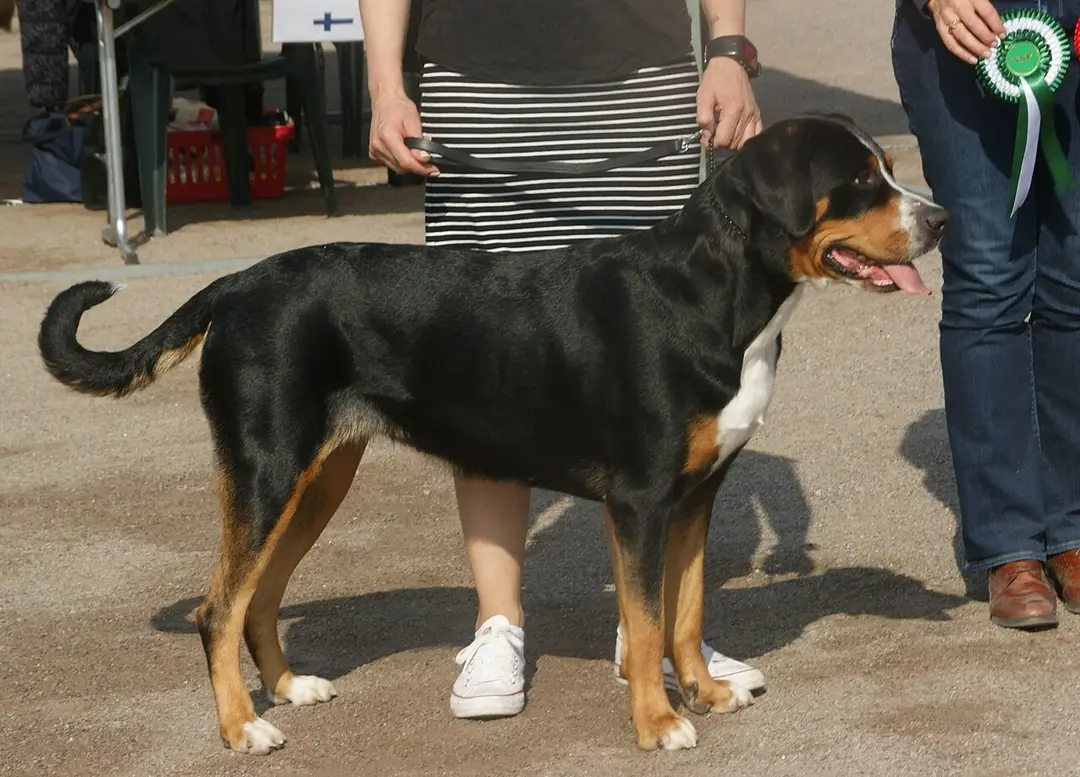
It is a large, heavily boned and muscular dog, slightly longer than tall, with a broad, flat skull and a strong muzzle. The short, dense double coat is tricoloured: a glossy black ground with rich rust markings over the eyes, on the cheeks, chest and legs, and white on the blaze, muzzle, chest, feet and tail tip. The thick undercoat is preferably dark grey or black but may be lighter.
Puppy growth
Lifespan
Where it comes from
The Greater Swiss Mountain Dog, called the Grosser Schweizer Sennenhund in its homeland, was long kept by farmers, dairymen and butchers in Switzerland. It pulled carts of milk, cheese and meat to market, moved cattle and guarded farmyards. It had grown rare by the late nineteenth century until Albert Heim championed it in the early twentieth. It stayed scarce for decades, though the Swiss army used it as a draught dog around the time of the Second World War. Dogs reached the United States in the late nineteen-sixties, and the American Kennel Club recognised the breed in the nineteen-nineties.
Breed standard
Questions people ask
Compare with related
Sources
- 1Morrill et al., 2022. Ancestry-inclusive dog genomics challenges popular breed stereotypes. Science 376: eabk0639 (Darwin's Ark). ↑
- 2Dogs Trust. Finding a good, responsible breeder. ↑
- 3American Kennel Club. Screening puppy buyers: how top breeders find the best homes. ↑
- 4
- 5American Kennel Club. Greater Swiss Mountain Dog breed page. ↑
- 6Hawthorne et al., 2004. Body-weight changes during growth in puppies of different breeds. Journal of Nutrition 134(8 Suppl): 2027S–2030S (WALTHAM). ↑
- 7AAFCO, 2016. AAFCO Dog and Cat Food Nutrient Profiles. Association of American Feed Control Officials. ↑