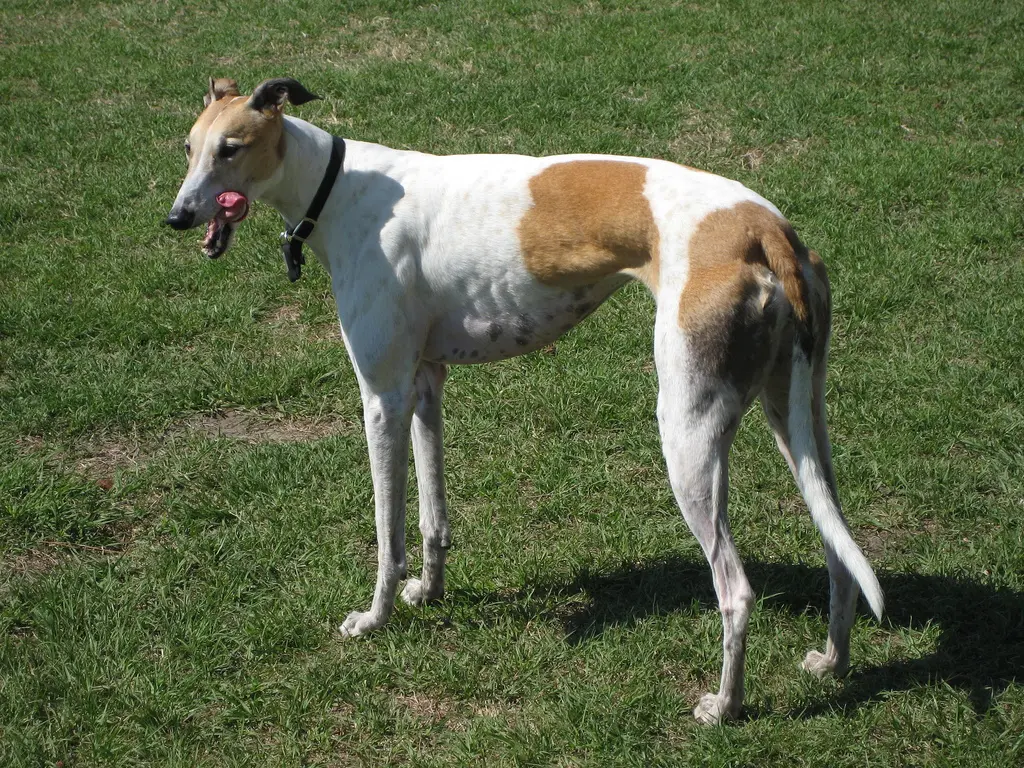
Greyhound

Sleeps for long stretches but keeps a strong urge to chase.
Adult male
26.2–38.5 kg
58–85 lb
Adult female
22.3–32.2 kg
49–71 lb
Lifespan
11.5 yrs
Handler demand
Suits a first-time owner
Class · Companion
also Lap dog

What it's like

In temperament the breed is quiet and gentle, content to sleep for long stretches, affectionate with its own people and sometimes reserved with strangers. It keeps a strong urge to chase small, fast-moving animals. Many retired racers are rehomed as companions through dedicated charities.

Owners who rated their dogs' everyday behaviour found Greyhounds calmer and more independent-minded than most. With people and with other dogs, they were about average. Breed is only a small part of any one dog's personality, so meet the dog before you decide.
Day to day
Activity
Happy with modest walks
Intelligence
Easy-going, simple routines
Handler demand
Suits a first-time owner
With people
Affection
Affectionate on its own terms
Loyalty
Bonded to its family
Independence
Cooperative, with its own ideas
Around the home
Sensitivity
Average
Voice
Quiet
Prey drive
Likely to chase small pets
Breed explains only about 9% of how individual dogs differ in behaviour1. Meet the dog. A good breeder breeds for temperament as well as health, and matches each puppy's personality to the right home2,3.
Is a Greyhound right for you?
Take the breed matcher

Living with one

Bred to sprint rather than run all day, it needs a modest amount of exercise. Heat is a real risk, so on hot days keep its exercise to the cool of the morning or evening.

Size and growth

A Greyhound is a large dog, about the weight of a grown Golden Retriever. Males end up clearly heavier than females.

The Greyhound is built for sprinting, with a long, narrow head, small folded ears, a deep chest, an arched loin, a tucked-up waist and powerful hindquarters ending in a long, tapering tail. At full speed it uses a double-suspension gallop, in which the body is airborne both when fully stretched and when fully gathered. The short, fine coat comes in many colours, including black, white, red, blue, fawn, fallow and brindle, alone or broken with white.

Puppy growth

Reference curve · community data appears as owners log
By about 5 months, a male Greyhound puppy is already as heavy as a grown Border Collie. They grow fastest between 3 and 4 months old. Most males grow into the size large-breed puppy foods are made for.
Fully grown
12 mo
Both sexes, at 99% of adult weight8
Male
Female
Shaded: expected range
0102030402m4m6m9m12m18m
0102030402m3m4m6m9m12m18m
Age
Male
Female
2 months
5.5–8.1 kg 12.1–17.9 lb
5.4–7.7 kg 11.9–17.0 lb
3 months
8.3–12.2 kg 18.3–26.9 lb
7.6–11.0 kg 16.8–24.3 lb
4 months
12.3–18.0 kg 27.1–39.7 lb
10.9–15.7 kg 24.0–34.6 lb
5 months
15.7–23.1 kg 34.6–50.9 lb
13.7–19.8 kg 30.2–43.7 lb
6 months
18.7–27.5 kg 41.2–60.6 lb
16.1–23.2 kg 35.5–51.1 lb
7 months
21.1–31.1 kg 46.5–68.6 lb
17.8–25.8 kg 39.2–56.9 lb
8 months
22.9–33.6 kg 50.5–74.1 lb
19.1–27.5 kg 42.1–60.6 lb
9 months
24.1–35.4 kg 53.1–78.0 lb
20.0–28.8 kg 44.1–63.5 lb
10 months
24.8–36.5 kg 54.7–80.5 lb
20.6–29.7 kg 45.4–65.5 lb
11 months
25.2–37.1 kg 55.6–81.8 lb
21.0–30.4 kg 46.3–67.0 lb
12 months
25.5–37.5 kg 56.2–82.7 lb
21.3–30.8 kg 47.0–67.9 lb
15 months
25.9–38.1 kg 57.1–84.0 lb
22.0–31.8 kg 48.5–70.1 lb

Health and lifespan

Vets record these more often in Greyhounds than in crossbreeds. Bone cancer, which is life-limiting, stands out as far more likely, and gum disease (moderate) is more likely. One listed condition comes from lab-confirmed cases rather than vet records: blood-vessel cancer of the skin (serious) is more likely there, though lab figures run higher than vet-record ones. These are figures for the breed as a whole, not a prediction for your dog.
Listed by likelihood level, highest first, then by how serious it is, then by name.
  • Bone cancer
    Far more likely
    Impact: life-limiting
  • Blood-vessel cancer of the skin
    Lab-confirmed cases
    More likely
    Impact: serious
  • Gum disease
    More likely
    Impact: moderate
Lab-confirmed: compares dogs whose tumour samples went to a lab with dogs seen in general practice, so the figures run higher than vet-record ones.

For your vet

A healthy adult Greyhound's bloodwork looks odd by general dog standards, so ask for results to be read against greyhound-specific ranges so normal numbers aren't mistaken for disease.

Lifespan

In UK vet records, the typical Greyhound lived to about 11 and a half years, shorter than the typical large breed.

Where it comes from

The Greyhound took its settled form in Britain, though the FCI notes that experts lean, not unanimously, towards the Middle East for its earliest origins. A medieval law reserved hunting with greyhounds to royalty and the nobility. It was a hare-coursing hound, the racing Greyhound was developed from those coursers, and show-bred dogs are now bigger and heavier than racers15,16.

The Greyhound's later history in Britain was shaped by organised coursing, in which two hounds were judged on their pursuit of a hare. Its rules are traditionally credited to a Duke of Norfolk in Elizabethan times, and formal coursing clubs appeared in the eighteenth century. The Waterloo Cup, run near Liverpool until hare coursing was outlawed, became its chief fixture. Track racing behind a mechanical lure arrived from the United States in the nineteen-twenties and quickly drew large crowds.

Breed standard

The Greyhound is judged against standard no. 158, in group 10, Sighthounds15.

Questions people ask

General guidance for dogs rather than a measured Greyhound figure: most females have a first season somewhere between six and fifteen months, and cycles then settle to roughly every 180 days. Smaller breeds tend to start earlier and larger ones later, so a large breed is most likely at the later end.
Track your own Greyhound
Log a minute a day and watch them sit on these curves. Free.

Sources

Something wrong on this page?
Parts of this page were written by AI ·