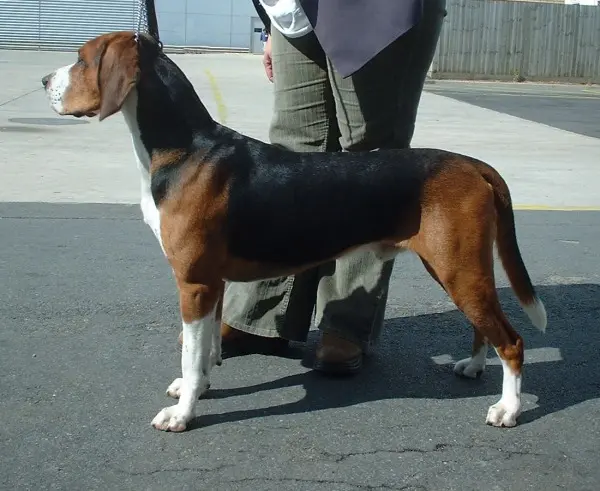
Hamiltonstovare

Friendly and even-tempered; single-minded on a scent.
Adult male
23–27 kg
51–60 lb
Adult female
20–25 kg
44–55 lb
Lifespan
12–14 yrs
Class · Field
also Family

What it's like

In temperament it is friendly and even-tempered, and energetic outdoors. Once on a scent it can be single-minded, a trait that reflects its work of following game independently.

Day to day
Activity
Needs lots of exercise
Intelligence
Learns readily, likes games
Handler demand
Needs steady training
With people
Affection
Affectionate on its own terms
Loyalty
Friendly with everyone
Independence
Decides for itself
Around the home
Sensitivity
Hardy, takes a busy home in its stride
Voice
Very vocal
Prey drive
Likely to chase small pets
Breed explains only about 9% of how individual dogs differ in behaviour1. Meet the dog. A good breeder breeds for temperament as well as health, and matches each puppy's personality to the right home2,3.
Is a Hamiltonstovare right for you?
Take the breed matcher

Living with one

It has a short coat. It sheds through the year rather than in big seasonal moults. Plan on a brush once a week. It needs plenty of exercise compared with other breeds.

Size and growth

A Hamiltonstovare is a medium dog, heavier than a Border Collie and lighter than a Golden Retriever. Males end up a little heavier than females.

It is a sturdy, rectangular hound with a long head, soft hanging ears and a low-carried tail. The tricolour coat follows a set pattern: a black mantle over the back, brown on the head and legs, and white on the muzzle, chest, feet and tail tip. A close, weather-resistant top coat covers a soft undercoat that becomes especially dense in winter.

Puppy growth

Reference curve · community data appears as owners log
By about 5 months, a male Hamiltonstovare puppy is already as heavy as a grown Staffordshire Bull Terrier. They grow fastest between 3 and 4 months old.
Fully grown
11 mo
Both sexes, at 99% of adult weight7
Male
Female
Shaded: expected range
01020302m4m6m9m12m18m
01020302m3m4m6m9m12m18m
Age
Male
Female
2 months
5.0–5.9 kg 11.0–13.0 lb
4.8–6.0 kg 10.6–13.2 lb
3 months
7.4–8.7 kg 16.3–19.2 lb
6.8–8.5 kg 15.0–18.7 lb
4 months
10.7–12.6 kg 23.6–27.8 lb
9.7–12.2 kg 21.4–26.9 lb
5 months
13.8–16.1 kg 30.4–35.5 lb
12.3–15.4 kg 27.1–34.0 lb
6 months
16.4–19.3 kg 36.2–42.5 lb
14.4–18.1 kg 31.7–39.9 lb
7 months
18.4–21.6 kg 40.6–47.6 lb
16.0–20.0 kg 35.3–44.1 lb
8 months
19.8–23.3 kg 43.7–51.4 lb
17.1–21.4 kg 37.7–47.2 lb
9 months
20.8–24.5 kg 45.9–54.0 lb
17.9–22.4 kg 39.5–49.4 lb
10 months
21.5–25.2 kg 47.4–55.6 lb
18.5–23.1 kg 40.8–50.9 lb
11 months
22.0–25.8 kg 48.5–56.9 lb
18.9–23.6 kg 41.7–52.0 lb
12 months
22.3–26.2 kg 49.2–57.8 lb
19.1–23.9 kg 42.1–52.7 lb
15 months
22.9–26.8 kg 50.5–59.1 lb
19.7–24.7 kg 43.4–54.5 lb

Lifespan

No vet study has measured how long Hamiltonstovares live yet. The 12–14 years shown is a general figure without a published source.

Where it comes from

The Hamiltonstövare is a Swedish scent hound that hunts hare and fox alone, giving tongue. Foxhound and Harrier blood is believed to have gone into it, along with scent hounds from southern Germany and Switzerland. A pair Count Adolf Hamilton showed at Sweden's first dog show, in 1886, is considered its origin; in 1921 it took the name of the count, a founder of the Swedish Kennel Club4,8.

The Hamiltonstövare was developed in Sweden in the nineteenth century by Count Adolf Hamilton, founder of the Swedish Kennel Club, and was first known as the Swedish foxhound before being renamed in his honour in the early twentieth century. It became widely used for hunting. Stövare is the Swedish term for a hound that drives game by scent. The breed reached Britain in the late nineteen-sixties and has been recognised by the Kennel Club, though it remains uncommon there. A single hound ranges through forest, finds a hare or fox and follows it while baying, so that the quarry circles back towards a waiting hunter; the dog is not meant to catch it.

Breed standard

The Hamiltonstovare is judged against standard no. 132, in group 6, Scenthounds and related breeds4.

Questions people ask

General guidance for dogs rather than a measured Hamiltonstovare figure: most females have a first season somewhere between six and fifteen months, and cycles then settle to roughly every 180 days. Smaller breeds tend to start earlier and larger ones later, so a medium-sized breed is most likely somewhere in the middle.
Track your own Hamiltonstovare
Log a minute a day and watch them sit on these curves. Free.

Sources

Uncited on this page: Lifespan — no reviewed source yet, so it is a general reference figure rather than a published one.
Something wrong on this page?
Parts of this page were written by AI ·