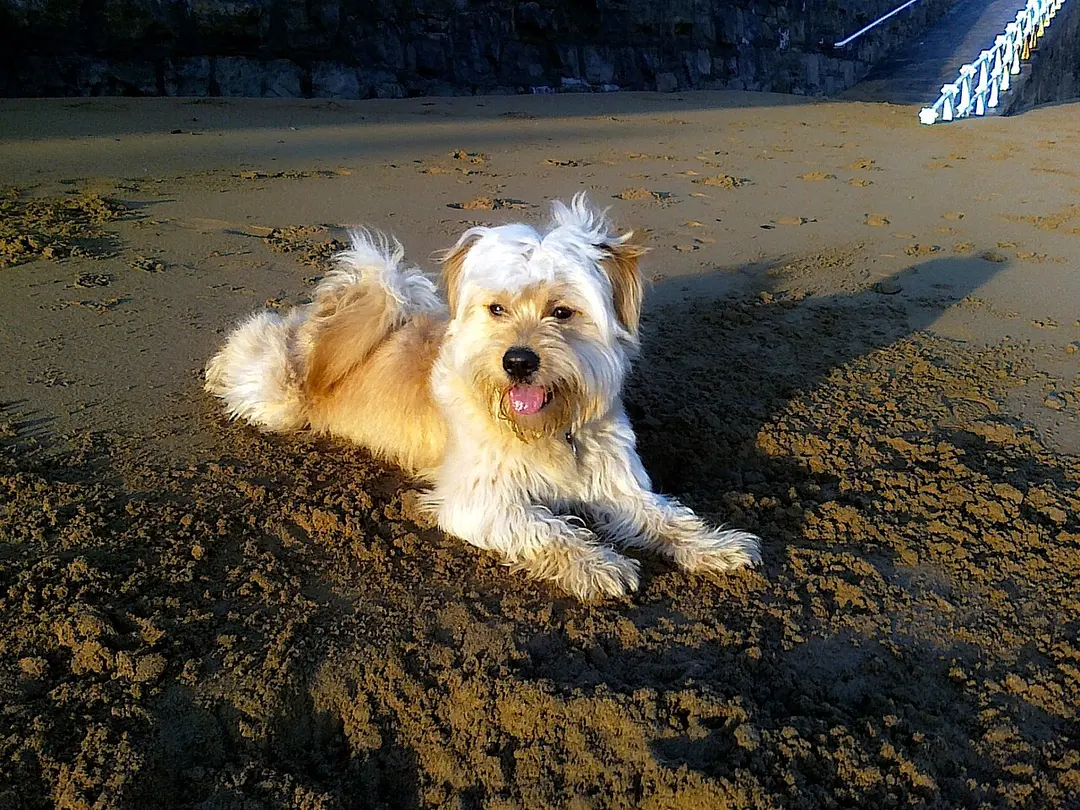
Havanese

Lively and playful, quick to pick up tricks.
Adult weight
3.2–5.9 kg
7–13 lb
Lifespan
14.5 yrs
Handler demand
Suits a first-time owner
Class · Lap dog
also Companion, Family

What it's like

In temperament the Havanese is lively, playful and affectionate, and closely attached to its household. It learns quickly and readily picks up tricks, which may explain its old circus work. It is sometimes known as the Havana Silk Dog.

Day to day
Activity
Happy with modest walks
Intelligence
Learns readily, likes games
Handler demand
Suits a first-time owner
With people
Affection
A lap or leaning dog
Loyalty
Sticks close to its people
Independence
Keen to work with you
Around the home
Sensitivity
Needs a calm, predictable home
Voice
Barks to alert, then settles
Prey drive
Usually fine with small pets
Breed explains only about 9% of how individual dogs differ in behaviour1. Meet the dog. A good breeder breeds for temperament as well as health, and matches each puppy's personality to the right home2,3.
Is a Havanese right for you?
Take the breed matcher

Living with one

It has a long coat. It sheds through the year rather than in big seasonal moults. Plan on daily brushing. It needs a modest amount of exercise compared with other breeds.

Size and growth

A Havanese is a toy dog, heavier than a Chihuahua and lighter than a Yorkshire Terrier. It is one of the heaviest toy breeds.

The Havanese is a small, sturdy dog, slightly longer than tall, with a topline that rises gently towards the rear and a plumed tail carried over the back. Its long, soft, light coat may be straight or wavy and can be left to form cords. It comes in many colours, and the breed moves with a distinctive springy gait.

Puppy growth

Reference curve · community data appears as owners log
Havanese dogs reach half their adult weight at about 4 months. They grow fastest between 3 and 4 months old.
Fully grown
10 mo
Both sexes, at 99% of adult weight7
Male
Female
Shaded: expected range
02462m4m6m9m12m18m
02462m3m4m6m9m12m18m
Age
Male
Female
2 months
1.0–1.9 kg 2.2–4.2 lb
1.1–2.1 kg 2.4–4.6 lb
3 months
1.3–2.4 kg 2.9–5.3 lb
1.4–2.5 kg 3.1–5.5 lb
4 months
1.7–3.1 kg 3.7–6.8 lb
1.8–3.2 kg 4.0–7.1 lb
5 months
2.0–3.7 kg 4.4–8.2 lb
2.0–3.8 kg 4.4–8.4 lb
6 months
2.3–4.2 kg 5.1–9.3 lb
7 months
2.5–4.5 kg 5.5–9.9 lb
2.4–4.4 kg 5.3–9.7 lb
8 months
2.6–4.8 kg 5.7–10.6 lb
2.5–4.7 kg 5.5–10.4 lb
9 months
2.7–5.0 kg 6.0–11.0 lb
2.6–4.9 kg 5.7–10.8 lb
10 months
2.8–5.1 kg 6.2–11.2 lb
2.7–5.0 kg 6.0–11.0 lb
11 months
2.9–5.3 kg 6.4–11.7 lb
2.8–5.2 kg 6.2–11.5 lb
12 months
2.9–5.4 kg 6.4–11.9 lb
2.9–5.3 kg 6.4–11.7 lb
15 months
3.0–5.6 kg 6.6–12.3 lb
3.0–5.5 kg 6.6–12.1 lb
18 months
3.2–5.8 kg 7.1–12.8 lb
3.1–5.8 kg 6.8–12.8 lb

Lifespan

In UK vet records, the typical Havanese lived to about 14 and a half years, longer than the typical toy breed. Too few had died yet to pin the figure down, so it may turn out higher.

Where it comes from

The Havanese is a bichon of western Mediterranean stock, thought to have reached Cuba with Spanish or Italian traders, and it became the island's national dog. Its old Cuban lines died out in the upheaval after the Communist takeover, and the breed survived in the United States through the few dogs that apparently got out. The FCI calls its Havana origin a legend, sparked by its common tobacco-brown shade4,9.

The Havanese was kept by the Cuban aristocracy and wealthy planter families through the nineteenth century, when it was also called the Blanquito de la Habana, and the type had a spell of fashion in Europe at the same time. The modern breed owes most to work begun in the United States in the nineteen-seventies. Breeders gathered dogs brought out by Cuban emigrants and rebuilt the line from them, and the American Kennel Club recognised the breed in the nineteen-nineties. It was bred mainly as a companion, although small bichons of this kind also worked as performing dogs in European circuses.

Breed standard

The Havanese is judged against standard no. 250, in group 9, Companion and Toy Dogs4.

Questions people ask

General guidance for dogs rather than a measured Havanese figure: most females have a first season somewhere between six and fifteen months, and cycles then settle to roughly every 180 days. Smaller breeds tend to start earlier and larger ones later, so a toy breed is most likely at the early end.
Track your own Havanese
Log a minute a day and watch them sit on these curves. Free.

Sources

Something wrong on this page?
Parts of this page were written by AI ·