Hovawart
What it's like
In temperament it is devoted to its family, watchful and reserved with strangers. It guards its territory readily but should not be aggressive without cause. It is even-tempered and independent-minded, and it is known for maturing slowly.
Living with one
Size and growth
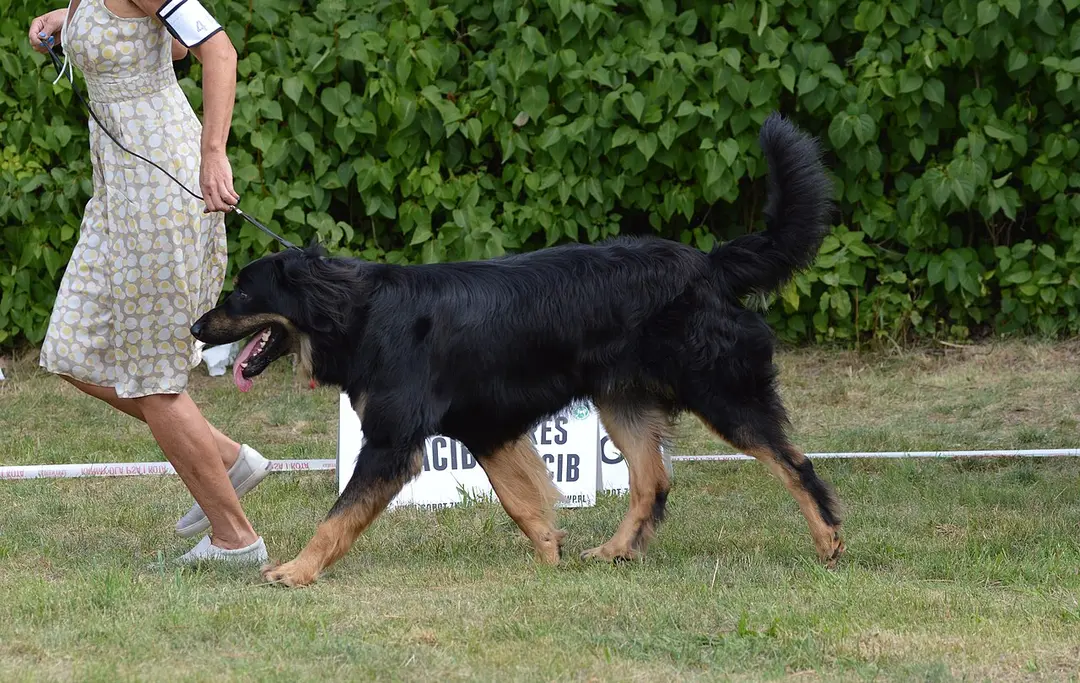
The Hovawart is a strong, slightly long-bodied dog with a rounded head and a long, gently wavy coat that lies fairly flat. The coat is longer on the chest, the backs of the legs and the bushy tail. Only three colours are accepted: black, black and gold, and blond. Males and females differ clearly in size and in the shape of the head.
Puppy growth
Lifespan
Where it comes from
The Hovawart took shape as a modern breed through Kurt Friedrich König's breeding, presented as a revival of old farm guard dogs, and the German kennel club recognised it in the late nineteen-thirties. The Second World War scattered much of the breeding stock, so enthusiasts rebuilt it after the war, and international recognition from the FCI followed in the nineteen-sixties. German breed clubs have long kept close control over breeding, assessing dogs for character as well as build. It was developed to guard house and yard, a role still central to its nature. It is also trained for tracking, search and rescue and obedience work.
Breed standard
Questions people ask
Compare with related
Sources
- 1Morrill et al., 2022. Ancestry-inclusive dog genomics challenges popular breed stereotypes. Science 376: eabk0639 (Darwin's Ark). ↑
- 2Dogs Trust. Finding a good, responsible breeder. ↑
- 3American Kennel Club. Screening puppy buyers: how top breeders find the best homes. ↑
- 4
- 5The Kennel Club. Hovawart breed standard. ↑
- 6
- 7AAFCO, 2016. AAFCO Dog and Cat Food Nutrient Profiles. Association of American Feed Control Officials. ↑
- 8Hawthorne et al., 2004. Body-weight changes during growth in puppies of different breeds. Journal of Nutrition 134(8 Suppl): 2027S–2030S (WALTHAM). ↑
- 9The Kennel Club. Hovawart. ↑