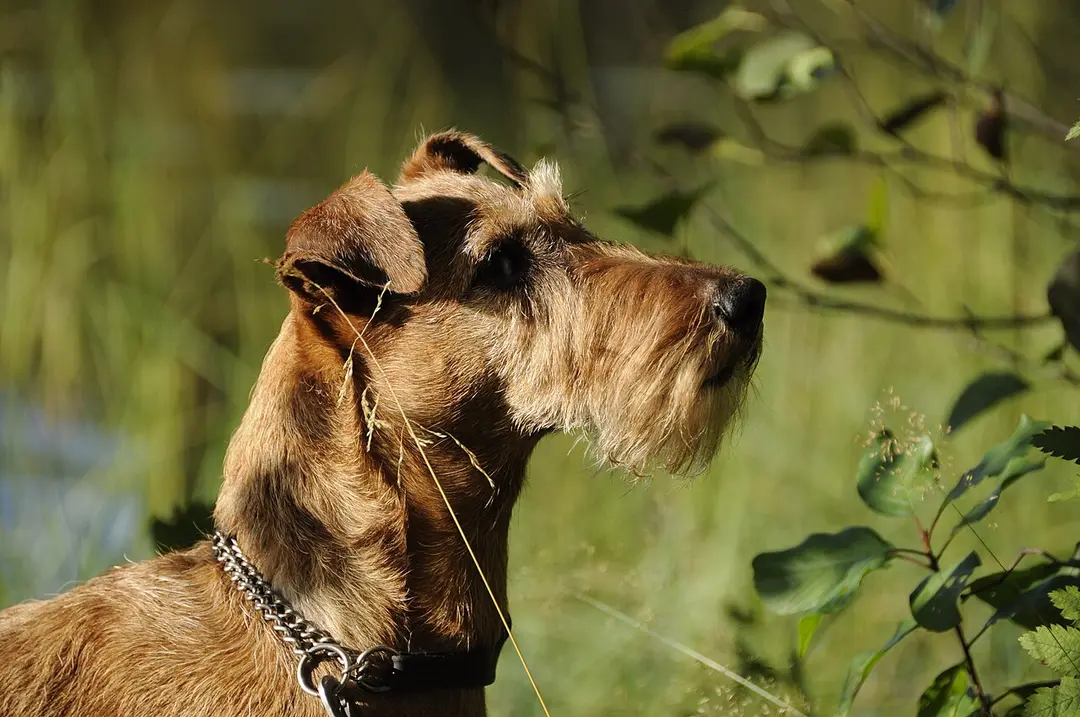
Irish Terrier

Bold and loyal, but can be quarrelsome with other dogs.
Adult male
11–14 kg
24–30 lb
Adult female
10–13 kg
22–28 lb
Lifespan
13.5 yrs
Class · Companion
also Watchdog, Sport

What it's like

The breed is nicknamed the daredevil. It is bold and spirited, loyal and affectionate with its own people, and can be quarrelsome with other dogs. Jack London made Irish Terriers the heroes of two of his books, Jerry of the Islands and Michael, Brother of Jerry.

Day to day
Activity
A good daily walk and play
Intelligence
Learns readily, likes games
Handler demand
Needs an experienced owner
With people
Affection
Affectionate on its own terms
Loyalty
Sticks close to its people
Independence
Decides for itself
Around the home
Sensitivity
Hardy, takes a busy home in its stride
Voice
Barks to alert, then settles
Prey drive
Likely to chase small pets
Breed explains only about 9% of how individual dogs differ in behaviour1. Meet the dog. A good breeder breeds for temperament as well as health, and matches each puppy's personality to the right home2,3.
Is an Irish Terrier right for you?
Take the breed matcher

Living with one

It has a wire or harsh coat. Loose hair stays caught in the coat until it is brushed, stripped or clipped out. Plan on a brush once a week, plus hand-stripping two or three times a year. It needs a moderate amount of exercise compared with other breeds.

Size and growth

An Irish Terrier is a small dog, heavier than a Pug and lighter than a Cocker Spaniel. Males end up a little heavier than females. It is one of the heaviest small breeds. Its weight is an estimate, not a published figure.

In build it is longer in the leg and body than the Fox Terrier, giving it a racy, athletic outline. The head is long, with a flat skull, small dark eyes under bushy brows and a short beard on the muzzle. The small ears are V-shaped and fold forward. The coat is harsh and wiry, lying close and dense over a softer undercoat, and comes in solid shades of red, red wheaten or wheaten.

Puppy growth

Reference curve · community data appears as owners log
By about 5 months, a male Irish Terrier puppy is already as heavy as a grown Cavalier King Charles Spaniel. They grow fastest between 3 and 4 months old.
Fully grown
10 mo
Both sexes, at 99% of adult weight6
Male
Female
Shaded: expected range
0510152m4m6m9m12m18m
0510152m3m4m6m9m12m18m
Age
Male
Female
2 months
2.8–3.4 kg 6.2–7.5 lb
2.9–3.5 kg 6.4–7.7 lb
3 months
3.8–4.7 kg 8.4–10.4 lb
3.7–4.5 kg 8.2–9.9 lb
4 months
5.3–6.6 kg 11.7–14.6 lb
5.0–6.1 kg 11.0–13.4 lb
5 months
6.6–8.1 kg 14.6–17.9 lb
6.0–7.4 kg 13.2–16.3 lb
6 months
7.6–9.4 kg 16.8–20.7 lb
6.9–8.4 kg 15.2–18.5 lb
7 months
8.4–10.3 kg 18.5–22.7 lb
7.5–9.2 kg 16.5–20.3 lb
8 months
9.0–11.0 kg 19.8–24.3 lb
8.0–9.8 kg 17.6–21.6 lb
9 months
9.4–11.6 kg 20.7–25.6 lb
8.4–10.3 kg 18.5–22.7 lb
10 months
9.8–12.0 kg 21.6–26.5 lb
8.7–10.7 kg 19.2–23.6 lb
11 months
10.0–12.3 kg 22.0–27.1 lb
9.0–11.0 kg 19.8–24.3 lb
12 months
10.2–12.6 kg 22.5–27.8 lb
9.2–11.3 kg 20.3–24.9 lb
15 months
10.6–13.1 kg 23.4–28.9 lb
9.7–11.9 kg 21.4–26.2 lb
18 months
11–14 kg 24–30 lb
10.1–12.4 kg 22.3–27.3 lb

Health and lifespan

In UK lab records, the conditions below turn up more often in Irish Terriers than in crossbreeds. Melanoma of the eye or eyelid stands out as far more likely. The most serious, blood-vessel cancer of the spleen, can shorten a life and is more likely. These are figures for the breed as a whole, not a prediction for your dog.
Listed by likelihood level, highest first, then by how serious it is, then by name.
  • Melanoma of the eye or eyelid
    Lab-confirmed cases
    Far more likely
    Impact: serious
  • Skin melanoma
    Lab-confirmed cases
    Much more likely
    Impact: moderate
  • Blood-vessel cancer of the spleen
    Lab-confirmed cases
    More likely
    Impact: life-limiting
  • Mast cell tumour
    Lab-confirmed cases
    More likely
    Impact: serious
Lab-confirmed: compares dogs whose tumour samples went to a lab with dogs seen in general practice, so the figures run higher than vet-record ones.

Lifespan

In UK vet records, the typical Irish Terrier lived to about 13 and a half years, about average for a small breed.

Where it comes from

The Irish Terrier was a farm dog, guard and hunter in Ireland, and possibly the oldest of the country's four terrier breeds. Early show dogs were mostly black and tan, black, grey or brindle until selective breeding, helped by a red bitch named Poppy whose puppies were all red, made the red coat universal by the 20th century. In the First World War it carried messages in the trenches4,9.

The Irish Terrier came into the show ring in the second half of the nineteenth century, and a breed club was formed in Dublin in the late eighteen-seventies. About a decade later the club ruled that dogs with cropped ears could no longer be shown, making the breed one of the first to set that standard in Britain and Ireland. Earlier, the dogs had worked on farms, keeping down rats and other vermin, going after rabbits and small game, and guarding the yard.

Breed standard

The Irish Terrier is judged against standard no. 139, in group 3, Terriers4.

Questions people ask

General guidance for dogs rather than a measured Irish Terrier figure: most females have a first season somewhere between six and fifteen months, and cycles then settle to roughly every 180 days. Smaller breeds tend to start earlier and larger ones later, so a small breed is most likely at the early end.
Track your own Irish Terrier
Log a minute a day and watch them sit on these curves. Free.

Sources

Something wrong on this page?
Parts of this page were written by AI ·