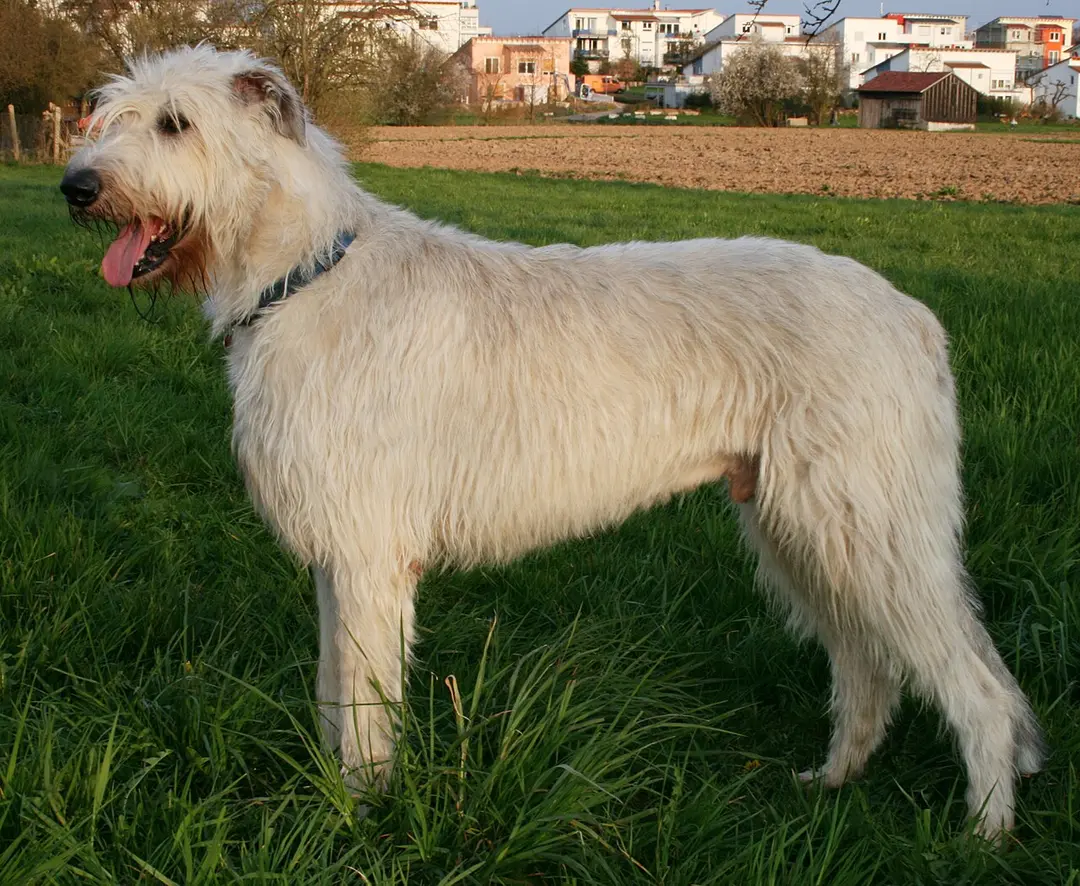
Irish Wolfhound

Calm and quiet; more likely to greet than challenge.
Adult male
55–82 kg
120–180 lb
Adult female
48–64 kg
105–140 lb
Lifespan
9.9 yrs
Class · Companion

What it's like

In temperament the wolfhound is calm, quiet and dignified, friendly towards people and patient with them. Despite its size it is not a natural guard, and it is more likely to greet a stranger than challenge one.

Day to day
Activity
Happy with modest walks
Intelligence
Easy-going, simple routines
Handler demand
Needs steady training
With people
Affection
A lap or leaning dog
Loyalty
Bonded to its family
Independence
Cooperative, with its own ideas
Around the home
Sensitivity
Average
Voice
Quiet
Prey drive
Likely to chase small pets
Breed explains only about 9% of how individual dogs differ in behaviour1. Meet the dog. A good breeder breeds for temperament as well as health, and matches each puppy's personality to the right home2,3.
Is an Irish Wolfhound right for you?
Take the breed matcher

Living with one

It has a wire or harsh coat. Loose hair stays caught in the coat until it is brushed, stripped or clipped out. Plan on a brush once a week, plus hand-stripping two or three times a year. It needs a moderate amount of exercise compared with other breeds.

Size and growth

An Irish Wolfhound is a giant dog, about the weight of a grown Great Dane. Males end up clearly heavier than females.

It is very tall and long-legged, muscular yet graceful, with a long head carried high, small folded ears, a deep chest and a long, gently curved tail. The coat is rough and harsh to the touch, growing longer and wiry over the eyes and under the jaw to give a whiskered look. Grey, brindle, red, black, white, fawn and wheaten are accepted.

Puppy growth

Reference curve · community data appears as owners log
By about 5 months, a male Irish Wolfhound puppy is already as heavy as a grown German Shepherd. They grow fastest between 4 and 5 months old. The chart follows Irish Wolfhounds themselves, not a general size band. Most males grow into the size large-breed puppy foods are made for.
Fully grown
12 mo
Both sexes, at 99% of adult weight6
Male
Female
Shaded: expected range
02550751002m4m6m9m12m18m
02550751002m3m4m6m9m12m18m
Age
Male
Female
2 months
9.2–13.8 kg 20.3–30.4 lb
8.1–10.7 kg 17.9–23.6 lb
3 months
15.5–23.1 kg 34.2–50.9 lb
13.5–18.0 kg 29.8–39.7 lb
4 months
23.7–35.5 kg 52.2–78.3 lb
20.7–27.6 kg 45.6–60.8 lb
5 months
32.7–48.9 kg 72.1–107.8 lb
28.5–38.1 kg 62.8–84.0 lb
6 months
40.6–60.7 kg 89.5–133.8 lb
35.4–47.3 kg 78.0–104.3 lb
7 months
46.3–69.4 kg 102.1–153.0 lb
40.5–54.0 kg 89.3–119.0 lb
8 months
50.0–74.8 kg 110.2–164.9 lb
43.6–58.2 kg 96.1–128.3 lb
9 months
52.1–78.0 kg 114.9–172.0 lb
45.5–60.7 kg 100.3–133.8 lb
10 months
53.2–79.7 kg 117.3–175.7 lb
46.5–62.0 kg 102.5–136.7 lb
11 months
53.8–80.6 kg 118.6–177.7 lb
47.0–62.7 kg 103.6–138.2 lb
12 months
54.2–81.1 kg 119.5–178.8 lb
47.3–63.1 kg 104.3–139.1 lb
15 months
54.5–81.5 kg 120.2–179.7 lb
47.6–63.4 kg 104.9–139.8 lb

Health and lifespan

In North American vet records, lymph node cancer turns up more often in Irish Wolfhounds than in crossbreeds: it is more likely. It can shorten a life. These are figures for the breed as a whole, not a prediction for your dog.
Listed by likelihood level, highest first, then by how serious it is, then by name.
  • Lymph node cancer
    More likely
    Impact: life-limiting

Lifespan

In UK vet records, the typical Irish Wolfhound lived to about 10 years, about average for a giant breed.

Where it comes from

Until the close of the 17th century the Irish Wolfhound was used in Ireland against wolves, deer and wild boar, and the first written account of it dates from 391 AD. With the wolf gone by the late 18th century and the Great Famine of the 1840s, it became very rare, until a Scot, Captain George Augustus Graham, revived it with Deerhound, Great Dane and Tibetan Mastiff outcrosses4,10.

The Irish Wolfhound of today owes its shape largely to Captain Graham's work in the later nineteenth century. He collected the scattered dogs said to descend from the old type, crossed them with Deerhounds and other breeds, bred them towards a consistent pattern, and helped found the Irish Wolfhound Club in the eighteen-eighties. Since the early twentieth century a wolfhound has served as the mascot of the Irish Guards, marching at the head of the regiment on parade, and a wolfhound appeared on the Irish sixpence from the late nineteen-twenties. Its type recalls the old Irish hounds that hunted wolves and deer with speed and strength.

Breed standard

The Irish Wolfhound is judged against standard no. 160, in group 10, Sighthounds4.

Questions people ask

General guidance for dogs rather than a measured Irish Wolfhound figure: most females have a first season somewhere between six and fifteen months, and cycles then settle to roughly every 180 days. Smaller breeds tend to start earlier and larger ones later, so a giant breed is most likely at the late end.
Track your own Irish Wolfhound
Log a minute a day and watch them sit on these curves. Free.

Sources

Something wrong on this page?
Parts of this page were written by AI ·