Jack Russell Terrier
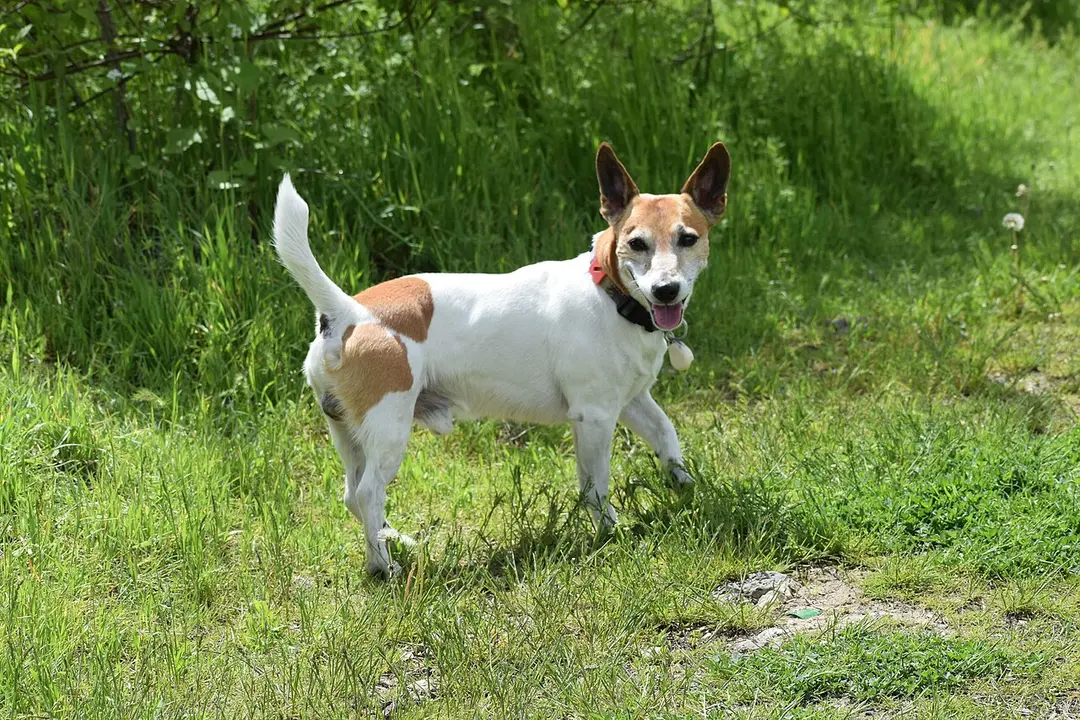
Bold and persistent, with a strong urge to chase and dig.
Adult weight
5–6 kg
11–13 lb
Lifespan
13.3 yrs
Class · Sport
also Field, Companion

What it's like

In temperament it is lively, alert and bold, quick to learn and persistent once interested in something. It has a strong urge to chase and dig, and can be forthright with other dogs. A Jack Russell played Eddie in the American sitcom Frasier.

Day to day
Activity
Needs lots of exercise
Intelligence
Needs daily brain work
Handler demand
Needs an experienced owner
With people
Affection
Affectionate on its own terms
Loyalty
Bonded to its family
Independence
Decides for itself
Around the home
Sensitivity
Average
Voice
Very vocal
Prey drive
Likely to chase small pets
Breed explains only about 9% of how individual dogs differ in behaviour1. Meet the dog. A good breeder breeds for temperament as well as health, and matches each puppy's personality to the right home2,3.
Is a Jack Russell Terrier right for you?
Take the breed matcher

Living with one

A Jack Russell's coat can be smooth, broken or rough. It sheds through the year rather than in seasonal moults, and in the rougher coats loose hair stays caught until it is brushed, stripped or clipped out. Bred to go after vermin in bursts, it needs a moderate amount of exercise compared with other breeds.

Size and growth

A Jack Russell Terrier is a small dog, about the weight of a grown Yorkshire Terrier. It is one of the lightest small breeds.

It is a compact, slightly rectangular terrier with a predominantly white coat marked in tan, black or both; the white is often said to have helped huntsmen tell dog from fox. Its ears are button or dropped.

Puppy growth

Reference curve · community data appears as owners log
By about 3 months, a male Jack Russell Terrier puppy is already as heavy as a grown Chihuahua. They grow fastest between 3 and 4 months old.
Fully grown
10 mo
Both sexes, at 99% of adult weight7
Male
Female
Shaded: expected range
02462m4m6m9m12m18m
02462m3m4m6m9m12m18m
Age
Male
Female
2 months
1.6–1.9 kg 3.5–4.2 lb
1.8–2.1 kg 4.0–4.6 lb
3 months
2.0–2.4 kg 4.4–5.3 lb
2.2–2.6 kg 4.9–5.7 lb
4 months
2.7–3.2 kg 6.0–7.1 lb
2.8–3.3 kg 6.2–7.3 lb
5 months
3.1–3.8 kg 6.8–8.4 lb
3.2–3.8 kg 7.1–8.4 lb
6 months
3.5–4.2 kg 7.7–9.3 lb
7 months
3.8–4.6 kg 8.4–10.1 lb
3.8–4.5 kg 8.4–9.9 lb
8 months
4.1–4.9 kg 9.0–10.8 lb
4.0–4.8 kg 8.8–10.6 lb
9 months
4.2–5.1 kg 9.3–11.2 lb
4.1–4.9 kg 9.0–10.8 lb
10 months
4.4–5.2 kg 9.7–11.5 lb
4.3–5.1 kg 9.5–11.2 lb
11 months
4.5–5.3 kg 9.9–11.7 lb
4.4–5.2 kg 9.7–11.5 lb
12 months
4.5–5.4 kg 9.9–11.9 lb
4.5–5.3 kg 9.9–11.7 lb
15 months
4.8–5.7 kg 10.6–12.6 lb
4.7–5.6 kg 10.4–12.3 lb
18 months
4.9–5.9 kg 10.8–13.0 lb

Health and lifespan

Vets record these more often in Jack Russells than in crossbreeds, but only slightly more often. Cushing's syndrome and a torn cruciate ligament in one knee are rated serious; gum disease and a kneecap slipping out of place are moderate. These are figures for the breed as a whole, not a prediction for your dog.
Listed by likelihood level, highest first, then by how serious it is, then by name.
  • Cushing's syndrome
    Slightly more likely
    Impact: serious
  • Torn cruciate ligament in one knee
    Slightly more likely
    Impact: serious
  • Gum disease
    Slightly more likely
    Impact: moderate
  • Kneecap slipping out of place
    Slightly more likely
    Impact: moderate

Lifespan

In UK vet records, the typical Jack Russell Terrier lived to about 13 and a half years, about average for a small breed.

Where it comes from

The Jack Russell Terrier goes back to John Russell, a Devon-born parson of the 1800s whose Fox Terriers could keep up with his foxhounds, then follow a fox underground and drive it out. His strain later split: the taller, squarer dogs became the Parson Russell Terrier, while breeders in Australia fixed the shorter type as the Jack Russell, which Britain's Kennel Club recognised only in 20164,13.

The Jack Russell Terrier spent most of its history as a working type rather than a show breed. Through the twentieth century it was kept by hunt servants, farmers and stable yards across Britain, and bred for what it could do rather than for a fixed look, so sizes and shapes varied widely. Dogs taken to Australia were developed into a consistent, shorter-legged type, and the international federation's standard names England as the country of origin and Australia as the country of development. Its job was to bolt foxes from earths and to keep rats down around farms. The standard asks for a chest that can be spanned by two hands behind the elbows, so the dog can follow quarry through narrow tunnels.

Breed standard

Kennel clubs do not all register this breed the same way.

The Russell Terrier

The Russell Terrier: both sexes weigh 4.1–6.8 kg (breed club figure)15; both sexes stand 25.4–30.5 cm (breed club figure)15.

Questions people ask

General guidance for dogs rather than a measured Jack Russell Terrier figure: most females have a first season somewhere between six and fifteen months, and cycles then settle to roughly every 180 days. Smaller breeds tend to start earlier and larger ones later, so a small breed is most likely at the early end.
Track your own Jack Russell Terrier
Log a minute a day and watch them sit on these curves. Free.

Sources

Something wrong on this page?
Parts of this page were written by AI ·