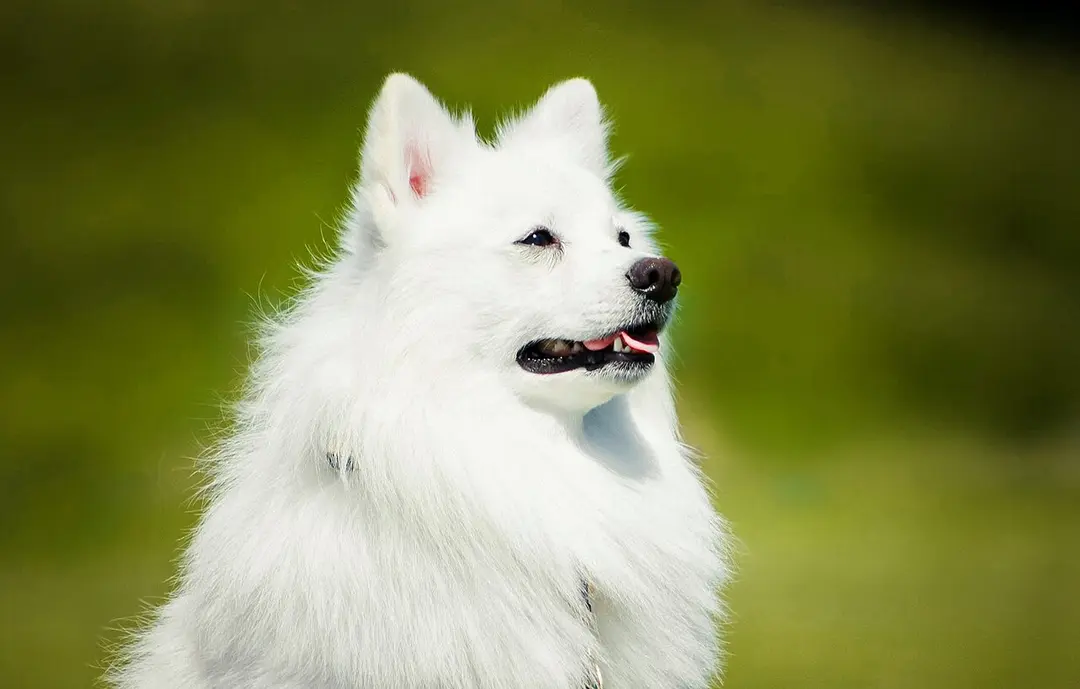
Japanese Spitz

Bright and playful, quick to notice anything unusual.
Adult weight
4.5–11 kg
9.9–25 lb
Lifespan
13 yrs
Handler demand
Suits a first-time owner
Class · Companion
also Family

What it's like

In temperament it is lively, bright and affectionate with its household, playful, and quick to notice anything unusual, though often reserved with strangers. Its appearance is often compared to that of a small Samoyed, but the two are separate breeds.

Day to day
Activity
A good daily walk and play
Intelligence
Learns readily, likes games
Handler demand
Suits a first-time owner
With people
Affection
A lap or leaning dog
Loyalty
Sticks close to its people
Independence
Keen to work with you
Around the home
Sensitivity
Average
Voice
Barks to alert, then settles
Prey drive
Usually fine with small pets
Breed explains only about 9% of how individual dogs differ in behaviour1. Meet the dog. A good breeder breeds for temperament as well as health, and matches each puppy's personality to the right home2,3.
Is a Japanese Spitz right for you?
Take the breed matcher

Living with one

It has a long coat. Most of the shedding comes when the seasons change. Plan on daily brushing. It needs a moderate amount of exercise compared with other breeds.

Size and growth

A Japanese Spitz is a small dog, heavier than a Cavalier King Charles Spaniel and lighter than a Pug. Its weight is an estimate, not a published figure.

It is a compact, well-proportioned spitz with a pure white, stand-off double coat, a full ruff around the neck and shoulders, and a plumed tail carried curled over the back. The skull is slightly rounded and the muzzle pointed, with small, triangular, upright ears, dark almond-shaped eyes, and black nose and lips that stand out sharply against the white. The outer coat is often said to shed dirt readily once dry.

Puppy growth

Reference curve · community data appears as owners log
By about 5 months, a male Japanese Spitz puppy is already as heavy as a grown Yorkshire Terrier. They grow fastest between 3 and 4 months old.
Fully grown
10 mo
Both sexes, at 99% of adult weight6
Male
Female
Shaded: expected range
0510152m4m6m9m12m18m
0510152m3m4m6m9m12m18m
Age
Male
Female
2 months
1.3–3.4 kg 2.9–7.5 lb
1.5–3.7 kg 3.3–8.2 lb
3 months
1.8–4.5 kg 4.0–9.9 lb
1.9–4.7 kg 4.2–10.4 lb
4 months
2.4–6.1 kg 5.3–13.4 lb
2.5–6.2 kg 5.5–13.7 lb
5 months
3.0–7.4 kg 6.6–16.3 lb
2.9–7.3 kg 6.4–16.1 lb
6 months
3.3–8.4 kg 7.3–18.5 lb
3.3–8.2 kg 7.3–18.1 lb
7 months
3.6–9.1 kg 7.9–20.1 lb
3.5–8.9 kg 7.7–19.6 lb
8 months
3.8–9.6 kg 8.4–21.2 lb
3.7–9.4 kg 8.2–20.7 lb
9 months
4.0–10.0 kg 8.8–22.0 lb
3.9–9.8 kg 8.6–21.6 lb
10 months
4.1–10.3 kg 9.0–22.7 lb
4.0–10.1 kg 8.8–22.3 lb
11 months
4.2–10.5 kg 9.3–23.1 lb
4.1–10.3 kg 9.0–22.7 lb
12 months
4.2–10.7 kg 9.3–23.6 lb
4.2–10.5 kg 9.3–23.1 lb
15 months
4.4–11.0 kg 9.7–24.3 lb
4.3–10.9 kg 9.5–24.0 lb
18 months
4.5–11 kg 9.9–25 lb
4.5–11.2 kg 9.9–24.7 lb

Lifespan

In UK vet records, the typical Japanese Spitz lived to about 13 years, about average for a small breed.

Where it comes from

The Japanese Spitz is a 20th-century breed, said to descend from large white German Spitz that reached Japan about 1920 by way of Siberia and north-east China. Crosses with white Spitz imported from Canada, the United States, Australia and China into the mid-1930s shaped it, the Japan Kennel Club fixed a unified standard in 1948, and exports to Sweden later took it into Europe4,8.

The Japanese Spitz became widely popular in Japan in the years after the Second World War, but its standing there later fell, partly because the dogs had a reputation for persistent barking. Breeders responded by selecting for steadier, quieter animals, and the modern breed is generally regarded as less vocal than its early forebears. It reached Britain in the later twentieth century and is now placed in the Kennel Club's Utility Group. It was developed as a companion and house dog rather than for any working role.

Breed standard

The Japanese Spitz is judged against standard no. 262, in group 5, Spitz and primitive types4.

Questions people ask

General guidance for dogs rather than a measured Japanese Spitz figure: most females have a first season somewhere between six and fifteen months, and cycles then settle to roughly every 180 days. Smaller breeds tend to start earlier and larger ones later, so a small breed is most likely at the early end.
Track your own Japanese Spitz
Log a minute a day and watch them sit on these curves. Free.

Sources

Something wrong on this page?
Parts of this page were written by AI ·