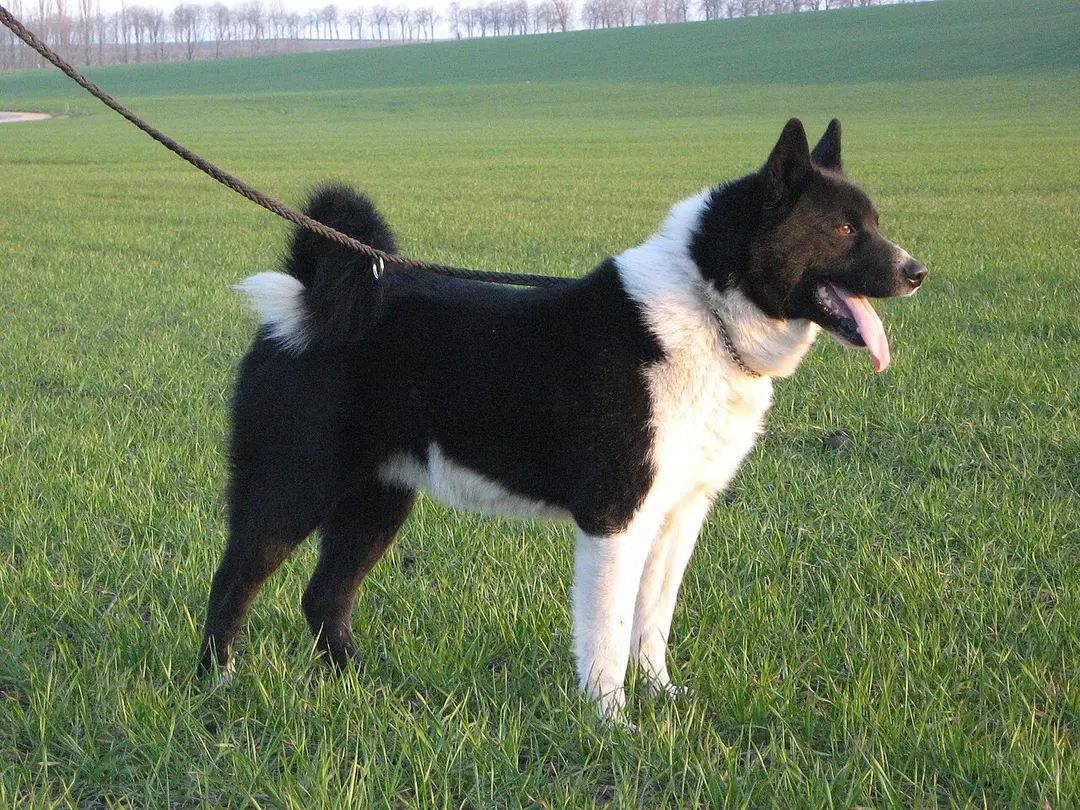
Karelian Bear Dog

Calm with its people, but can be sharp with other dogs.
Adult male
25–28 kg
55–62 lb
Adult female
17–20 kg
37–44 lb
Lifespan
11–13 yrs
Class · Field
also Watchdog

What it's like

The breed is bold, determined and self-reliant. It is usually calm and loyal with its own people but reserved with strangers, and it can be sharp with other dogs. In North America, Karelian Bear Dogs have been used in wildlife management to chase black and grizzly bears away from towns and campsites, a practice known as bear shepherding.

Day to day
Activity
Needs lots of exercise
Intelligence
Learns readily, likes games
Handler demand
Needs an experienced owner
With people
Affection
Likes its own space
Loyalty
Sticks close to its people
Independence
Decides for itself
Around the home
Sensitivity
Hardy, takes a busy home in its stride
Voice
Very vocal
Prey drive
Likely to chase small pets
Breed explains only about 9% of how individual dogs differ in behaviour1. Meet the dog. A good breeder breeds for temperament as well as health, and matches each puppy's personality to the right home2,3.
Is a Karelian Bear Dog right for you?
Take the breed matcher

Living with one

It has a double coat, an outer coat over an undercoat. Most of the shedding comes when the seasons change. Plan on a brush once a week, plus daily brushing through the seasonal moult. It needs plenty of exercise compared with other breeds.

Size and growth

A Karelian Bear Dog is a medium dog, heavier than a Border Collie and lighter than a Golden Retriever. Males end up clearly heavier than females.

The dog is a sturdy, well-boned spitz with a head shaped like a blunt wedge, medium-sized pricked ears and a tail curled over the back. The coat is straight and harsh over a dense undercoat. It is black, often with a slightly brownish or dull tinge, and most have clear white markings on the head, neck, chest, belly and legs.

Puppy growth

Reference curve · community data appears as owners log
By about 5 months, a male Karelian Bear Dog puppy is already as heavy as a grown Staffordshire Bull Terrier. They grow fastest between 3 and 4 months old.
Fully grown
11 mo
Both sexes, at 99% of adult weight7
Male
Female
Shaded: expected range
01020302m4m6m9m12m18m
01020302m3m4m6m9m12m18m
Age
Male
Female
2 months
5.4–6.1 kg 11.9–13.4 lb
4.1–4.8 kg 9.0–10.6 lb
3 months
8.0–9.0 kg 17.6–19.8 lb
5.8–6.8 kg 12.8–15.0 lb
4 months
11.6–13.0 kg 25.6–28.7 lb
8.3–9.7 kg 18.3–21.4 lb
5 months
14.9–16.7 kg 32.8–36.8 lb
10.5–12.3 kg 23.1–27.1 lb
6 months
17.8–20.0 kg 39.2–44.1 lb
12.3–14.4 kg 27.1–31.7 lb
7 months
20.0–22.4 kg 44.1–49.4 lb
13.6–16.0 kg 30.0–35.3 lb
8 months
21.6–24.2 kg 47.6–53.4 lb
14.5–17.1 kg 32.0–37.7 lb
9 months
22.7–25.4 kg 50.0–56.0 lb
15.2–17.9 kg 33.5–39.5 lb
10 months
23.4–26.2 kg 51.6–57.8 lb
15.7–18.5 kg 34.6–40.8 lb
11 months
23.9–26.7 kg 52.7–58.9 lb
16.0–18.9 kg 35.3–41.7 lb
12 months
24.2–27.1 kg 53.4–59.7 lb
16.3–19.1 kg 35.9–42.1 lb
15 months
24.8–27.8 kg 54.7–61.3 lb
16.8–19.7 kg 37.0–43.4 lb

Lifespan

No vet study has measured how long Karelian Bear Dogs live yet. The 11–13 years shown is a general figure without a published source.

Where it comes from

The Karelian Bear Dog was bred in Finland from hunting dogs of Ladoga Karelia, Olonets and Russian Karelia, with the Komi dog regarded as its origin. Breeding began in 1936 to produce a sturdy dog that finds elk or bear and barks to hold it at bay. The first standard came in 1945, and the first dogs were registered in 19464.

The Karelian Bear Dog, known in Finland as the Karjalankarhukoira, was still a young breed when the Second World War disrupted its development, and numbers fell sharply during the conflicts with the Soviet Union. Finnish breeders rebuilt it afterwards from the dogs that remained, and it settled into steady use among hunters, chiefly for elk rather than bear. Its work is to range silently and widely through forest, find large game and then bark persistently to hold the animal in place until the hunter arrives.

Breed standard

The Karelian Bear Dog is judged against standard no. 48, in group 5, Spitz and primitive types4.

Questions people ask

General guidance for dogs rather than a measured Karelian Bear Dog figure: most females have a first season somewhere between six and fifteen months, and cycles then settle to roughly every 180 days. Smaller breeds tend to start earlier and larger ones later, so a medium-sized breed is most likely somewhere in the middle.
Track your own Karelian Bear Dog
Log a minute a day and watch them sit on these curves. Free.

Sources

Uncited on this page: Lifespan — no reviewed source yet, so it is a general reference figure rather than a published one.
Something wrong on this page?
Parts of this page were written by AI ·