Keeshond
What it's like
The Keeshond is friendly, lively and outgoing, and is closely attached to its household. It is quick to bark at visitors but is not aggressive. It is usually said to have little urge to hunt or roam.
Living with one
Size and growth
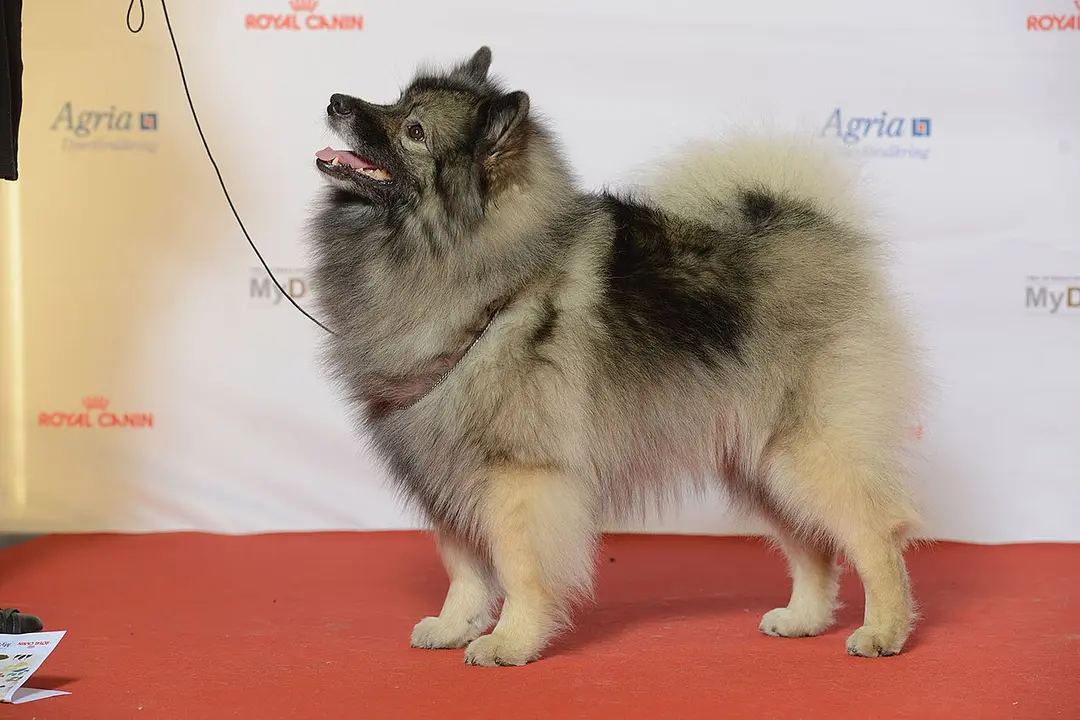
It is a compact, square-built spitz with a wedge-shaped head, small pointed ears and a plumed tail curled tightly over its back. The dense double coat stands off from the body and forms a thick ruff around the neck. Its colour is a blend of grey, black and cream, paler on the legs and underside. A dark line runs from each eye towards the ear, and with short eyebrow markings it forms what are known as spectacles.
Puppy growth
Lifespan
Where it comes from
The Keeshond is usually said to take its name from Kees de Gyselaer, a Patriot leader whose dog came to represent the party. The Dutch revival of the twentieth century owed much to Baroness van Hardenbroek, who began tracing surviving dogs on riverboats and farms in the nineteen-twenties. A Dutch breed club followed, and in Britain the name Keeshond replaced Dutch Barge Dog during the same decade. The breed was kept as a watchdog and companion rather than for hunting or herding, and its job was to raise the alarm.
Breed standard
Questions people ask
Compare with related
Sources
- 1Morrill et al., 2022. Ancestry-inclusive dog genomics challenges popular breed stereotypes. Science 376: eabk0639 (Darwin's Ark). ↑
- 2Dogs Trust. Finding a good, responsible breeder. ↑
- 3American Kennel Club. Screening puppy buyers: how top breeders find the best homes. ↑
- 4
- 5American Kennel Club. Keeshond breed page. ↑
- 6
- 7Hawthorne et al., 2004. Body-weight changes during growth in puppies of different breeds. Journal of Nutrition 134(8 Suppl): 2027S–2030S (WALTHAM). ↑
- 8
- 9The Kennel Club. Keeshond. ↑
- 10American Kennel Club. Keeshond breed history. ↑
- 11The Kennel Club. Breed list. ↑
- 12American Kennel Club. Breed pages. ↑