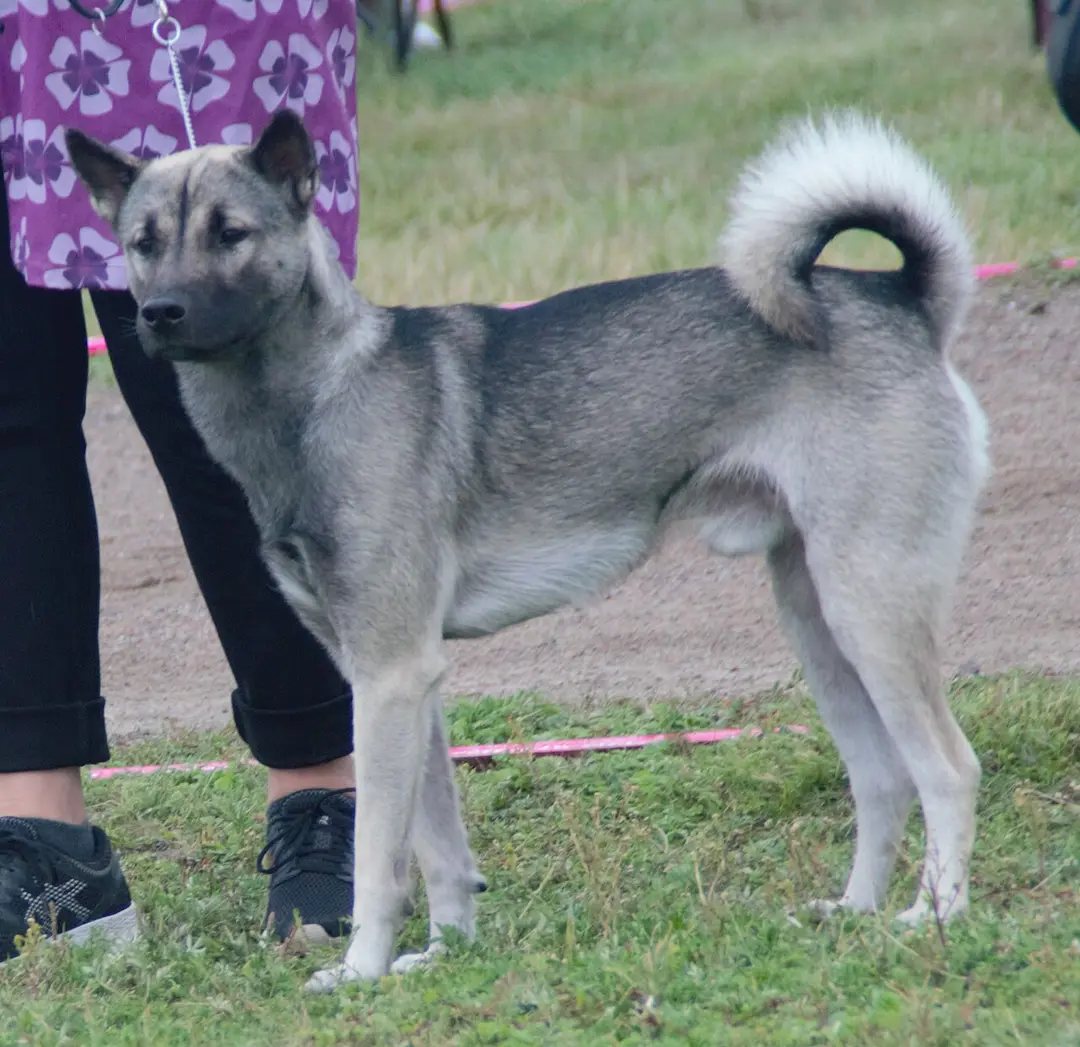
Kishu Ken

Calm at home, often attached to one person.
Adult male
17–23 kg
37–51 lb
Adult female
15–18 kg
33–40 lb
Lifespan
11–14 yrs
Class · Companion
also Field

What it's like

In temperament the Kishu Ken is dignified, loyal and alert, generally calm at home and reserved with strangers. It tends to attach itself closely to one person or household, and its strong hunting instinct can make it intolerant of small animals and of other dogs.

Day to day
Activity
A good daily walk and play
Intelligence
Learns readily, likes games
Handler demand
Needs an experienced owner
With people
Affection
Likes its own space
Loyalty
Sticks close to its people
Independence
Decides for itself
Around the home
Sensitivity
Average
Voice
Quiet
Prey drive
Likely to chase small pets
Breed explains only about 9% of how individual dogs differ in behaviour1. Meet the dog. A good breeder breeds for temperament as well as health, and matches each puppy's personality to the right home2,3.
Is a Kishu Ken right for you?
Take the breed matcher

Living with one

It has a double coat, an outer coat over an undercoat. Most of the shedding comes when the seasons change. Plan on a brush once a week, plus daily brushing through the seasonal moult. It needs a moderate amount of exercise compared with other breeds.

Size and growth

A Kishu Ken is a medium dog, about the weight of a grown Border Collie. Males end up clearly heavier than females.

It is a well-muscled, sturdily built spitz with a broad forehead, small triangular eyes, small pricked ears that tilt slightly forward, and a thick tail carried curled or in a sickle over the back. Its double coat has a harsh, straight outer layer over a soft, dense undercoat.

Puppy growth

Reference curve · community data appears as owners log
By about 3 months, a male Kishu Ken puppy is already as heavy as a grown Jack Russell. They grow fastest between 3 and 4 months old.
Fully grown
11 mo
Both sexes, at 99% of adult weight7
Male
Female
Shaded: expected range
01020302m4m6m9m12m18m
01020302m3m4m6m9m12m18m
Age
Male
Female
2 months
3.7–5.0 kg 8.2–11.0 lb
3.6–4.3 kg 7.9–9.5 lb
3 months
5.5–7.4 kg 12.1–16.3 lb
5.1–6.1 kg 11.2–13.4 lb
4 months
7.9–10.7 kg 17.4–23.6 lb
7.3–8.8 kg 16.1–19.4 lb
5 months
10.2–13.8 kg 22.5–30.4 lb
9.2–11.1 kg 20.3–24.5 lb
6 months
12.1–16.4 kg 26.7–36.2 lb
10.8–13.0 kg 23.8–28.7 lb
7 months
13.6–18.4 kg 30.0–40.6 lb
12.0–14.4 kg 26.5–31.7 lb
8 months
14.7–19.8 kg 32.4–43.7 lb
12.8–15.4 kg 28.2–34.0 lb
9 months
15.4–20.8 kg 34.0–45.9 lb
13.4–16.1 kg 29.5–35.5 lb
10 months
15.9–21.5 kg 35.1–47.4 lb
13.8–16.6 kg 30.4–36.6 lb
11 months
16.2–22.0 kg 35.7–48.5 lb
14.1–17.0 kg 31.1–37.5 lb
12 months
16.5–22.3 kg 36.4–49.2 lb
14.4–17.2 kg 31.7–37.9 lb
15 months
16.9–22.9 kg 37.3–50.5 lb
14.8–17.8 kg 32.6–39.2 lb

Lifespan

No vet study has measured how long Kishu Ken dogs live yet. The 11–14 years shown is a general figure without a published source.

Where it comes from

The Kishu Ken was fixed as a breed in the mountains of Kishu, now Wakayama and Mie prefectures, from medium-sized dogs Japan has kept since ancient times, and it still hunts wild boar. Early Kishu coats were often marked with conspicuous red, sesame or brindle, but from 1934, the year it became a natural monument, only solid colours were accepted; white is one of the coats seen today4.

The Kishu Ken takes its name from the old province of Kishu on the Kii Peninsula, where its local strains were long known by the names of individual local districts, such as Kumano and Taichi, before a single breed name was settled. After the breed was designated a natural monument, Japanese breeders concentrated on solid-coloured dogs, and white came to dominate the breed over the twentieth century while red and sesame became uncommon. It remains rare outside its homeland. The breed was developed to work alongside hunters in steep, wooded country, tracking wild boar and deer and holding the quarry at bay until the hunter arrived.

Breed standard

The Kishu Ken is judged against standard no. 318, in group 5, Spitz and primitive types4.

Questions people ask

General guidance for dogs rather than a measured Kishu Ken figure: most females have a first season somewhere between six and fifteen months, and cycles then settle to roughly every 180 days. Smaller breeds tend to start earlier and larger ones later, so a medium-sized breed is most likely somewhere in the middle.
Track your own Kishu Ken
Log a minute a day and watch them sit on these curves. Free.

Sources

Uncited on this page: Lifespan — no reviewed source yet, so it is a general reference figure rather than a published one.
Something wrong on this page?
Parts of this page were written by AI ·