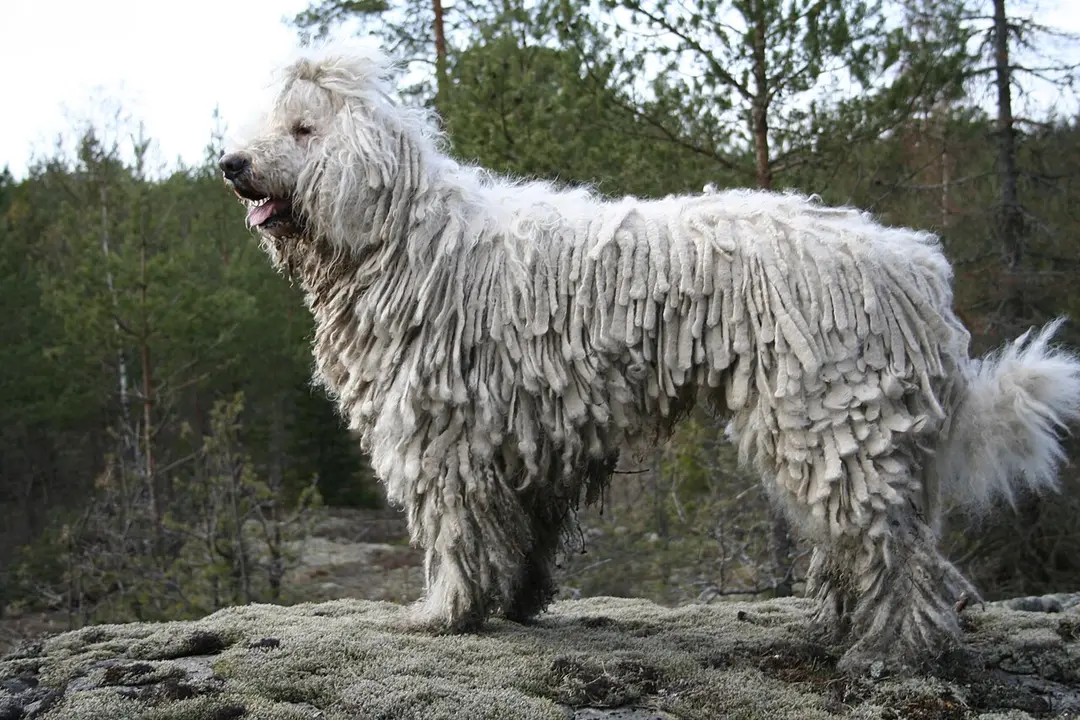
Komondor

Calm and independent, firm in defending its own.
Adult male
50–60 kg
110–132 lb
Adult female
40–50 kg
88–110 lb
Lifespan
10–12 yrs
Class · Watchdog
also Working

What it's like

In temperament the Komondor is calm and watchful, devoted to its household and wary of strangers. Bred to make its own decisions, it is independent, and it will act firmly to defend what it sees as its own.

Day to day
Activity
A good daily walk and play
Intelligence
Learns readily, likes games
Handler demand
Needs an experienced owner
With people
Affection
Likes its own space
Loyalty
Sticks close to its people
Independence
Decides for itself
Around the home
Sensitivity
Average
Voice
Very vocal
Prey drive
Usually fine with small pets
Breed explains only about 9% of how individual dogs differ in behaviour1. Meet the dog. A good breeder breeds for temperament as well as health, and matches each puppy's personality to the right home2,3.
Is a Komondor right for you?
Take the breed matcher

Living with one

How it sheds and the grooming it needs depend on the coat. It needs plenty of exercise compared with other breeds.

Size and growth

A Komondor is a giant dog, heavier than a Rottweiler and lighter than a Great Dane. Males end up clearly heavier than females.

It is a big-boned, muscular dog, always white, and its coat is unlike almost any other. The soft puppy coat slowly mats as the dog matures, with the outer coat and undercoat felting together into heavy cords that hide the eyes and can reach the ground in older dogs. The coat is never brushed out. Instead, the cords are pulled apart by hand, and a washed coat takes a long time to dry.

Puppy growth

Reference curve · community data appears as owners log
By about 5 months, a male Komondor puppy is already as heavy as a grown Labrador. They grow fastest between 4 and 5 months old. They keep growing past their first birthday, longer than a Beagle does. Most males grow into the size large-breed puppy foods are made for.
Fully grown
13 mo
Both sexes, at 99% of adult weight5
Male
Female
Shaded: expected range
02040602m4m6m9m12m18m
02040602m3m4m6m9m12m18m
Age
Male
Female
2 months
8.7–10.5 kg 19.2–23.1 lb
7.0–8.7 kg 15.4–19.2 lb
3 months
14.0–16.8 kg 30.9–37.0 lb
11.2–14.0 kg 24.7–30.9 lb
4 months
20.8–24.9 kg 45.9–54.9 lb
16.6–20.8 kg 36.6–45.9 lb
5 months
28.1–33.8 kg 61.9–74.5 lb
22.5–28.1 kg 49.6–61.9 lb
6 months
34.9–41.9 kg 76.9–92.4 lb
27.9–34.9 kg 61.5–76.9 lb
7 months
40.2–48.2 kg 88.6–106.3 lb
32.2–40.2 kg 71.0–88.6 lb
8 months
43.9–52.7 kg 96.8–116.2 lb
35.1–43.9 kg 77.4–96.8 lb
9 months
46.3–55.6 kg 102.1–122.6 lb
37.0–46.3 kg 81.6–102.1 lb
10 months
47.8–57.4 kg 105.4–126.5 lb
38.2–47.8 kg 84.2–105.4 lb
11 months
48.7–58.4 kg 107.4–128.7 lb
39.0–48.7 kg 86.0–107.4 lb
12 months
49.3–59.1 kg 108.7–130.3 lb
39.4–49.3 kg 86.9–108.7 lb
15 months
49.8–59.8 kg 109.8–131.8 lb
39.9–49.8 kg 88.0–109.8 lb
18 months
50.0–59.9 kg 110.2–132.1 lb
40–50 kg 88–110 lb

Lifespan

No vet study has measured how long Komondors live yet. The 10–12 years shown is a general figure without a published source.

Where it comes from

The Komondor is a large Hungarian flock guard whose ancestors, its FCI standard says, came out of Asia, almost certainly with the nomadic Magyars when they moved into the Carpathian basin. The name turns up in Hungarian writing from the 16th century, and only a few dozen dogs in Europe survived the Second World War. Grown dogs wear a thick coat of cords4,7,8.

The Komondor's modern history has largely been one of recovery. After the losses of the Second World War, Hungarian breeders rebuilt the breed from a few survivors. Dogs had already gone abroad, including to the United States, where the American Kennel Club had recognised the breed in the late nineteen-thirties. Although the FCI places it with the sheepdogs, the Komondor was never a herding dog. It is a livestock guardian that lived alongside the flocks on the open Hungarian plains and defended them against wolves and thieves, often acting on its own judgement.

Breed standard

The Komondor is judged against standard no. 53, in group 1, Sheepdogs and Cattledogs4.

Questions people ask

General guidance for dogs rather than a measured Komondor figure: most females have a first season somewhere between six and fifteen months, and cycles then settle to roughly every 180 days. Smaller breeds tend to start earlier and larger ones later, so a giant breed is most likely at the late end.
Track your own Komondor
Log a minute a day and watch them sit on these curves. Free.

Sources

Uncited on this page: Lifespan — no reviewed source yet, so it is a general reference figure rather than a published one.
Something wrong on this page?
Parts of this page were written by AI ·